Table of Contents
Two weeks after buying every organizer on the internet, most small kitchens look exactly the way they did before. Not because the products failed. Because storage and organization solve two different problems, and buying bins doesn’t fix the second one on its own.
Storage is capacity. Organization is whether that capacity keeps working once real life starts happening in it: the Tuesday you’re cooking dinner in twelve minutes, the grocery haul that doesn’t quite fit where the last one did, the guest staying over who has no idea your system exists. A kitchen can have plenty of storage and still fall apart within a month if nothing has an actual assigned home, or if the home it has doesn’t match how you move through the space.
This guide is about the second half of that equation: the drawer systems, pantry workarounds, and daily habits that hold up under normal use, not just on the day you set them up.
The Difference Between Stored and Organized
A drawer can be completely full and still be disorganized. That’s the distinction most storage advice skips. Organization isn’t about how much fits somewhere. It’s about whether you can find what you need in under five seconds, and whether the system survives being used by someone in a hurry.
Three signs a kitchen is organized, not just stored:
- You can name what’s in every drawer and cabinet without opening it
- Putting something away takes the same effort as leaving it on the counter
- A guest could reasonably find a spoon without asking
If any of those fails, more storage won’t fix it. The layout will.
Drawer Systems That Hold Up Past Week One
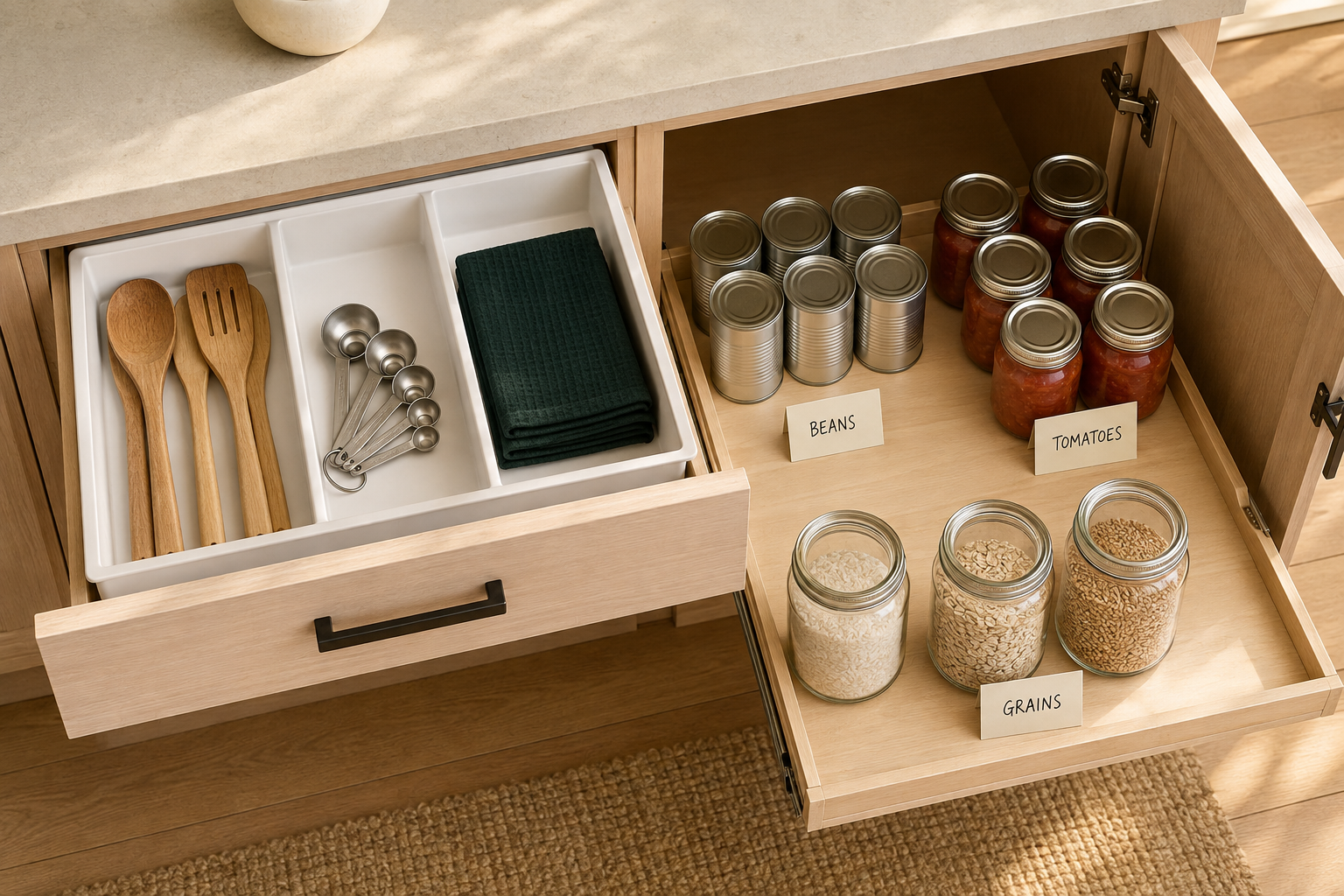
A drawer stays organized when every item inside it has a fixed boundary, because unboundaried drawers drift back into chaos within about two weeks no matter how carefully they started. This is the single most common failure point in kitchen organization, and it has a specific, cheap fix.
Adjustable dividers create that boundary. A drawer without one turns into a catch-all: the rubber band that migrated in, the takeout menu, the loose batteries that don’t belong anywhere else. Once a divider sets a physical wall around “utensils go here,” the drift mostly stops, because there’s simply nowhere for the wrong item to land without visibly not fitting.
For the junk drawer every kitchen seems to have, the fix isn’t eliminating it. It’s containing it. A small tray or box inside the drawer, holding only the handful of true miscellany items (spare keys, a tape measure, a pen), keeps that drawer from spreading into the ones next to it.
Deep drawers benefit from vertical dividers more than horizontal ones. Cutting boards, baking sheets, and trays that would otherwise stack flat and become unreachable can stand upright in slim vertical slots, which turns a “dig to the bottom” drawer into a “grab and go” one.
And one habit matters more than any product here: assign, don’t accumulate. Decide what a drawer holds before things start landing in it, not after it’s already full of whatever ended up there.
Pantry Alternatives When There’s No Pantry
Most rental kitchens don’t come with a dedicated pantry, and that gap causes more day-to-day frustration than almost any other missing feature. The fix isn’t finding more square footage. It’s designating one spot to function as a pantry, even if it wasn’t built to be one.
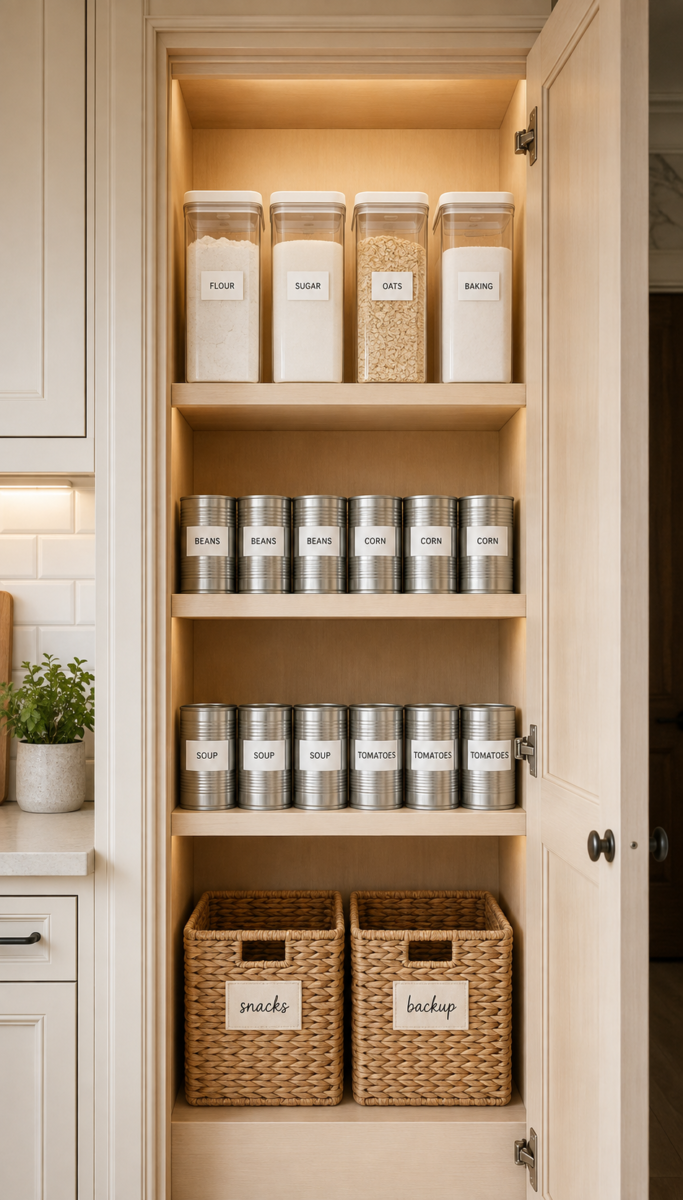
A single tall cabinet, if the kitchen has one, is the closest substitute. Group dry goods by type on separate shelves, front-facing so labels are visible without pulling anything out, and reserve the eye-level shelf for what gets used weekly.
A rolling cart or freestanding shelf unit works when no tall cabinet exists. Positioned near, but not necessarily inside, the kitchen, it can hold canned goods, snacks, and baking supplies in one visible, contained spot instead of scattered across three different cabinets.
A closet shelf just outside the kitchen is a legitimate pantry substitute for studio and small one-bedroom layouts, especially for bulk or backup items that don’t need daily access. Keep the frequently used items in the kitchen itself and reserve the closet shelf for overflow and backstock.
Whichever version applies, the organizing principle stays the same: group by category, and within each category, put what you reach for most often at eye level and front-facing. Everything else, the backup jar of something, the seasonal baking supplies, goes to the harder-to-reach spots.
Zone Mapping: Organize by Motion, Not Category
The most durable kitchen organization system groups items by where you use them, not by what category they technically belong to. This single shift is why some kitchens stay organized effortlessly and others need constant re-sorting.
A traditional approach groups “cooking utensils” together, “baking supplies” together, “cleaning supplies” together, regardless of where those tasks actually happen in the kitchen. A motion-based approach instead asks: where does this get used, and does it live there?
Prep zone: cutting boards, knives, and mixing bowls live in the cabinet or drawer nearest the counter space you actually prep on, even if that’s technically closer to the sink than to “where prep supplies belong” in a bigger kitchen’s layout.
Cook zone: pots, pans, and cooking utensils live within arm’s reach of the stove. If the nearest cabinet to the stove currently holds mismatched Tupperware, that’s worth swapping, because every extra step between stove and pot handle adds friction to every single meal.
Cleanup zone: dish soap, sponges, and trash bags live under or beside the sink, with nothing else competing for that space.
This isn’t a radical reorganization. It’s usually shifting the contents of two or three cabinets to match how you actually move, and the payoff shows up every single day rather than just on the day you set it up.
The Daily Habits That Keep It From Sliding Back
A perfectly organized kitchen on day one and a chaotic one by day thirty usually share the exact same storage. What’s different is habit, not layout.
The one-in, one-home rule matters more than any bin. When something new enters the kitchen, whether it’s a new mug or a grocery haul, it needs an assigned spot before it goes anywhere near the counter. Setting it “down for now” is how counters accumulate clutter one small decision at a time.
A two-minute end-of-day reset does more for long-term organization than any weekend deep clean. Putting dishes away, wiping the counter, and returning anything that migrated during cooking takes almost no time when done daily, and prevents the kind of buildup that eventually requires a full weekend to undo.
A designated landing spot for mail and stray items, somewhere that isn’t the kitchen counter, solves one of the most common clutter sources in small apartments. If there’s no other option, a single small tray by the door works better than letting the counter absorb it by default.
A seasonal or quarterly reset catches the drift that daily habits miss. Expired pantry items, duplicate gadgets, and systems that quietly stopped matching how you actually cook all build up slowly enough that you won’t notice until a short, scheduled check-in forces the question.
None of these habits require extra time on their own. What they require is doing them before the mess accumulates, rather than after, which is the entire difference between a kitchen that stays organized and one that needs to be reorganized from scratch every few months.
Organization Mistakes That Quietly Undo Good Systems
Even a well-designed system can fall apart if a few specific habits go unchecked. These show up often enough to be worth naming directly.
Organizing for the kitchen you wish you had, not the one you actually have. A system copied from a much larger kitchen, with dedicated zones for a spice wall or a full baking station, often doesn’t survive contact with a 70-square-foot layout. Build the system around your actual cabinet count and counter space, not an idealized version of it.
Treating labels as decoration instead of function. A label only helps if it’s legible from where you’d actually stand to grab the item, at eye level, front-facing, in a font size you can read without leaning in. A beautifully hand-lettered label on the back of a jar, facing the wall, does nothing.
Skipping the “who else uses this kitchen” question. A system that only makes sense to the person who built it tends to break down fast if a partner, roommate, or houseguest can’t intuitively follow it. If putting something back requires remembering a rule instead of following an obvious visual cue, the system will get abandoned under time pressure.
Letting one overflowing zone become the excuse for the whole system. A single messy drawer doesn’t mean the entire kitchen has failed. It usually means one zone needs a five-minute reset, not a full teardown. Treating a small local failure as proof the whole approach doesn’t work is how people end up abandoning systems that were actually 90 percent working.
Forgetting that organization has to flex with the season. Holiday baking supplies, a summer influx of iced tea and pitchers, a winter stretch of soup-making gear: real kitchens shift what they need month to month. A system with zero room to temporarily expand one category tends to snap back into disorganization the moment life gets a little different than usual.
Catching these early is far easier than rebuilding a system from scratch once it’s already collapsed. A quick honest look at which of these applies to your kitchen right now is often enough to fix the actual weak point.
Frequently Asked Questions
How long does it take to fully organize a small kitchen? A focused weekend, roughly six to eight hours, is usually enough for a full drawer and cabinet reset in a kitchen under 100 square feet. Pantry alternatives and zone remapping can extend that if the kitchen is starting from real chaos rather than a light refresh.
What’s the biggest mistake people make when organizing a small kitchen? Organizing by category instead of by how the kitchen actually gets used. A perfectly labeled system that doesn’t match your daily motion still creates friction, even though it looks organized on paper.
Do I need to buy new containers to organize my pantry alternative? No. Matching containers help visually but aren’t required for the system to function. Grouping by category and keeping frequently used items front-facing matters more than whether the containers match.
How often should I redo my kitchen organization system? A light check every three to four months catches most drift before it becomes a real problem. A full reset is rarely necessary if the quarterly check happens consistently.
Is it worth organizing a kitchen I’m about to move out of? Yes, especially if the move is more than a couple months out. An organized kitchen is genuinely easier to live in day to day, and most organization tools, from dividers to rolling carts, move with you rather than staying behind.
Related Reading
- The Complete Small Kitchen Guide — the full storage → organization → style sequence this guide fits into
- Small Kitchen Storage Guide — the vertical storage and cabinet additions that give this organization system enough capacity to work
- Rental Kitchen Upgrade Guide — the styling layer to add once storage and organization are both solid
- Complete Guide to Organizing a Small Kitchen — related Taims Space guide.
- Pantry Organization Without a Pantry — related Taims Space guide.
- Countertop Systems That Prevent Clutter — related Taims Space guide.
- Daily Habits for a Small Kitchen — related Taims Space guide.
- Small Kitchen Storage Ideas: Complete Guide — related Taims Space guide.
Category: Kitchen Organization Hub: /small-kitchens/
Reviewed by the Taims Space editorial team.