Table of Contents
Decluttering advice usually assumes one of two starting points: either you have a full free weekend and boundless motivation, or you’re already standing in a completely empty room with everything dumped on the floor, ready for the dramatic sorting montage. Neither of those is how it actually goes for most people living in a small apartment with a full week and a limited amount of energy left over at the end of it.
The real starting point is usually a lived-in space that’s slowly accumulated more than it can comfortably hold, some areas visibly cluttered, others just quietly overfull, and a sense that tackling it all at once would take more time and energy than anyone actually has to give it in one sitting. That’s a completely normal place to start from, and it’s exactly what this guide is built around.
This guide covers small-space decluttering in the order that actually works: starting with the areas that build momentum fastest, then a method for maintaining that progress in short sessions rather than marathon weekends, then finally the genuinely hard category, sentimental items, that most decluttering advice either skips entirely or oversimplifies.
Start With Momentum, Not the Hardest Room
The instinct to tackle the messiest, most overwhelming room first is understandable, but it’s usually the wrong place to begin. Starting with the hardest room often means starting with the lowest energy and the least confidence in your own decision-making process, which is exactly the combination most likely to lead to stalling out partway through.
Begin with categories that have obvious, low-stakes answers. Expired products, duplicate items you already know you don’t need both of, and things that are visibly broken or unusable require almost no deliberation. Clearing these first creates real, visible progress within the first few minutes, which builds the confidence and momentum needed for harder decisions later.
Move to spaces with low emotional attachment before high-attachment spaces. A kitchen junk drawer or a bathroom cabinet full of half-used products is almost always easier to declutter than a closet holding clothes tied to a specific time in your life, or a box of items connected to a person or memory. Save the emotionally loaded spaces for when you’ve built up real decision-making momentum from the easier wins.
Work in a sequence that builds outward from small, contained spaces. A single drawer, a single shelf, a single cabinet, each with a natural, visible boundary, gives a sense of completion that a sprawling, undefined space (like “the closet” as one giant task) doesn’t offer nearly as quickly.
For the full room-by-room order, including exactly which spaces to tackle first and which to save for later, Where to Start Decluttering When Everything Feels Like Clutter breaks this sequence down in complete detail.
Layer Two: A System for Maintaining Progress in Small Sessions
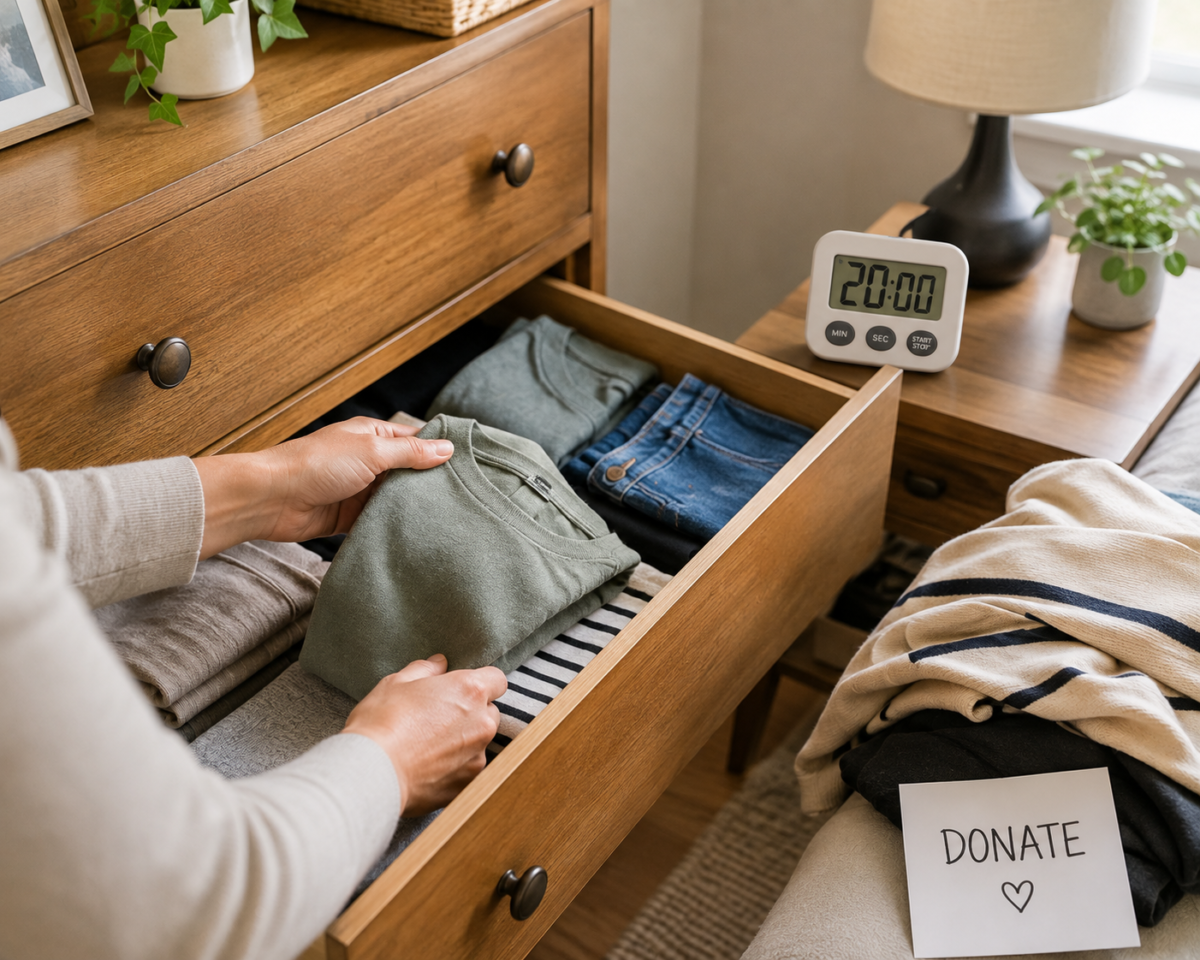
Decluttering doesn’t require a dedicated free day to make genuine progress, and in practice, waiting for that free day is one of the most common reasons decluttering projects never actually start. Short, focused sessions, even as brief as twenty minutes, compound into real, lasting change when they happen consistently.
A defined time limit removes the pressure of “finishing” a whole space in one sitting. Committing to twenty minutes rather than an open-ended “however long it takes” session makes starting feel far more manageable, and it’s genuinely surprising how much a single small drawer or shelf can be fully sorted within that window.
Consistency matters more than session length. Three twenty-minute sessions across a week accomplish more, and feel far less draining, than one exhausting three-hour session that leaves the rest of the week with zero decluttering momentum at all.
A short session works well specifically because it forces prioritization. With limited time, the instinct shifts from deliberating endlessly over every single item to making faster, more confident decisions on the ones that plainly don’t belong, which is often exactly the skill that a longer, unstructured session doesn’t build.
The complete twenty-minute framework, including exactly how to structure a session for maximum progress in minimum time, lives in The 20-Minute Declutter Method for Busy Weeks, with specific guidance for fitting this into an already full schedule.
Layer Three: The Category Most Decluttering Advice Skips
Sentimental items are consistently the hardest category in any decluttering project, and they’re also the category most likely to bring an otherwise productive session to a complete standstill. A box of old letters, childhood keepsakes, or items connected to someone significant doesn’t respond to the same quick, low-stakes decision-making that works for expired products or unused kitchen gadgets.
These items deserve their own separate approach, not the same rules as everything else. Trying to apply a fast, twenty-minute-session pace to a box of sentimental items usually backfires, either by rushing through decisions that deserve more thought, or by triggering exactly the kind of overwhelm that stalls the whole decluttering process.
A decision framework matters more here than speed. Rather than asking “do I still need this,” which rarely has a clear answer for a sentimental item, a better set of questions focuses on what the item represents, whether keeping it is honoring a memory or avoiding a decision, and whether there’s a way to preserve the meaning without necessarily keeping every physical object.
It’s genuinely fine to set this category aside until the rest of the project has real momentum. Unlike expired products or unused duplicates, sentimental items don’t create the same day-to-day friction of clutter, so there’s little cost to addressing them last, once the easier categories are handled and the harder emotional work has dedicated attention rather than getting squeezed into a rushed session.
The full framework for approaching sentimental items without guilt or unnecessary rushing lives in How to Declutter Sentimental Items Without the Guilt, covering the specific questions and approaches that make this category more manageable.
Bringing the Three Layers Together
These three layers aren’t strictly sequential in a rigid, one-must-finish-before-the-next-begins sense, they’re better understood as three different modes that apply to different parts of a decluttering project. Early momentum-building work and the ongoing twenty-minute session system can run in parallel from the start, chipping away at the easier categories in short, regular sessions. Sentimental items sit apart, addressed deliberately and without time pressure, whenever there’s real bandwidth to give them proper attention.
A realistic timeline for a genuinely cluttered small apartment might look like two to three weeks of regular twenty-minute sessions working through the room order, covering kitchen drawers, bathroom cabinets, closets, and general storage, followed by one or two dedicated, unhurried sessions specifically for sentimental items once the rest of the space already feels lighter and more manageable.
What Decluttering a Small Space Actually Requires
A place for donations to actually go. A bag or box by the door that fills up and then genuinely leaves the apartment, rather than sitting there indefinitely, keeps momentum from stalling at the “I’ll drop this off eventually” stage that so often becomes never.
A simple sorting system, even a basic three-category one. Keep, donate or sell, and discard covers the large majority of decluttering decisions without needing an elaborate system. Overcomplicating the sorting categories tends to slow decisions down rather than speed them up.
Realistic expectations about pace. A small apartment doesn’t need to be fully decluttered in a single weekend, and expecting that timeline is one of the most common reasons the whole project feels defeating before it’s even really started. Two to four weeks of consistent, manageable effort produces a far more sustainable result than one exhausting attempt at doing everything at once.
Permission to keep things that genuinely add value. Decluttering isn’t about achieving an empty, minimalist apartment for its own sake, it’s about removing what no longer serves a purpose so what remains actually has room to be used and enjoyed. An item you genuinely love and use regularly isn’t clutter, regardless of how much of it there is.
Maintaining a Decluttered Space Over Time
Build a light, ongoing habit rather than treating decluttering as a one-time project. A five-minute check of one drawer or shelf every week or two, well after the initial project is complete, prevents the same buildup from happening again and keeps future decluttering sessions small and manageable rather than another full project.
Pair new acquisitions with an honest look at what they’re replacing. Not as a strict rule for every single purchase, but as a general habit, considering whether something new genuinely earns its place, or whether it’s simply adding to what’s already there, keeps clutter from quietly rebuilding after the initial effort.
Revisit sentimental items periodically, not just once. How you feel about a specific keepsake or box of memories can genuinely shift over time, and a decision that felt too difficult during the initial decluttering project might feel more approachable a year or two later, which is a completely normal part of the process rather than a sign anything was done wrong the first time.
Decluttering With Others in a Shared Small Space
Most of this guide assumes a single decision-maker, but a genuinely large share of small-apartment decluttering happens with a roommate, partner, or family sharing the same limited square footage, which adds a layer this guide would be incomplete without addressing.
Separate shared spaces from personal spaces before starting. A living room, kitchen, or shared closet needs agreement from everyone using it, while a personal dresser or individual storage area can be decluttered independently without needing buy-in from anyone else. Sorting which spaces fall into which category before starting avoids friction partway through a session.
Different people move at different paces, and that’s fine. One person’s twenty-minute session might feel rushed to someone else, or one person might be ready to part with something the other still needs time to consider. Treating shared decluttering as an ongoing, flexible process rather than a single joint event reduces the pressure to align perfectly on every decision.
Sentimental items shared between people need extra care. An item connected to a shared memory, a couple’s early apartment, a family heirloom, deserves a joint conversation rather than a unilateral decision, even if one person is doing most of the physical sorting work in a given session.
Set shared expectations about donation and disposal. Agreeing in advance on where donated items go, and confirming before anything leaves the apartment, prevents the specific frustration of someone discovering later that an item they wanted to keep was already given away.
Deciding What to Do With What You’re Letting Go Of
Deciding to part with something is only half the process; where it actually goes next matters both for the practical goal of getting it out of the apartment and for making the parting-with feel less wasteful.
Donate items that are genuinely still useful. Clothing, kitchenware, and household goods in reasonable condition can go to a local donation center, and many organizations offer pickup service for larger quantities, which removes the last logistical excuse for items sitting in a donation bag by the door for weeks.
Sell higher-value items if the effort is worth it. Furniture, electronics, and specialty items can recoup some value through resale platforms, though it’s worth being honest about the time cost of listing, photographing, and coordinating pickup against the actual amount likely to be recovered. For lower-value items, donation is often the more time-efficient choice.
Recycle what can genuinely be recycled, rather than defaulting everything to the trash. Electronics, in particular, often have specific recycling requirements or drop-off locations rather than standard curbside pickup, worth checking before assuming the trash is the only option.
Discard what’s genuinely unusable without guilt. Not everything needs to find a second home, and broken, expired, or unsalvageable items are appropriately headed for the trash. Spending excessive time trying to find a home for something that’s simply worn out often delays the whole decluttering process for very little actual benefit, and letting go of an item without a perfect destination for it is still real, meaningful progress.
Frequently Asked Questions
How do I start decluttering when my whole apartment feels overwhelming? Start with low-stakes, obvious categories first, expired products, visible duplicates, broken items, rather than the messiest or most emotionally difficult room. Building momentum with easy decisions makes the harder ones further into the process feel more manageable.
How much time does it take to declutter a small apartment? It depends on how much has accumulated, but consistent short sessions, twenty minutes a few times a week, typically produce meaningful, lasting progress within two to four weeks, without requiring a single overwhelming block of time.
What should I do with sentimental items I can’t decide about? Set them aside for a dedicated, unhurried session rather than rushing a decision during a quick decluttering pass. A specific decision framework, rather than the same fast rules used for everyday clutter, tends to make these decisions feel less overwhelming.
Is it normal to feel stuck when decluttering? Yes, particularly with sentimental or high-attachment items. Feeling stuck on a specific category is common and doesn’t mean anything is wrong with the overall approach, it usually just means that category deserves a different pace and a different kind of attention than the rest of the project.
How do I keep a small apartment from getting cluttered again after decluttering? A short, regular maintenance habit, checking one drawer or shelf every week or two, prevents the same level of buildup from happening again. Pairing new purchases with an honest look at whether they genuinely add value also helps keep clutter from quietly returning over time.
Related Reading
- Where to Start Decluttering When Everything Feels Like Clutter — the full room-by-room order that builds momentum from the very first session.
- The 20-Minute Declutter Method for Busy Weeks — the short-session system that turns decluttering into a sustainable habit instead of a dreaded weekend project.
- How to Declutter Sentimental Items Without the Guilt — the decision framework for the hardest category in any decluttering project.
- Closet Organization — where to focus once a space has been decluttered and it’s time to organize what remains.
- Parent Category: Decluttering
- Parent Hub: Organization & Storage