Table of Contents
If your kitchen came with four cabinets, four feet of counter, and absolutely nowhere to put a stand mixer, you already know the problem. What you’re probably less sure about is where to start fixing it.
Most people tackle a small kitchen backward. They buy a cute over-the-sink shelf, add a few baskets, hang something on the wall, and wonder three weeks later why the counter is covered in mail and the one usable drawer is jammed shut again. The issue isn’t effort. It’s sequence. Storage, organization, and style solve different problems, and doing them out of order means redoing the earlier steps once the later ones expose what’s actually wrong.
This guide lays out that order. Fix the physical storage capacity first. Build the systems that keep it working after the honeymoon phase wears off. Then, if you’re renting, make the upgrades that look intentional without costing your deposit. Do it in that sequence and a kitchen under 100 square feet can genuinely function like a much bigger one. Do it out of order and you’ll spend money twice.
What Actually Makes a Small Kitchen Feel Small
A kitchen feels small when the number of decisions it forces on you outpaces the space available to make them in. It’s rarely square footage alone. Two kitchens can both measure 70 square feet, and one will feel workable while the other feels impossible, because the workable one has vertical storage, a clear counter zone, and a logical flow between fridge, stove, and sink.
The average kitchen in an older rental building or converted apartment tends to land somewhere between 60 and 100 square feet, often with a single wall or narrow galley layout and a fraction of the cabinet run you’d get in newer construction. That’s not a design failure on your part. It’s a constraint you’re working around, and constraints respond to sequence, not more stuff.
Three things drive whether a small kitchen works:
- Vertical capacity: how much of the wall space above counter height is actually storing something
- Zone clarity: whether prep, cooking, and cleanup each have a defined, uncluttered spot
- Habit durability: whether the systems you set up survive a busy Tuesday, not just the day you built them
Fix those three, in that order, and the square footage stops being the limiting factor.
Start With Storage: The Order of Operations
Before organizing anything, solve capacity first. A small kitchen usually doesn’t have an organization problem so much as a not-enough-storage problem wearing an organization problem’s clothes. No labeling system fixes a kitchen that physically doesn’t have anywhere to put a stand mixer, a case of canned goods, or the pots that don’t fit in one cabinet.
The fix is vertical, almost always. Wall space above the counter and beside the fridge is the most underused real estate in a rental kitchen, because it requires zero permanent modification and works whether you own the unit or not.
Start here, roughly in this order:
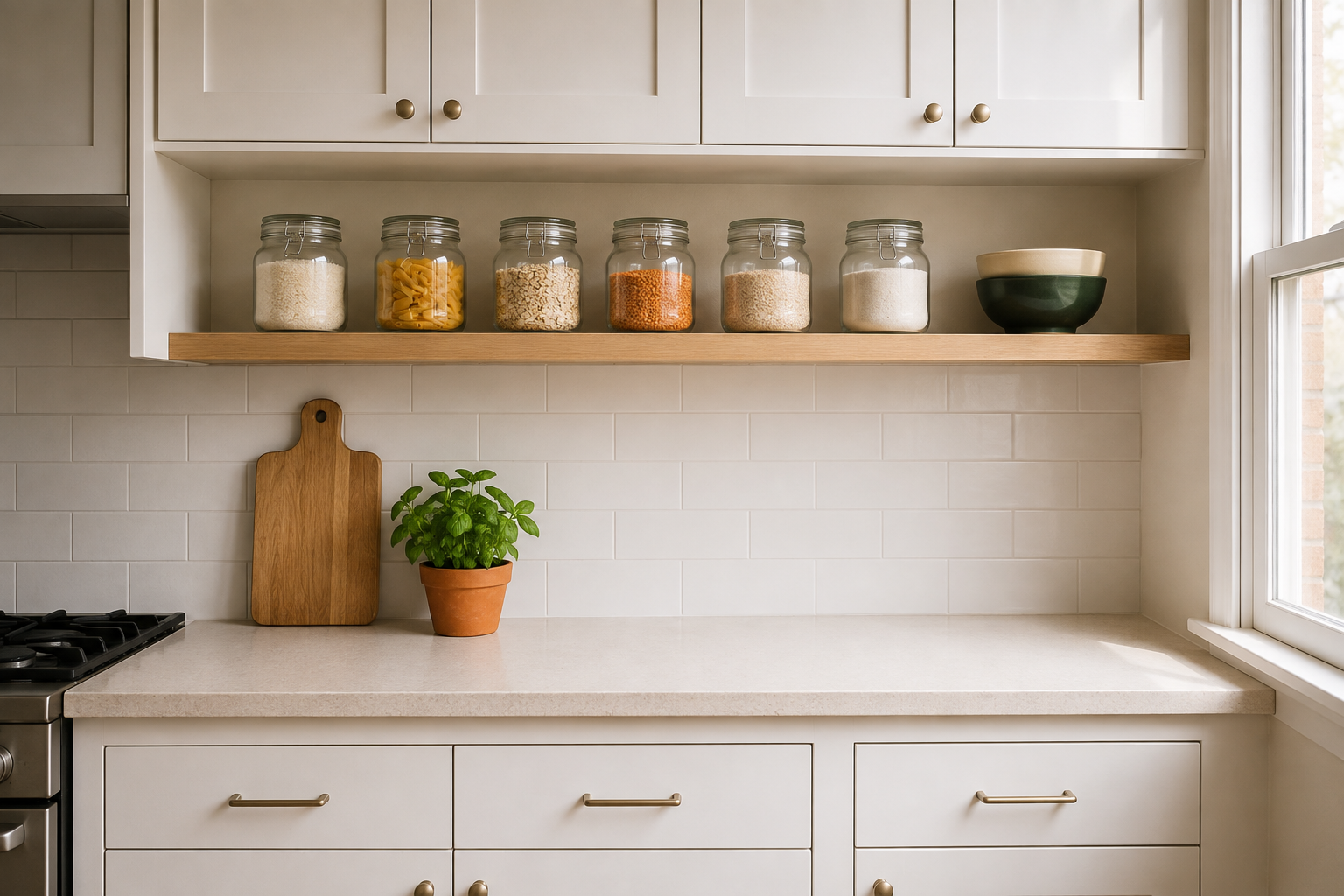
- Wall-mounted or freestanding open shelving above the counter, sink, or stove, which adds storage without touching cabinet space
- Over-the-cabinet-door organizers for cutting boards, foil, and trays that otherwise slide around a deep drawer
- Under-shelf baskets that clip beneath an existing shelf and effectively double it
- A slim rolling cart (12–16 inches wide) if there’s any floor gap beside the fridge or counter’s end. This single piece regularly adds the equivalent of a full extra cabinet
- Tension rods inside cabinets to create a second tier for shallow items like cutting boards or baking sheets
A single wall-mounted shelf unit with three tiers, roughly 24 inches wide, typically adds enough vertical storage to hold what would otherwise fill two drawers. That’s the kind of return that makes storage the right first move, before a single organizer bin gets purchased.
The full breakdown of specific products, cabinet-by-cabinet strategies, and what to buy versus skip lives in the dedicated storage guide below. This section is about sequence: get the capacity right before you organize what’s inside it, because organizing a kitchen that’s still short on space just means neatly arranging the overflow.
If your cabinets are technically full but still feel chaotic every time you open one, that’s not a storage problem anymore. That’s the next section.
Organization Systems That Survive Week Three
Organization is what happens after storage capacity is solved, and it’s judged by whether it still works a month later, not whether it looked good the day you set it up. A kitchen with plenty of storage can still feel unmanageable if nothing has a fixed home, which is the actual definition of a disorganized kitchen versus a small one.
The systems that hold up long-term share a specific trait: they match how you actually move through the space, not how a magazine photo wants you to move through it.
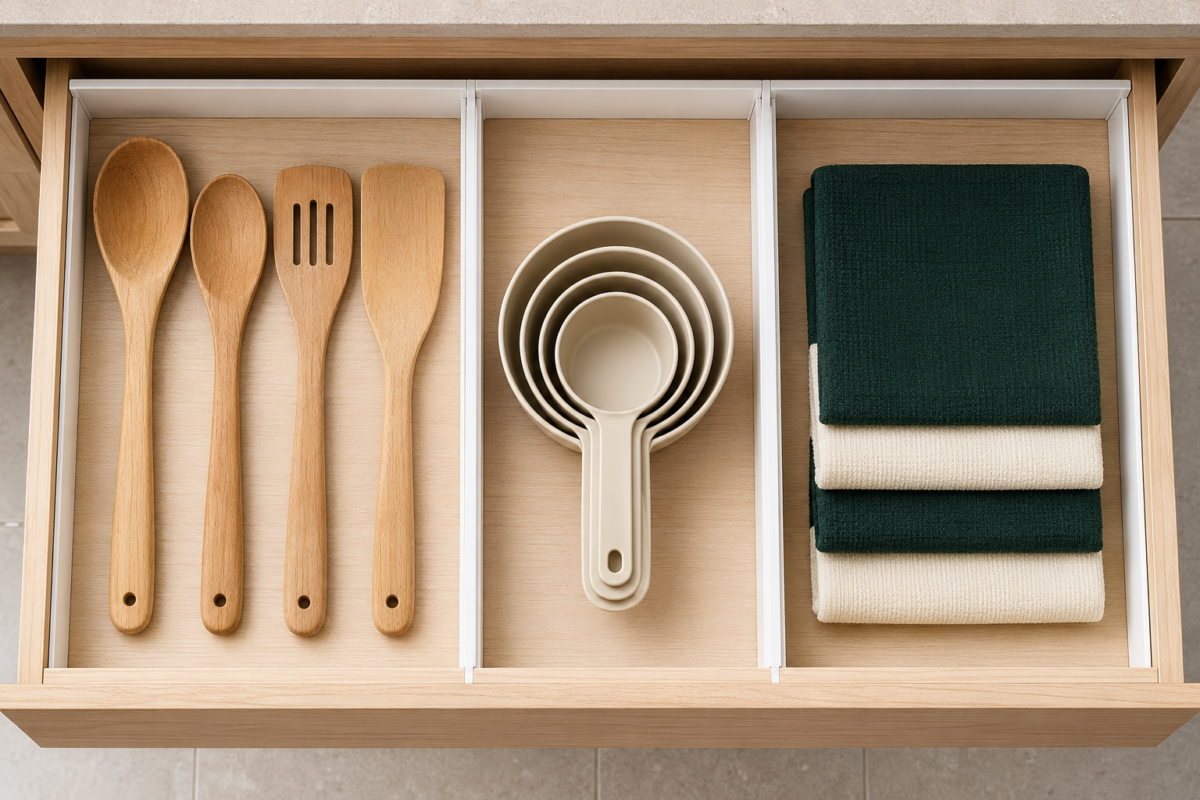
Drawer dividers work because they force a boundary. Without one, a “utensil drawer” slowly absorbs rubber bands, takeout menus, and loose batteries within about two weeks. A single adjustable divider costs less than most kitchen gadgets and prevents that drift entirely.
Zone-based cabinet assignment means grouping by task, not by category. Baking items (measuring cups, mixing bowl, sheet pans) live together near wherever you actually roll out dough, even if that’s technically two cabinets away from where “baking supplies” would go in a bigger kitchen. Cooking near the stove, prep near the cutting board, cleanup supplies under the sink. Sounds obvious. Most kitchens still group by category instead of by motion, which adds unnecessary steps to every single task.
Pantry alternatives, for the roughly two-thirds of rental kitchens that don’t have a dedicated pantry, matter more here than almost anywhere else. A single tall cabinet, a rolling cart, or even a closet shelf near the kitchen can function as a pantry if it’s organized by how often you use something (front and eye-level) rather than by category alone.
A study on kitchen workflow efficiency, cited widely in commercial kitchen design, found that reducing the number of steps between prep, cook, and clean zones cut task completion time by roughly 20 percent. Home kitchens follow the same logic at a smaller scale. The system doesn’t need to be elaborate. It needs to match the three or four things you actually do in that kitchen every single day.
Once the systems hold, most people naturally want the space to look like it was designed, not just organized. That’s where rental-friendly upgrades come in, and where a lot of renters stop themselves too early over damage worries that mostly don’t apply.
Rental-Friendly Upgrades That Actually Move Out With You
A rental kitchen can look intentionally styled without a single permanent change, using upgrades that are fully removable and cause zero damage on move-out. The category that makes this possible is temporary, adhesive-based, or freestanding design: peel-and-stick backsplash tile, removable wallpaper on a single accent wall or inside open shelving, cabinet hardware swaps (keeping the originals boxed for move-out), and a curated set of counter and open-shelf styling objects.
Peel-and-stick backsplash tile, when applied over a clean, primed surface, removes cleanly in the vast majority of rental cases and instantly changes how “finished” a kitchen looks, often for under $40 for a standard run behind a stove or sink. Cabinet hardware, similarly, is one of the highest-impact, lowest-cost swaps available: new pulls change the entire read of a cabinet front in under an hour, and the original hardware goes back on before you hand over keys.
The upgrades that tend to disappoint are the ones people attempt without checking reversibility first: contact paper applied directly to unsealed wood (which can pull finish off on removal), or heavy adhesive hooks rated for less weight than what gets hung on them. The dedicated rental upgrade guide below covers exactly which products are genuinely damage-free versus which ones only claim to be.
This is also the stage where style choices should follow, not lead, the earlier work. A kitchen with unresolved storage and organization problems will look cluttered no matter how good the backsplash is. Style is the finishing layer, and it reads as finished specifically because the functional layer underneath it is already solid.
The Full Decision Order, One More Time
For a kitchen you’re setting up from scratch, or resetting after it’s drifted into chaos, this is the sequence that avoids redoing work:
- Audit vertical wall space and add shelving or rail systems before buying a single organizer bin
- Solve pantry alternatives if there’s no dedicated pantry, using the tallest available cabinet or a rolling cart
- Divide and zone drawers and cabinets by task, not category
- Build the daily habit systems (a designated mail-drop spot away from the counter, a fixed home for the items that tend to migrate)
- Add rental-friendly style upgrades only once the first four steps are solid
Skipping straight to step five, which is the single most common mistake, produces a kitchen that photographs well for exactly one week before the underlying capacity and habit problems resurface and undo the styling.
Frequently Asked Questions
How small is too small for a functional kitchen? There’s no hard cutoff. Kitchens under 50 square feet function fine with the right vertical storage and zoning; kitchens over 150 square feet still feel chaotic without it. Function depends on storage-to-clutter ratio, not raw square footage.
Should I buy storage solutions before or after decluttering? Declutter first, but only a rough first pass. A full, perfect declutter before buying anything often stalls the whole project. Clear obvious duplicates and expired items, then move to storage, then do a second, more thorough declutter once you can actually see what you have.
What’s the single highest-impact change for a small rental kitchen? Vertical wall shelving above the counter or beside the fridge. It adds real storage capacity without any renovation, and it’s the one change that makes every later organization step easier.
Do peel-and-stick backsplash tiles actually damage rental walls? Applied correctly over a clean, primed surface and removed within the manufacturer’s recommended timeframe, most peel-and-stick products come off without damage. The risk climbs on unsealed or textured surfaces, which is worth checking before buying.
How often should a small kitchen system get reset? Roughly every three to four months, or whenever a drawer stops closing easily. Habits and inventory shift over a season, and a quick 20-minute reset keeps the original system from slowly falling apart.
Related Reading
- Small Kitchen Storage Guide — the full vertical storage and cabinet organizer breakdown, product by product
- Small Kitchen Organization Guide — drawer systems, pantry alternatives, and the habits that keep a one-counter kitchen from sliding back into chaos
- Rental Kitchen Upgrade Guide — which damage-free upgrades actually hold up, and which ones only claim to be reversible
- Small Kitchen Storage Ideas: Complete Guide — related Taims Space guide.
- Complete Guide to Organizing a Small Kitchen — related Taims Space guide.
- Complete Guide to Decorating a Small Kitchen — related Taims Space guide.
- Complete Guide to Rental Kitchen Upgrades — related Taims Space guide.
- Pantry Organization Without a Pantry — related Taims Space guide.
- Small Kitchen Lighting That Changes the Room — related Taims Space guide.
Category: Kitchen Storage Hub: /small-kitchens/
Reviewed by the Taims Space editorial team.