Table of Contents
Open four cabinets in a rental kitchen and you’ll usually find the same story. One holds pots stacked so deep you have to unload three to reach the one you need. One is half-empty because the shelf height doesn’t fit anything taller than a coffee mug. One has become the junk drawer’s overflow zone. And the fourth is somehow both full and completely disorganized at the same time.
That’s not a you problem. Standard rental kitchens are built around a fixed cabinet count, not around how much stuff a real person actually cooks with, and the gap between those two numbers is exactly where the frustration lives. The fix isn’t a bigger kitchen. It’s using the space that already exists, most of which is currently doing nothing.
This guide ranks the storage additions that make the biggest difference in a genuinely small kitchen, starting with the ones that add the most usable space per square foot and working down from there. None of it requires a landlord’s permission or a drill.
How Much Storage Does a Small Kitchen Actually Need?
A functional small kitchen needs enough storage to hold everything you use at least monthly within arm’s reach, and everything else stored vertically above or below that zone. The number isn’t fixed. What matters is the ratio between how much you own and how much surface area is dedicated to storing it, and in a kitchen under 100 square feet, that ratio gets tight fast if storage stays limited to the original cabinets.
Here’s the part that surprises people: most small kitchens don’t actually have a “too much stuff” problem. They have an unused-space problem. Look up. The wall between your upper cabinets and the counter, roughly 18 inches of vertical space in most layouts, sits empty in the vast majority of rental kitchens. So does the inside of most cabinet doors. So does the gap beside the fridge, if there is one.
Before buying a single organizer, walk your kitchen and count the flat, empty vertical surfaces you’re not using. That number, more than your cabinet count, tells you how much runway you actually have.
Vertical Storage: The Single Biggest Lever
Everything else in this guide is a refinement. This section is the one that changes the math.
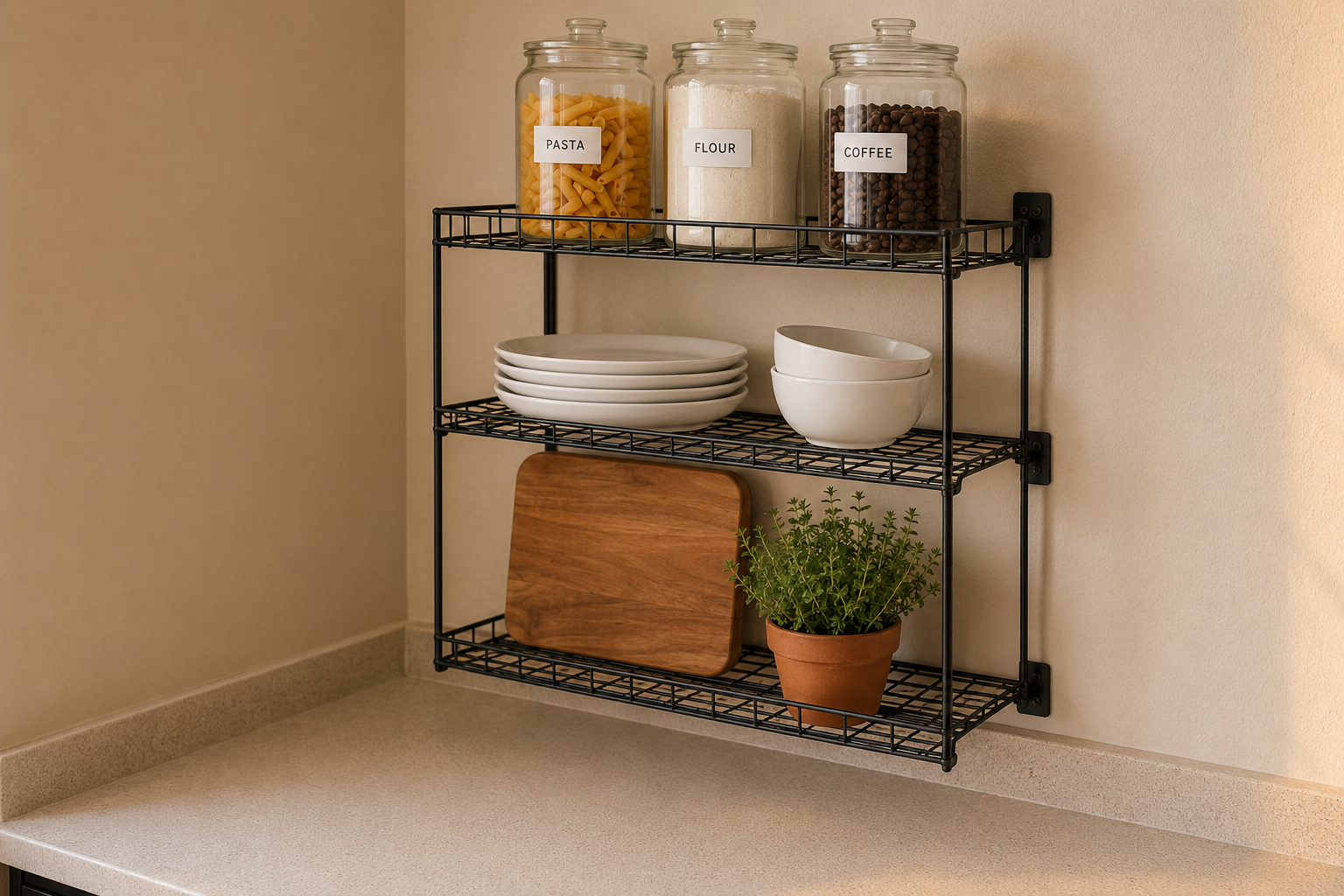
Wall-mounted shelving above the counter is the highest-return addition available in a small kitchen, adding storage without touching a single existing cabinet or drawer. A three-tier unit, 24 to 36 inches wide, mounted with anchors rated for the wall type, typically holds what would otherwise fill two full cabinet shelves. Renters worried about wall damage can use a stud-mounted bracket system or, where drilling isn’t allowed, a tension-mounted shelf that wedges floor to ceiling without a single hole.
Rail systems, the kind with S-hooks and a mounted metal bar, work especially well beside a stove for hanging utensils, pot holders, and small pans. They clear counter and drawer space simultaneously, and a single 24-inch rail with six hooks removes an entire utensil crock from the counter.
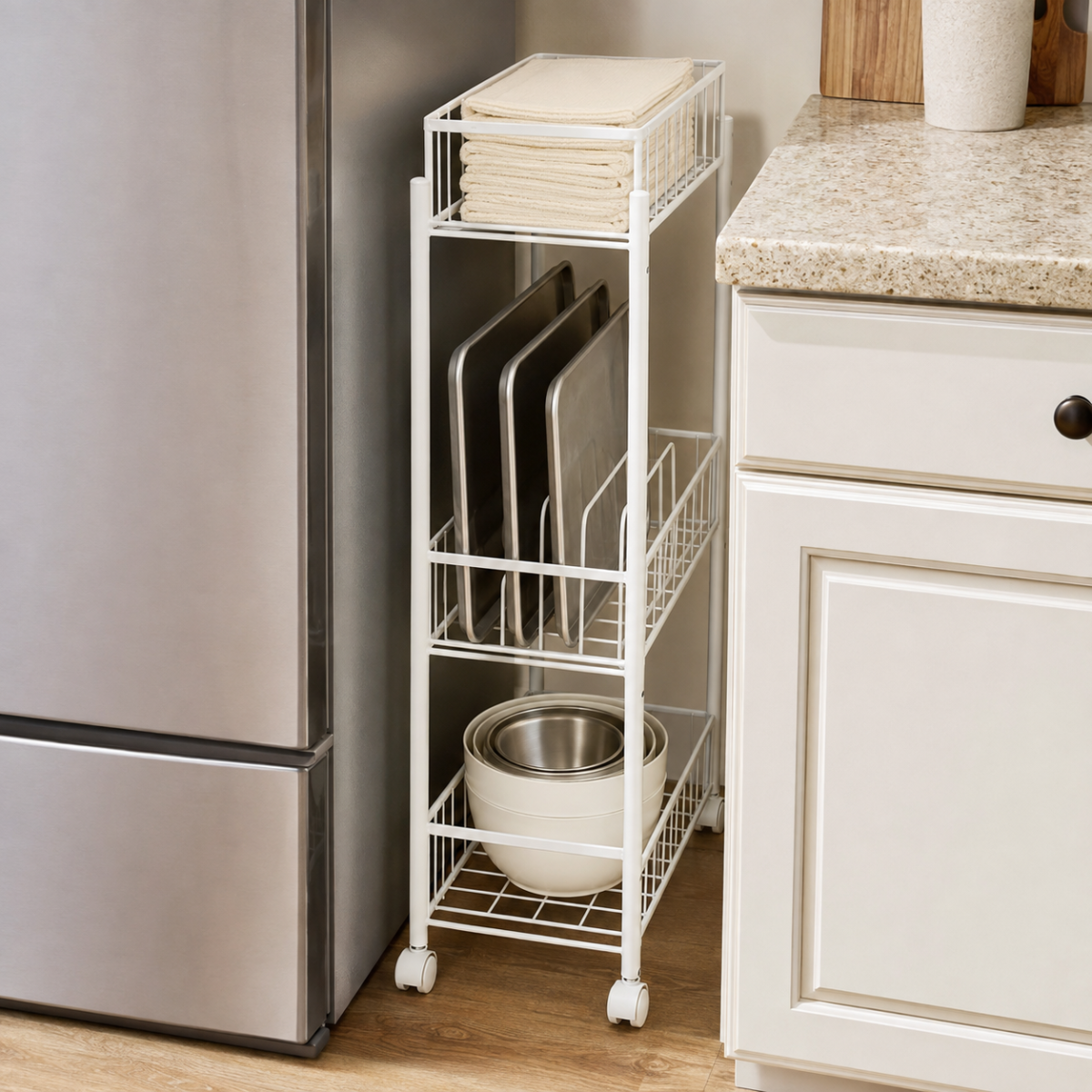
The gap beside the fridge is one of the most overlooked spots in any small kitchen. A slim rolling cart, usually between 10 and 16 inches wide, slides into that dead zone and functions as a genuine extra cabinet. Three or four tiers on wheels means it can roll out for baking days and tuck away the rest of the time. This one addition regularly solves the “where do I even put my baking sheets” problem on its own.
Over-the-door organizers, mounted on the inside of a pantry or under-sink cabinet door, add a full storage plane that’s otherwise wasted space. Spice racks, cleaning supplies, and foil or plastic wrap boxes all work well here, since the pocket depth is shallow but the surface area adds up.
Ceiling-mounted or under-cabinet hooks are the smallest addition on this list and also the cheapest, usually under $15 for a set. They’re worth mentioning because they solve one specific, recurring annoyance: the mug collection that never quite fits in the cabinet. Hang the mugs, and the shelf space they were hogging goes back to something else.
Add up two or three of these and a kitchen that felt permanently short on room usually ends up with more storage than it needs, which is when the conversation shifts from “where do I put this” to “how do I keep this organized.”
Cabinet Organizers Worth the Money
Not every organizer earns its space, and this is where a lot of small kitchen budgets get wasted on products that look good in a photo but don’t actually add capacity. The ones below pass a simple test: they either increase how much a cabinet holds, or they meaningfully cut the time it takes to find something inside it.
Pull-out drawer shelves for base cabinets solve the “reach into the dark abyss” problem that deep lower cabinets are famous for. Rather than unstacking three pots to reach the one in back, a sliding shelf pulls the entire contents forward. These require minimal hardware and, in most cases, no permanent modification if mounted with adjustable tension brackets instead of screws.
Stackable shelf risers double the usable height inside a single cabinet shelf by creating a second tier above the first. A cabinet holding one row of plates can hold two rows of smaller items, like bowls or mugs, once a riser adds that second level.
Lazy Susans, specifically for corner cabinets, solve one of the most consistently wasted spots in any kitchen. Corner cabinets lose a large share of their true volume to dead, unreachable corners, and a rotating shelf reclaims most of that space without any structural change.
Tension rods installed vertically inside a cabinet create a slim divider for cutting boards, baking sheets, and trays, which otherwise slide flat and stack into an unreachable pile. A single $6 rod solves a problem that most people assume requires a custom cabinet insert.
What doesn’t earn its space, generally, is anything single-purpose and bulky. A dedicated pot lid organizer that only holds lids, for example, often takes up more cabinet volume than the mess it’s solving. If an organizer solves one narrow problem while eating a disproportionate amount of the space around it, skip it and use that space more flexibly instead.
What Should Never Live on the Counter
A functional counter in a small kitchen holds almost nothing permanently, because every square inch of counter space is also your only real prep surface. This is the rule that gets broken the most, and it’s the one with the biggest daily impact on how the kitchen actually feels to cook in.
The short list of things that can reasonably live on a small counter: a coffee maker or kettle used daily, and maybe one small appliance in active weekly rotation, like a toaster. Everything else, including the mail, the fruit bowl, the extra cutting board, and the stack of unopened packages, is either storage overflow or clutter, and both belong somewhere with a door.
A cluttered counter doesn’t just look messy. It functionally shrinks your prep space to whatever gap is left, which means a kitchen with plenty of storage can still feel impossibly cramped if the one clear surface keeps collecting things it shouldn’t. Fixing this usually isn’t about buying more storage. It’s about assigning every counter object a home somewhere else, even if that home is a single designated basket in a nearby cabinet.
Storage Mistakes That Waste Money
A few patterns show up again and again in small kitchens, and each one quietly undoes the work of everything else on this list.
Buying storage before measuring the space it’s going into is the most common one. A shelf unit that’s two inches too deep for the available wall gap either doesn’t fit or forces an awkward workaround, and returns on bulky home goods eat time most people don’t have.
Stacking identical-looking containers without labels creates a different problem: the storage exists, but finding anything inside it takes just as long as before, because every jar looks the same from three feet away. A $4 pack of labels solves this in about ten minutes.
Buying single-use organizers for low-frequency items is the third recurring mistake. A dedicated organizer for something used twice a year, like a turkey roasting pan, usually isn’t worth permanent prime real estate. That item belongs in the least accessible spot available, like the very back of a top shelf, freeing the easy-reach spots for what actually gets used weekly.
And finally, treating storage as a one-time project rather than something that gets revisited. What worked for a kitchen six months ago doesn’t automatically still work once habits, groceries, and gadgets shift. A short reset every few months keeps the whole system from quietly drifting back into chaos, and it’s a much smaller job than the original overhaul ever was.
Once the storage layer is solid, the next question is almost never “where do I put this.” It becomes “how do I keep this exact spot working,” which is a different problem with a different set of fixes.
Frequently Asked Questions
What’s the cheapest way to add storage to a small kitchen? Tension rods and adhesive hooks, both usually under $10, solve two of the most common storage gaps: vertical dividers inside cabinets and extra hanging space for mugs or utensils. Neither requires drilling or a landlord’s approval.
Is it worth buying a rolling cart if my kitchen has zero floor gap? No. A rolling cart only earns its space if there’s a genuine gap to slide it into, usually 10 to 16 inches. Without that gap, a wall-mounted shelf or over-the-door organizer will add more usable storage for the same money.
How do I know if a storage product will actually fit before buying it? Measure the exact space, including depth, and subtract at least half an inch for installation clearance. Most storage disappointments come from skipping this step and assuming a product will fit based on the photo alone.
Do I need to declutter before adding storage, or can I do both at once? A rough first pass helps, mainly to clear obvious duplicates or expired items, but a full perfect declutter isn’t necessary before adding storage. Vertical storage additions often make the real decluttering easier, since you can finally see everything you own in one place.
How much storage is too much for a small kitchen? When storage additions start blocking movement or covering the counter itself, it’s too much. The goal is more storage capacity, not more visible stuff. A well-stored kitchen should look calmer after the additions, not busier.
Related Reading
- The Complete Small Kitchen Guide — the full storage → organization → style sequence this guide fits into
- Small Kitchen Organization Guide — the drawer systems and daily habits that keep this storage from sliding back into chaos
- Rental Kitchen Upgrade Guide — damage-free upgrades to layer on once storage and organization are solid
- Small Kitchen Storage Ideas: Complete Guide — related Taims Space guide.
- Vertical Storage for Kitchens — related Taims Space guide.
- Cabinet Door Storage Ideas — related Taims Space guide.
- Rental-Friendly Kitchen Storage Without Drilling — related Taims Space guide.
- Complete Guide to Organizing a Small Kitchen — related Taims Space guide.
Category: Kitchen Storage Hub: /small-kitchens/
Reviewed by the Taims Space editorial team.