Table of Contents
Here’s a small test: pick up whatever bin is currently under your bed, or the one you’re eyeing online, and imagine it fully loaded with folded sweaters, spare bedding, or a stack of books. Does the bottom flex? Do the side walls bow out? If the answer is yes, that bin was never built to hold what you’re asking it to hold, and that’s the actual reason under-bed storage fails, not a lack of space.
Most under-bed storage advice is really just sizing advice: measure your clearance, buy a bin that fits. That’s step one, but it skips the part that determines whether the system survives past month three. A bin has to hold real, sustained weight without warping, sitting low enough to slide, and staying accessible enough that you’ll actually keep using it. Get the weight rating wrong and you end up with a bin that cracks under a stack of winter clothes, or one so flimsy it collapses the moment you try to slide it out from the back wall.
The Mistake Most Under-Bed Guides Skip
The single biggest reason under-bed storage systems fail isn’t clearance, it’s weight capacity. A thin plastic bin rated for light, loose items like tissue paper or seasonal decorations will crack or bow within weeks if you load it with folded sweaters, hardcover books, or spare bedding, all of which are heavier and denser than most people estimate.
This is why “just measure your clearance and buy a bin that fits” isn’t the whole answer. Two bins can be the exact same external dimensions and hold completely different real-world loads, because the wall thickness, the base reinforcement, and the lid-to-body seal all vary by manufacturer. A bin rated for 20 pounds evenly distributed across the base will start to sag and crack at the corners well before you hit that number if the weight is concentrated in one spot, like a single stack of hardcovers pushed to one side.
What actually determines whether a bin holds up:
- Base thickness. Run a finger across the underside. If it flexes noticeably under light pressure with nothing inside, it will bow under a real load.
- Corner reinforcement. Molded or ribbed corners distribute weight outward instead of concentrating stress at the seams, which is usually where cheap bins crack first.
- Lid seal, not just lid fit. A snapping, clipped lid keeps out dust and pests. A lid that just rests on top does neither, and it slides off the moment you pull the bin out at an angle.
Measure Clearance Before You Buy the Bin, Not After
A standard queen bed frame gives roughly 8 inches of clearance underneath, enough for a mid-height rigid bin with a snap lid. Anything under 6 inches needs a flat, zippered storage bag instead, since a rigid bin simply won’t fit the gap no matter how well it’s built.
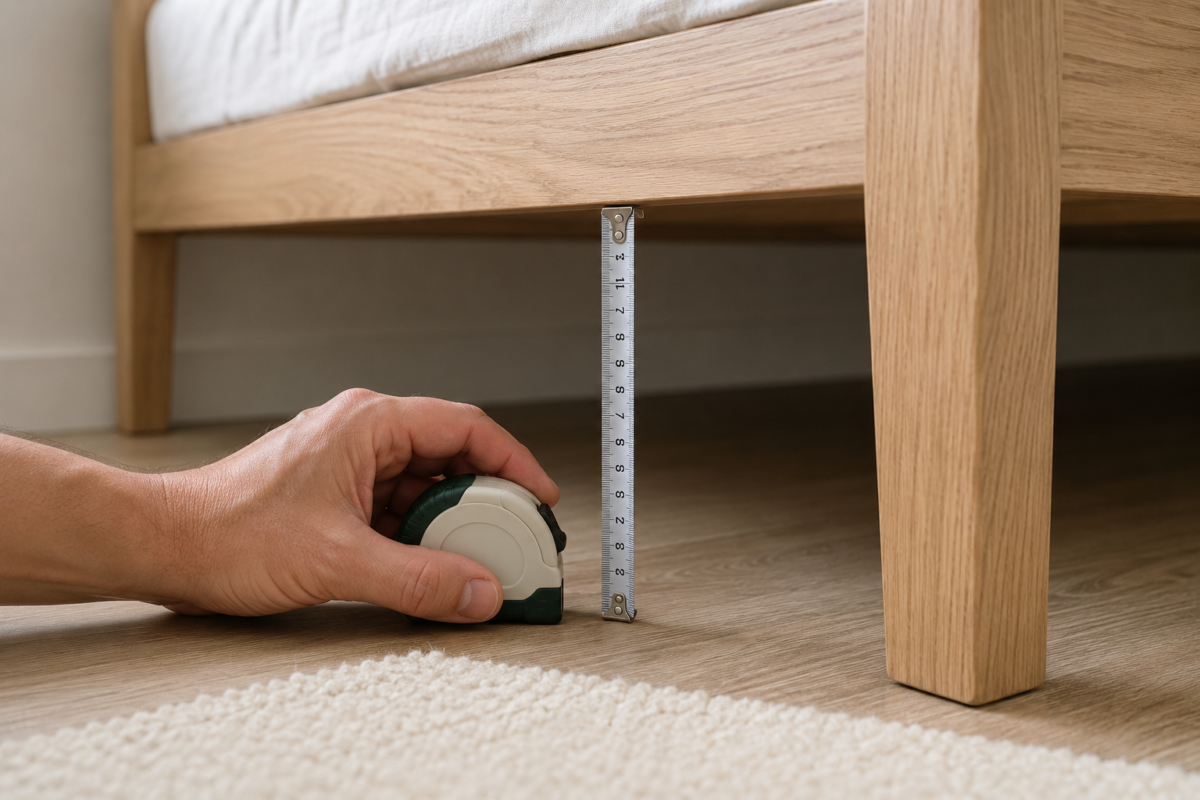
Get a tape measure and check the actual clearance from the floor to the bottom of your bed frame, not the mattress. Frame heights run anywhere from 4 inches on a low platform bed to 14 or more inches on a traditional frame sitting over a box spring, and that number is what decides your entire bin category before weight capacity even enters the picture.
| Clearance | Best option | Typical weight capacity |
| Under 6 inches | Flat zippered storage bag | 10–15 lbs, best for lightweight textiles |
| 6–10 inches | Rigid bin with snap lid | 25–35 lbs, holds folded clothing and bedding |
| 10+ inches | Rolling drawer unit | 40+ lbs, functions like a second dresser |
If your frame sits lower than 6 inches and you specifically need rigid, weight-rated storage rather than a soft bag, a bed riser kit typically adds 3 to 5 inches of clearance per leg. That single change can move you from the “flat bag only” row of that table up to “rigid bin,” which matters if what you’re storing is heavier than soft textiles, like books or shoes.
When a Bin Isn’t the Right Tool
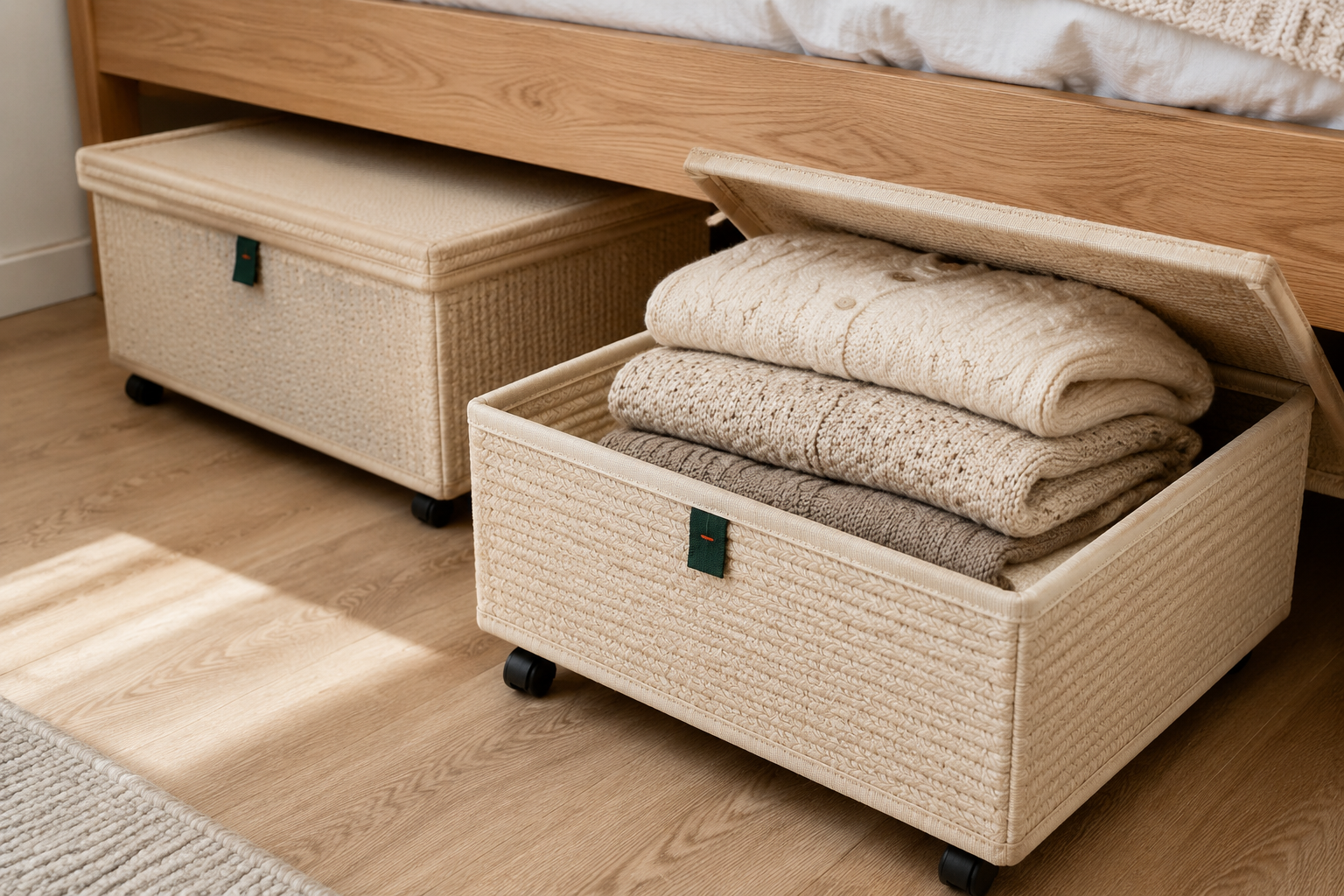
Bins solve most under-bed storage, but a rolling drawer system earns its higher cost when you’re storing daily-use items, not just seasonal overflow, because you’ll open it often enough that digging through a lidded bin becomes genuinely annoying within a few weeks. If you’re only accessing the space twice a year for off-season clothes, a simple bin costs less and does the job just as well.
A few situations where it’s worth the upgrade:
- You’re storing shoes you actually wear this season. A shallow rolling drawer keeps them visible and grabbable, where a lidded bin means unstacking everything on top just to reach the bottom pair.
- The bed sits against a wall on one side. Bins with wheels roll straight out. Bins without wheels have to be dragged, which wears through cheap plastic corners fast and is the number one reason bins crack within the first year.
- You need to see what’s inside without opening it. Clear-front drawer units solve the “I forgot what’s in there” problem that opaque bins create, especially once you have three or four of them lined up under the same bed.
What Not to Store Under a Bed
Photos, important documents, and anything leather or fabric that can’t tolerate humidity shouldn’t go under the bed long-term, since that zone gets less airflow than the rest of the room and is closer to the floor, where dust and moisture settle first. Keep those in a closet shelf or a sealed container elsewhere instead.
This is the myth worth correcting directly: under-bed storage looks like the perfect place for sentimental, fragile items because it’s out of sight, but out of sight is exactly the problem. Airflow under a bed is typically worse than anywhere else in the room, and that’s a slow, invisible risk for anything that can warp, yellow, or mildew. Save the under-bed zone for what it’s actually good at: clothing, bedding, and shoes that can handle a little dust and don’t need daily eyes on them.
Frequently Asked Questions
How much weight can an under-bed storage bin actually hold? It depends entirely on the bin, not just its size. A well-made rigid bin with reinforced corners typically holds 25–35 pounds evenly distributed. A thin, budget bin of the same external dimensions may start bowing well under 20 pounds if the weight isn’t spread evenly across the base.
What’s the best under-bed storage for a low platform bed? If your clearance is under 6 inches, a flat zippered storage bag is the only option that physically fits. If you specifically need rigid storage, bed risers typically add 3–5 inches per leg, which can open up the option for a proper snap-lid bin instead.
Is it safe to store books under the bed? Yes, as long as the bin has reinforced corners and a solid base. Books are dense and concentrate weight in a small footprint, which is exactly the load that cracks thin, budget bins. A rigid bin rated for at least 25 pounds handles a modest stack without issue.
Should I store photos or important documents under my bed? It’s better not to. Under-bed storage typically has less airflow than the rest of the room, which makes it a poor spot for anything sensitive to humidity or dust over time. A closet shelf or a sealed container elsewhere is a safer home for sentimental or important items.
Related Reading
If you’re setting up the whole storage sequence for a small bedroom and under-bed space is just one piece of it, The Small Bedroom Storage Guide (In the Right Order) walks through closet, under-bed, and furniture in the order that actually saves money.
If your closet is handling the bulk of your wardrobe and under-bed storage is just overflow, the Closet Organization hub covers double-rod setups and slim hanger swaps that free up hanging space before you need extra bins at all.
And if you’re outfitting a studio or one-bedroom rental where the bed is doing double duty as the room’s main storage zone, Studio Apartment Storage: A Room-by-Room System covers how under-bed decisions change when there’s no separate storage room to fall back on.
For every other storage guide organized by room, the Bedroom Storage category has the full library, and the Small Bedrooms hub covers layouts, decor, and organization for the whole room beyond just storage.