Table of Contents
Here’s a 10-second test: look at three pieces of furniture in your bedroom right now, your bed frame, your nightstand, whatever sits at the foot of the bed if anything does, and ask how many of them store something besides what’s sitting on top. For most small bedrooms, the honest answer is one, maybe none. That’s the real problem with small bedroom furniture. Most of it takes up floor space and gives back nothing but a flat surface.
Storage furniture is supposed to fix that, but a lot of what gets sold under that label barely qualifies. A “storage ottoman” with 4 inches of usable depth under a foam cushion isn’t really solving anything. The pieces worth their square footage hold a genuine amount, fit the specific gap in your room, and don’t force you to choose between storage and the walking space you need to actually use the room.
Run the Furniture Test Before You Buy Anything
A piece of furniture earns its square footage when it stores something you’d otherwise need a separate bin, drawer, or shelf for, and not simply because it has a lid or a drawer front. A shallow ottoman with an inch of clearance under the cushion is functionally the same as a stool with no storage at all. It just costs more.
Before buying anything labeled “storage,” check the actual interior dimensions, not just the exterior footprint. A bench that’s 40 inches wide on the outside might only have 30 inches of usable interior length once you account for the frame and hinge mechanism. That gap between advertised size and real capacity is where most storage furniture disappoints people after the first month.
Three questions worth asking before you buy:
- What’s the interior depth, not just the exterior height? A cushion and frame can eat 3 to 4 inches before you reach usable space.
- Does the lid stay open on its own, or do you need a free hand to prop it while you dig through the contents? Hinges without a support arm get frustrating fast.
- Is the opening wide enough for what you actually plan to store? A narrow slot works fine for folded throws. It’s useless for a rolled comforter.
Storage Beds: Only Worth It If You’re Already Replacing the Frame
A storage bed frame with drawer or lift-up storage typically adds 12 to 16 cubic feet of capacity, roughly equivalent to 4 to 6 large under-bed bins, built directly into the frame. It’s the highest-capacity piece of storage furniture available for a bedroom, but it only makes financial sense if you’re already due for a new bed frame.
This is where it’s worth being direct: don’t replace a perfectly good bed frame purely to gain the storage. The math doesn’t work. A set of quality under-bed bins costs a fraction of a new frame and solves the same underlying problem, just without the drawers built in. Where a storage bed genuinely wins is when your current frame is old, wobbly, or simply doesn’t fit the room anymore, and you’re shopping for a replacement regardless. At that point, choosing a drawer-base or lift-top frame over a plain one costs relatively little extra and adds real capacity you’d otherwise buy separately.
The two storage bed styles, and where each one fits:
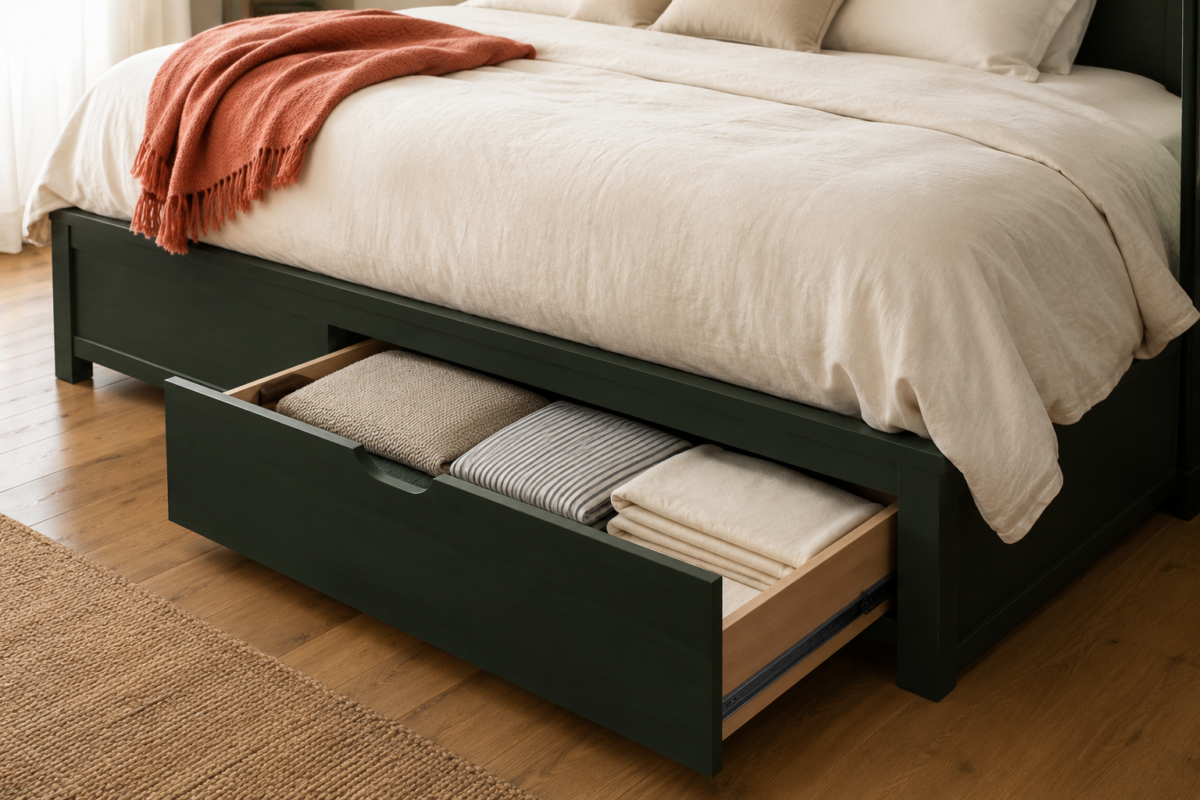
- Drawer-base frames slide out from the side, usually two to four drawers total. Best if your room has clear floor access on at least one long side of the bed, since the drawers need room to open.
- Lift-top (ottoman-style) frames hinge the entire mattress platform upward, revealing one large open cavity underneath. Best for bulkier items like spare bedding or luggage, but you’ll need to clear the bed entirely to access it, which makes it a poor fit for anything you need daily.
Benches and Ottomans at the Foot of the Bed
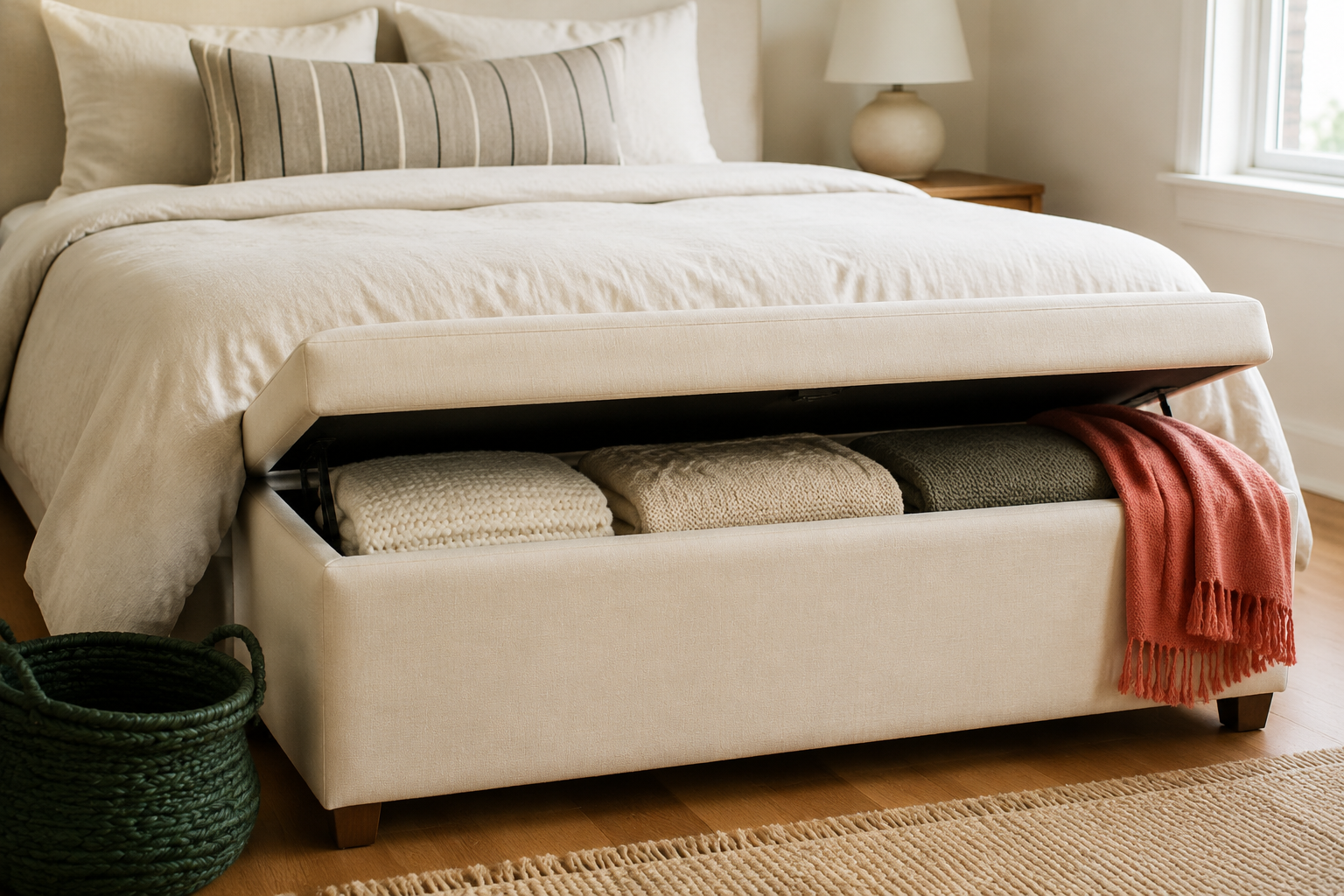
A storage bench or ottoman at the foot of the bed only makes sense if the clear walkway there is at least 24 inches, otherwise it turns a functional path into a squeeze point every time you pass through. Measure that gap before shopping for size, not after.
This is the piece people buy for the look first and the storage second, which is exactly backward for a small room. A bench that crowds the walkway costs you more in daily friction than it gives back in capacity. If your foot-of-bed space is tight, a slimmer option, a narrow bench under 16 inches deep, or simply skipping this zone and relying on under-bed storage instead, usually serves the room better than forcing a piece that doesn’t fit.
If the walkway supports it, here’s what actually earns the spot:
- A hinged bench with a flat, load-bearing lid, so it doubles as seating while you put on shoes, rather than a storage box that happens to have a cushion on top.
- An ottoman with a removable, not just hinged, top, since full removal gives easier access to bulkier items like extra pillows or a rolled blanket that a narrow hinge opening can’t easily fit through.
- A style that matches your existing furniture depth, so it doesn’t visually compete with the bed frame or nightstand and make the whole footprint feel bulkier than it is.
Storage Nightstands and Dressers That Double Up
A nightstand with at least one drawer plus open shelving underneath holds noticeably more than a single-surface side table, and it does it without adding any extra footprint to the room. This is the smallest, easiest upgrade on this list, since most nightstand-sized furniture already sits in a spot that has no alternative use.
The mistake here is buying a nightstand purely on style and ending up with a single open shelf that holds a lamp and nothing else. Look for at least one closed drawer, since an open shelf alone invites visible clutter, which works against the calm, organized feel a small bedroom needs. A slim two-drawer version, roughly 16 to 18 inches wide, fits most rental bedrooms without eating into the walkway beside the bed.
What to Skip: Furniture That Looks Like Storage But Isn’t
Skip any piece marketed as “storage furniture” that doesn’t list interior dimensions, since that’s usually a sign the actual capacity is minimal and the listing is relying on the word “storage” to do the selling. A genuine storage piece will tell you exactly how much it holds, in inches or cubic feet, instead of leaving you to guess from a product photo.
Decorative trunks with a false bottom, benches with a cushion that doesn’t lift at all, and shelving units with gaps too narrow for anything but a few small objects all fall into this category. They photograph well and solve almost nothing. If a listing doesn’t specify interior depth or width, assume it’s decorative until proven otherwise, and check the reviews for anyone who’s actually tried to store something real inside it.
Frequently Asked Questions
Is a storage bed worth buying just for the storage? Only if you’re already replacing your bed frame for another reason. If your current frame is fine, a set of quality under-bed bins solves the same problem for a fraction of the cost, without needing a new frame at all.
How much walkway space do I need for a storage bench at the foot of the bed? At least 24 inches of clear floor space. Anything tighter turns a normal walking path into a squeeze point every time you pass through, which makes the room feel more cramped than the bench’s storage is worth.
What’s the difference between a drawer-base and a lift-top storage bed? A drawer-base frame has side-access drawers, good for items you reach often, but it needs clear floor access on at least one long side. A lift-top frame hinges the whole mattress platform up, giving more total capacity but requiring you to clear the bed to access it.
Do storage nightstands actually hold much more than a regular one? Yes, if it has at least one closed drawer in addition to any open shelving. A single open shelf alone barely adds capacity over a plain side table, since it invites visible clutter rather than genuine storage.
Related Reading
If you’re deciding whether to buy furniture at all before checking what your closet and under-bed space can already handle, The Small Bedroom Storage Guide (In the Right Order) explains why furniture should be the last purchase, not the first.
If under-bed bins turn out to be the better fit than a storage bed frame, Under-Bed Storage Ideas That Actually Hold Things covers bin weight ratings and clearance sizing in detail.
And if a nightstand or bench doesn’t have room for everything, Vertical Storage Solutions for Every Wall covers the wall-mounted options that add capacity without taking any more floor space.
For the rest of the storage library organized by zone, the Bedroom Storage category has every guide in this series, and the Small Bedrooms hub covers the full room beyond storage alone.