Table of Contents
Standing in the middle of an apartment where every surface has something on it, every drawer is a little too full, and every closet door barely closes, the hardest part usually isn’t the decluttering itself. It’s figuring out where to even begin when the whole space feels equally overwhelming, and every room seems to need attention at the same time.
That feeling is common, and it’s also the exact reason most decluttering attempts stall before they really start. Facing an entire apartment as one giant, undifferentiated task is genuinely paralyzing, there’s no clear entry point, no obvious first step, and no sense of where the edges of the project even are. The fix isn’t more motivation or a bigger block of free time. It’s a specific starting order that turns one overwhelming task into a sequence of small, well-defined ones.
Why Room Order Matters More Than Motivation
Most decluttering advice focuses on willpower or big-picture philosophy, but the actual difference between someone who finishes a decluttering project and someone who abandons it after one exhausting afternoon usually comes down to something much simpler: which task they attempted first.
Starting with the hardest, most cluttered room sets up a project for failure before it’s even begun, since it demands the most decision-making energy at the exact moment when confidence and momentum are at their lowest. Starting with a small, contained, low-stakes space does the opposite: it produces a quick, visible win that makes the next task feel more approachable, and the one after that even more so.
This isn’t about avoiding hard rooms forever. It’s about sequencing them correctly, so that by the time you reach the genuinely difficult spaces, you’ve built up real practice at making decluttering decisions quickly and confidently.
Step One: The Single Junk Drawer or Cabinet
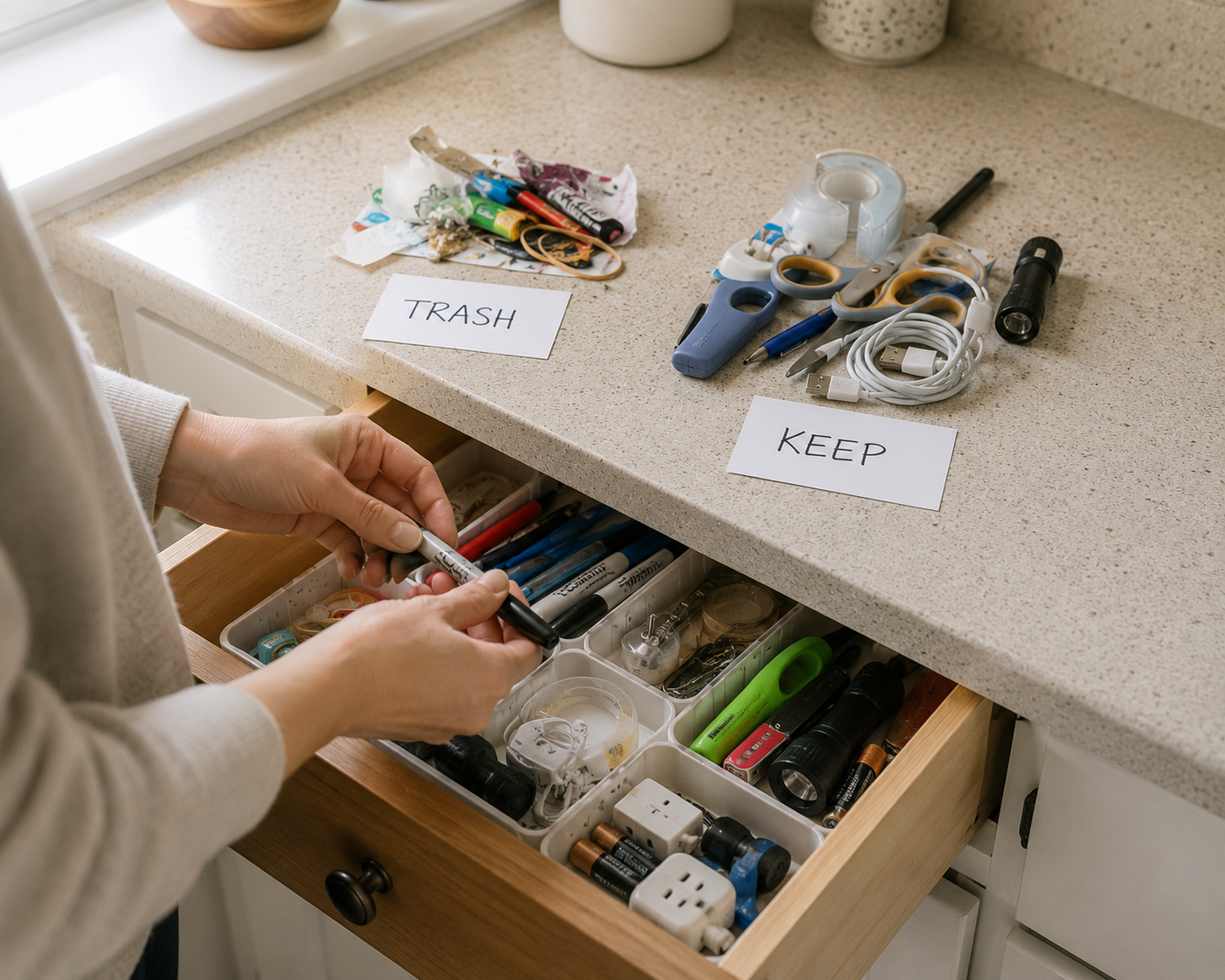
Every apartment has at least one drawer or cabinet that’s become a catch-all for things without an obvious home, and this is consistently the best possible starting point for an entire decluttering project.
Why this specific space works so well as a starting point. A single drawer has a hard physical boundary, you can see the entire task at once, and it typically takes under fifteen minutes to fully sort. There’s no ambiguity about when it’s “done,” which matters enormously when the goal is building confidence rather than accomplishing everything at once.
What to expect inside. Expired coupons, dead batteries, pens that no longer write, rubber bands, and random small items that migrated here because there was nowhere else obvious to put them. Almost everything in a typical junk drawer falls into an easy, low-stakes category: plainly trash, plainly belongs somewhere else, or genuinely useful and worth keeping right where it is.
The win this produces. Completing this single task, start to finish, in under fifteen minutes creates a real, tangible sense of progress. That feeling is what carries momentum into the next task, which is exactly why this is the recommended starting point rather than anywhere else in the apartment.
Step Two: Bathroom Cabinets and Drawers
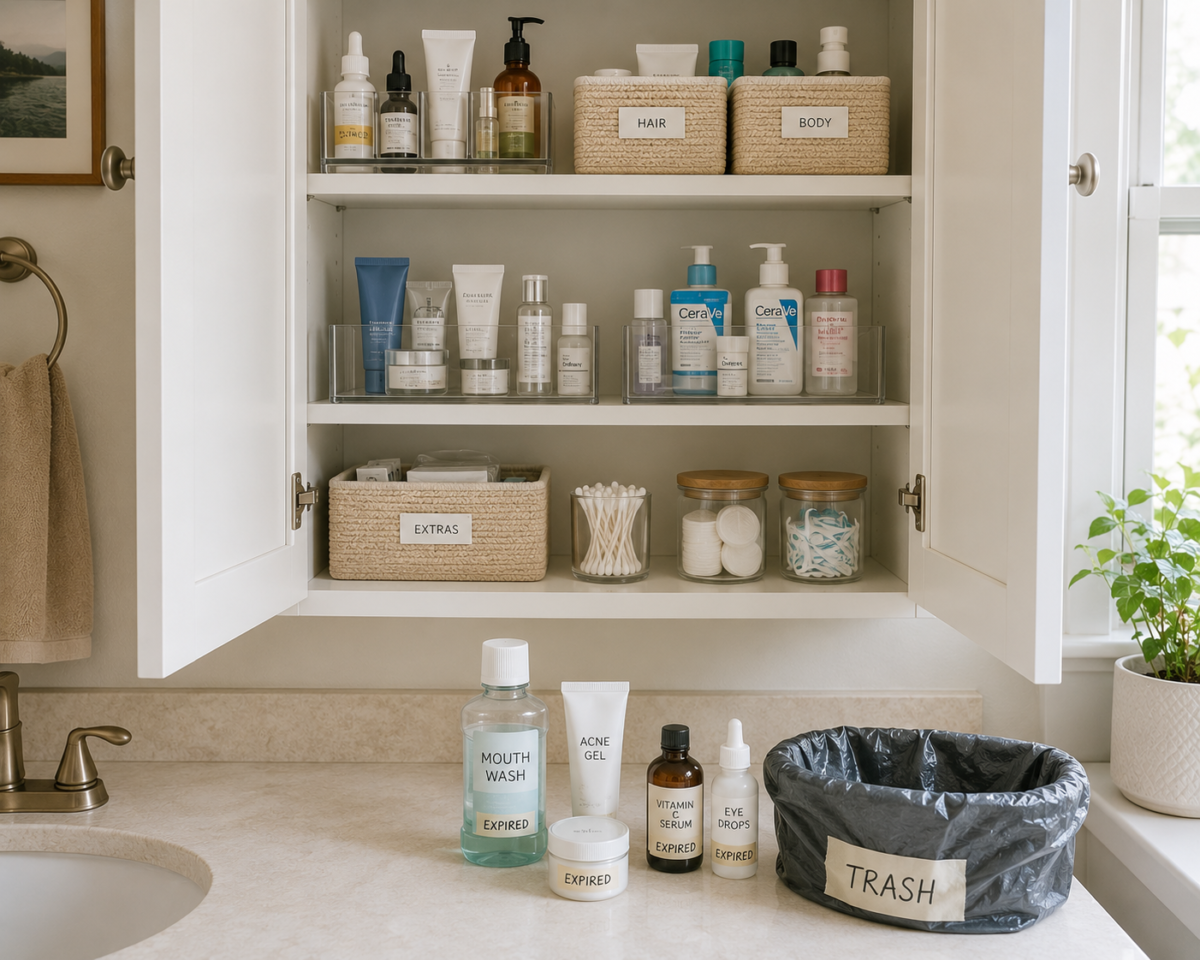
Bathroom storage is the second recommended stop, since it shares the same low-emotional-stakes quality as the junk drawer while adding a genuinely useful layer, expired product checks, that most people haven’t done in a while.
Check expiration dates specifically. Many skincare and cosmetic products have a genuine shelf life, and products past that window aren’t just clutter, they can actually cause skin irritation if used. This gives an extra, practical reason to clear these out beyond simply making space.
Address duplicates honestly. Multiple half-used bottles of the same product, backup items bought before realizing one was already open, and samples that were never actually tried are all easy candidates for this pass. Consolidate what’s genuinely still useful and let go of the rest.
This space tends to move fast. Most bathroom cabinets can be fully sorted in fifteen to twenty minutes, keeping the momentum from the junk drawer step going without introducing a task that demands significantly more time or emotional energy.
Step Three: Kitchen Cabinets and Pantry Items
The kitchen is a larger project than the first two steps, but it’s still a relatively low-emotional-stakes space, most kitchen clutter is practical rather than sentimental, which keeps the decision-making fast even as the physical volume increases.
Start with expired pantry items and forgotten leftovers of non-perishable stock. Anything past its expiration date is an easy, immediate decision, and clearing this category first often creates visible extra space before any harder decisions even come up.
Address duplicate cookware and gadgets. Most kitchens accumulate more mixing bowls, spatulas, and single-use gadgets than actually get used regularly. Keep what genuinely gets reached for, and let go of the rest, particularly single-purpose gadgets that seemed useful at purchase but rarely make it out of a drawer.
Tackle one cabinet or shelf at a time, not the whole kitchen at once. Even though the kitchen as a whole is a bigger project than the first two steps, breaking it into the same small, contained chunks, one cabinet, one shelf, one drawer, keeps each individual session feeling manageable rather than facing the entire kitchen as one task.
Step Four: Clothing You Already Know You Don’t Wear
Clothing sits in a slightly higher emotional-stakes category than kitchen or bathroom items, but it’s still generally more approachable than deeply sentimental items, which makes it a reasonable next step once some momentum has built.
Start with the easiest subset first: items that don’t fit, are damaged, or haven’t been worn in over a year. These are genuinely low-ambiguity decisions for most people, even if the broader closet still feels like a lot to face all at once.
Separate “aspirational” clothing from what actually gets worn. Items bought for a specific goal or occasion that never quite panned out, a size you’re hoping to fit into again, an outfit for an event that never happened, tend to occupy real closet space while providing very little actual daily value. This is worth acknowledging honestly rather than avoiding.
Leave genuinely difficult sentimental clothing for later. A piece connected to a specific memory or person doesn’t belong in this pass, set it aside in its own small pile rather than forcing a decision now, and revisit it during a dedicated sentimental items session instead.
Step Five: Shared or Common Areas
Living rooms and shared spaces come next, since clutter here often involves a mix of decor, media, and miscellaneous items with generally low emotional weight, but slightly more decision complexity than a single drawer or cabinet.
Address duplicate or unused decor first. Items bought for a specific styling moment that never quite landed, or decor that’s simply been forgotten in a corner, are usually easy to part with once actually noticed again.
Sort media and books honestly. Books you’ve already read and won’t reread, movies or media you no longer engage with, and anything genuinely obsolete (media formats you no longer have a way to play, for instance) are straightforward categories to clear.
Save furniture decisions for a separate, more deliberate pass. Deciding whether a piece of furniture stays or goes is a bigger commitment than the item-level sorting covered elsewhere in this guide, and it deserves its own focused consideration rather than getting rushed through as part of a general declutter.
Step Six: Storage Areas and Closets Beyond Clothing
Dedicated storage spaces, closets used for general storage rather than clothing, under-bed areas, or a storage unit if the apartment has access to one, tend to hold a mix of everything: some easy decisions, some genuinely difficult ones, all mixed together without an obvious sorting order.
Pull everything out before sorting, if space allows. Seeing the full contents of a storage area at once, rather than sorting item by item while still inside a dark closet, makes duplicate items and forgotten purchases much more obvious.
Separate into the same simple three categories used throughout: keep, donate or sell, discard. By this stage in the sequence, this sorting process should feel considerably faster and more confident than it would have felt as a starting point.
Flag anything sentimental for a separate session rather than deciding in the moment. Storage areas are exactly where sentimental items tend to accumulate, boxes from a move, items inherited from family, keepsakes without an obvious display spot, and forcing a decision on these during a general storage declutter often stalls the whole session.
Step Seven: The Room That Feels the Hardest
By the time this step arrives, whichever room or space felt the most overwhelming at the start of the process, often a closet holding both clothing and sentimental items, or a catch-all room without one clear function, is being approached with real decision-making practice already built up from every prior step.
This room deserves more time, not less. Rather than trying to complete it in one session the way earlier, smaller spaces were handled, plan for multiple shorter sessions here specifically, using the same twenty-minute structure that keeps any individual session from becoming exhausting.
Sentimental items get their own dedicated approach, not the general rules used elsewhere. If this room includes items connected to memories or people that matter, a different, more deliberate decision framework applies here than the fast sorting used for kitchen gadgets or expired products.
What Progress Actually Looks Like Along the Way
It’s worth setting realistic expectations for how this sequence actually feels while it’s happening, since progress in a small apartment isn’t always as visually dramatic as decluttering content sometimes suggests.
Early steps produce fast, visible results. A junk drawer or bathroom cabinet, once sorted, looks noticeably different immediately, which is part of why these are the right starting points. That visible change matters more for motivation than the raw number of items removed.
Middle steps feel less dramatic but matter just as much. Kitchen cabinets and clothing sorting produce real progress, but the before-and-after difference is often less immediately visible than the first two steps, since these spaces were already at least partly organized to begin with. Trust the process even when the visual payoff is smaller.
The hardest room won’t feel “done” the way earlier steps did. A closet or catch-all space handled over several shorter sessions, rather than one sweeping pass, might not have the same satisfying before-and-after moment as a junk drawer. That’s a normal, expected part of tackling a genuinely harder space, not a sign the approach isn’t working.
Setbacks and re-cluttering are part of the normal process, not a failure. A drawer that gets a little messy again a few weeks later, or a closet that needs a second pass once new decisions feel possible, doesn’t undo the progress already made. Decluttering a lived-in space is an ongoing relationship with your own belongings, not a single, permanent finish line.
Adapting the Order for Your Specific Apartment
This sequence is a strong general default, but every apartment’s actual clutter distribution is a little different, and it’s worth adjusting the order slightly based on where the real friction points are in your specific space.
If one room is dramatically more cluttered than the rest, it’s still worth working through the earlier, easier steps first, even if they’re less urgent, since the momentum they build genuinely helps once you reach the harder room. Skipping straight to the hardest space because it feels most urgent tends to backfire for exactly the reasons covered above.
If your apartment doesn’t have a clear junk drawer, look for the functional equivalent: a catch-all basket, a nightstand drawer, a bag by the door that’s become a dumping ground for whatever doesn’t have another home. The same low-stakes, quick-completion logic applies regardless of the specific container.
If you live with others, coordinate on shared spaces before starting, since a shared living room or kitchen benefits from at least a brief conversation about what’s being kept and what’s leaving, even if the actual sorting work happens solo.
If a step in this order genuinely doesn’t apply to your apartment (no separate pantry, no dedicated storage closet), skip it without guilt and move to the next relevant step. The underlying principle, easy and low-stakes before hard and high-stakes, matters more than following every single step exactly as listed here.
Frequently Asked Questions
What’s the best room to declutter first in an apartment? A single junk drawer or catch-all cabinet, rather than an entire room. Its small size and low emotional stakes make it possible to fully complete in under fifteen minutes, which builds real momentum for the harder spaces ahead.
Why does starting with the messiest room usually not work? The messiest room typically demands the most decision-making energy and often carries the highest emotional stakes, which is a difficult combination to face without any prior momentum. Starting small and building confidence through easier spaces first makes the harder rooms feel more approachable when their turn comes.
How do I know if something in my closet is worth keeping? Start with the easiest, lowest-ambiguity decisions first: items that don’t fit, are damaged, or haven’t been worn in over a year. Set aside anything genuinely sentimental for a separate, more deliberate session rather than deciding in the moment.
How long does it take to declutter an entire small apartment using this order? It varies by how much has accumulated, but working through this sequence in short, manageable sessions typically takes two to four weeks for a genuinely cluttered small apartment, without requiring any single overwhelming block of time.
What should I do with items I’m not sure about? Set them aside in their own small, separate pile rather than forcing an immediate decision. Revisiting uncertain items after the easier categories are sorted, when there’s more decision-making confidence built up, often makes the choice clearer than it felt in the moment.
Related Reading
- The Complete Small-Space Decluttering Guide — the full system this room-by-room order fits into, covering short-session methods and sentimental items too.
- The 20-Minute Declutter Method for Busy Weeks — the time-bound session structure that keeps each step in this order manageable.
- How to Declutter Sentimental Items Without the Guilt — the dedicated framework for the items this room-by-room order deliberately sets aside.
- Closet Organization — what comes next once a closet or storage space has been decluttered and it’s time to organize what remains.
- Parent Category: Decluttering
- Parent Hub: Organization & Storage