Table of Contents
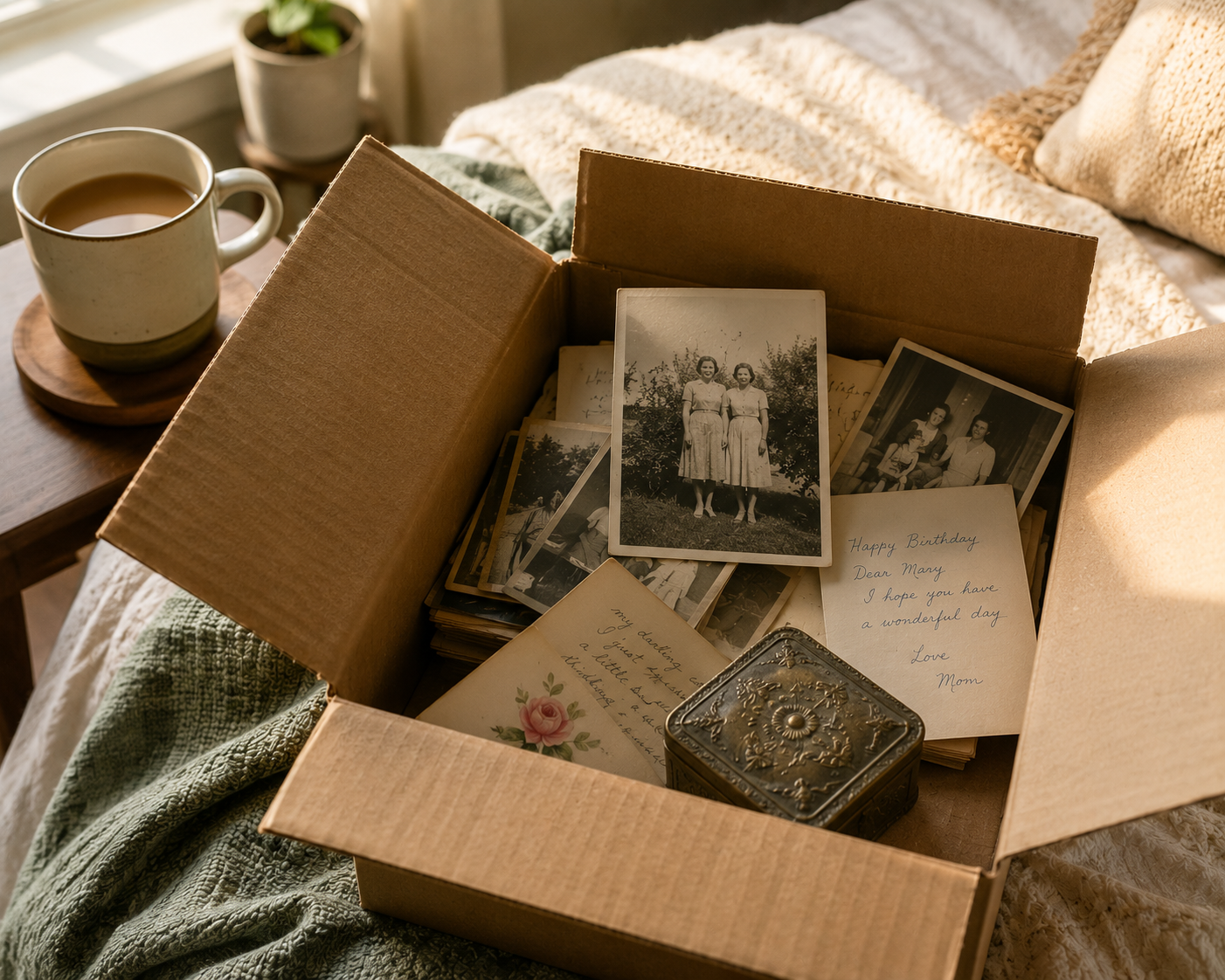
Every decluttering project eventually runs into the same box. It’s usually tucked in the back of a closet or the bottom of a storage bin, and it’s rarely the biggest box in the apartment, but it’s consistently the one that stops the whole process cold. Old photographs, cards from people who mattered, a child’s drawing, a piece of clothing tied to a specific memory, none of it responds to the fast, confident decision-making that works for expired products or clothes that don’t fit anymore.
That’s not a flaw in your decluttering approach. Sentimental items are genuinely different from ordinary clutter, and treating them with the same speed and detachment used for a kitchen drawer usually backfires, either through rushed decisions that feel wrong later, or through total avoidance that leaves the box exactly where it’s always been. What actually helps is a different framework entirely, one built around what these items represent rather than whether they’re technically still useful.
Why Sentimental Items Need a Different Approach
Ordinary clutter gets evaluated on function: does this work, do I use it, does it fit. Sentimental items don’t have a functional answer to fall back on, an old ticket stub or a handwritten note was never about function in the first place, so asking “do I need this” simply doesn’t produce a useful answer.
The real question with sentimental items is about meaning, not use. What does this item represent, and is keeping the physical object the only way, or even the best way, to hold onto that meaning? This shift, from a usefulness question to a meaning question, is the foundation of every approach in this guide.
Guilt often has more to do with obligation than actual attachment. A gift from someone you love, kept out of a sense that getting rid of it would somehow dishonor the relationship, is a genuinely common source of decluttering guilt, and it’s worth separating that obligation from your actual feelings about the specific object.
There’s no universal right answer for how much to keep. Some people feel most connected to a memory through a physical object; others feel just as connected through a photo or a story they tell. Neither approach is more correct, and comparing your own instincts to someone else’s minimalist (or maximalist) approach to sentimental items rarely helps.
A Framework for Individual Decisions
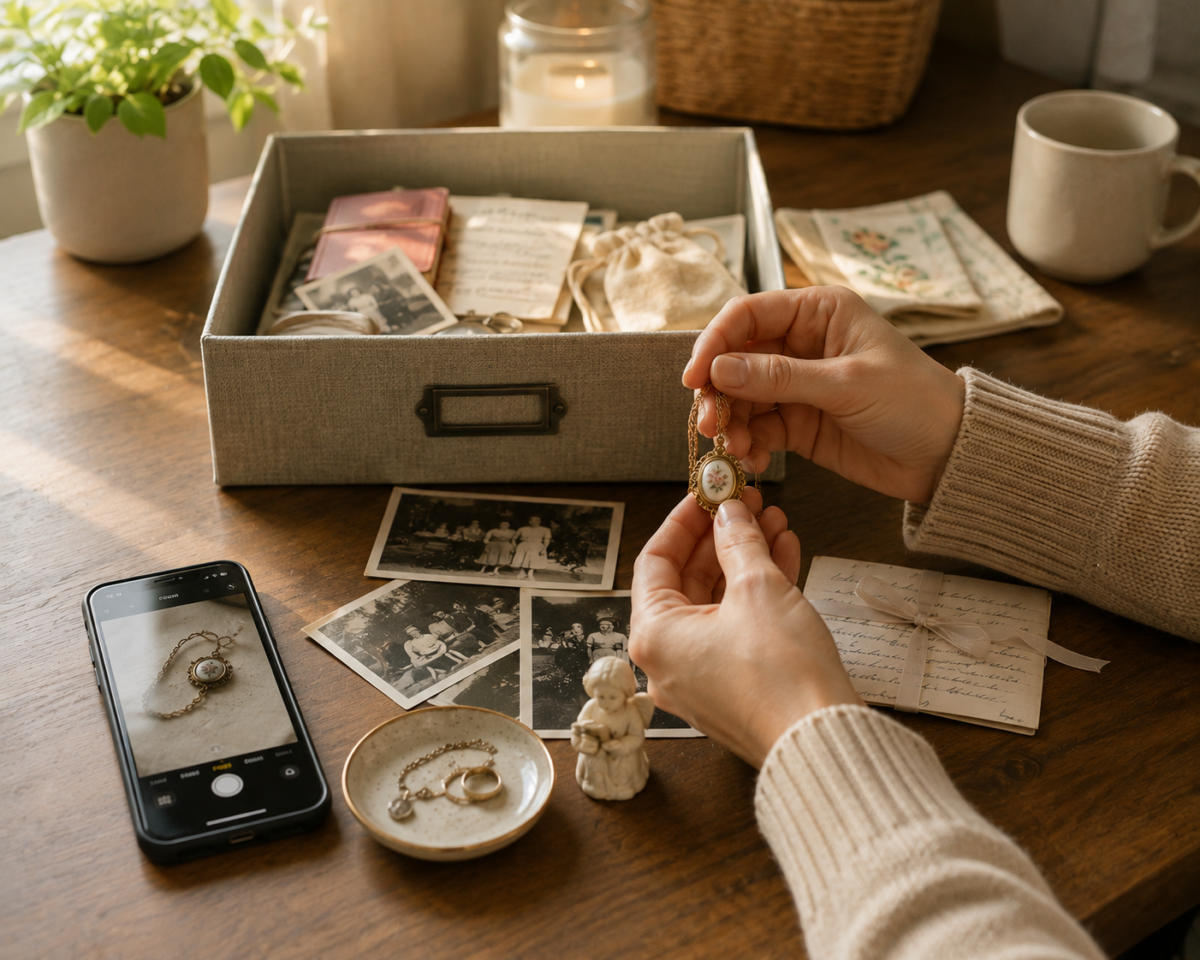
Rather than a fast yes-or-no decision, sentimental items respond better to a short sequence of questions that clarify what’s actually being weighed.
Does this represent a specific memory, or a category of memories? A single specific item, one particular card from one particular moment, often carries more meaning than an entire box of similar cards accumulated over years. If several items represent essentially the same memory or relationship, keeping one or two meaningful examples rather than the entire collection can preserve the feeling without the full physical volume.
Am I keeping this because of genuine attachment, or because getting rid of it feels like a statement about the relationship? These are different things, and it’s worth being honest about which one is actually driving the decision. An item can be let go of without it meaning anything negative about how much a person or memory mattered.
Would a photo preserve what actually matters about this item? For many keepsakes, a well-lit photograph captures the object’s appearance and the memory attached to it just as effectively as keeping the physical item indefinitely. This isn’t true for every item, some genuinely need to be held to mean anything, but it’s worth asking honestly rather than assuming the physical object is the only way to remember.
Is this item actively enjoyed, or is it stored away and rarely seen? An item kept in a box in a closet, never displayed or looked at, isn’t really being experienced as a memory in daily life, it’s being stored as an obligation. If a keepsake genuinely matters, consider whether it deserves a visible spot rather than permanent storage; if it doesn’t feel worth displaying, that itself is useful information about how much active meaning it still holds.
What would happen if this were lost or damaged tomorrow? This question sometimes reveals that an item matters far more, or far less, than assumed. A strong emotional reaction to the thought of losing something is real information about its importance; a shrug is also real information.
Categories Worth Approaching Differently
Not all sentimental items carry the same weight, and a few specific categories benefit from their own particular approach.
Photographs. Physical photos in overwhelming quantity are one of the most common sentimental clutter categories, and digitizing them, through a scanning app or a dedicated service, preserves the image while dramatically reducing the physical space needed. Consider keeping a small, curated selection of physical prints, the genuinely favorite images, displayed or in a small album, while digitizing the rest.
Children’s artwork and school items. The volume from even a single school year can be substantial, and keeping every piece isn’t necessary to honor a child’s effort or growth. Photographing each piece before letting it go, and keeping a small selection of genuine favorites in a dedicated box or album, preserves the record without needing to store everything physically indefinitely.
Clothing tied to a specific person or time. A parent’s old sweater, a wedding dress, a piece of clothing from a significant period, these often carry weight beyond their function as clothing. If the volume becomes difficult to manage, consider repurposing a small piece, a quilt square, a small memory pillow, from an item rather than keeping the full garment, which some people find preserves the connection in a form that’s easier to actually use and see regularly.
Cards and letters. Reading through a full collection before deciding, rather than sorting quickly, often reveals that some carry genuine significance while others were simply routine at the time. Keeping the ones that still feel meaningful on a second read, rather than the entire collection by default, is a reasonable middle ground.
Items from someone who has passed away. This category deserves particular patience, and there’s no timeline that’s inherently right for deciding what to do with these items. It’s genuinely fine for this specific category to sit untouched for as long as needed, revisited only when it feels approachable, without pressure to resolve it on the same schedule as the rest of a decluttering project.
When to Set an Item Aside Instead of Deciding
Not every sentimental item needs an immediate decision, and forcing one when the timing isn’t right often produces a choice you’ll regret rather than one that actually reflects how you feel.
A dedicated “not yet” box is a legitimate outcome, not a failure to decide. Setting an item aside for reconsideration in six months or a year, rather than forcing a keep-or-discard decision today, is a genuinely valid choice, provided the box has a real boundary (a specific size, a specific number of items) rather than becoming an unlimited catch-all that undoes the point of the entire exercise.
Revisit the “not yet” box on a set schedule, not indefinitely. Checking back in every six months to a year keeps this category from becoming a permanent holding pattern, and it’s common for a decision that felt impossible the first time to feel much more approachable on a second look, once some time and distance has passed.
If an item has been in the “not yet” box for multiple review cycles without any shift in feeling, that itself is useful information. It might mean the item genuinely deserves to stay, permanently, and that’s a completely fine outcome too, worth acknowledging rather than treating every sentimental item as something that eventually has to go.
Preserving Meaning Without Keeping Every Object
For many sentimental categories, there are ways to hold onto what actually matters, the memory, the connection, the story, without keeping every physical item indefinitely.
Photograph items before letting them go. A clear, well-lit photo, sometimes several angles for something with more detail, preserves the visual memory of an item in a fraction of the physical space, and a phone camera is genuinely good enough for this purpose in most cases.
Write down the story attached to an item, not just the image. A photo shows what something looked like; a short written note about why it mattered, who gave it, what it represented, preserves the actual meaning in a way the object alone might not fully carry once enough time has passed.
Choose a small number of items to physically display rather than store. A curated handful of genuinely meaningful keepsakes, visible and part of daily life, often provides more actual connection to the memories they represent than a much larger collection boxed away and rarely seen.
Consider whether the memory can be honored in a different form. Turning a collection of concert ticket stubs into a small shadow box, or a stack of children’s drawings into a bound photo book, can transform a large, unwieldy physical collection into something smaller, more display-worthy, and arguably more meaningfully engaged with than a box in a closet ever was.
Giving Yourself Permission to Move at Your Own Pace
There’s no deadline that makes sense for this category. Unlike expired pantry items or clothes that no longer fit, sentimental items don’t create the same daily friction, so there’s no real cost to taking genuinely as long as needed, provided the process is actually moving rather than being avoided entirely out of discomfort with starting at all.
A single sentimental item decided in a full, unhurried session is real progress, even if the whole box isn’t finished in one sitting. Comparing this category to the fast pace of a twenty-minute kitchen drawer session sets an unfair standard that doesn’t reflect what this kind of decision actually requires.
It’s okay if this category never gets fully “finished.” Some sentimental items may genuinely stay in your life indefinitely, and that’s a legitimate outcome of this process, not an incomplete one. The goal isn’t to eliminate every sentimental item, it’s to make sure what you’re keeping is being kept intentionally, rather than simply because it was never actively decided about at all.
Setting Up a Space That Makes These Decisions Easier
The physical setting for a sentimental decluttering session matters more than it does for a quick kitchen drawer pass, since the pace and emotional weight are genuinely different.
Choose a time when you’re not rushed and not emotionally depleted. A session squeezed into ten minutes before leaving for work, or attempted at the end of an exhausting day, tends to produce either rushed decisions or complete avoidance. A quiet evening or an unhurried weekend morning, with no hard stop in sight, tends to work far better for this specific category.
Have supplies ready before starting: a phone for photos, a notebook for writing down stories, and well-labeled containers for keep, “not yet,” and let go. Having these ready in advance means the session can focus entirely on the actual decisions rather than pausing to gather materials partway through.
Consider doing this with someone else if the items involve a shared memory. A sibling, a partner, a close friend who was present for the same memories can make certain decisions feel less solitary and can sometimes offer a perspective on an item’s significance that clarifies a decision you’ve been stuck on alone.
It’s fine to stop mid-session if it starts to feel like too much. Unlike a twenty-minute kitchen task where stopping partway just means an unfinished drawer, stopping a sentimental session because it’s become genuinely overwhelming is a reasonable, healthy choice, not a failure to push through. The box will still be there next time, and there’s no penalty for needing more than one attempt.
After the Decision: Handling What You’re Letting Go Of
Once a decision has been made to let a sentimental item go, how it’s handled next can matter almost as much as the decision itself, particularly for items connected to a specific person.
Consider whether someone else in your life might want the item. A family member, a close friend, or someone else who shared the memory might genuinely value an item you’ve decided not to keep, and offering it before donating or discarding can turn a difficult decision into something that feels more like passing a memory forward than losing it entirely.
Donation is often more fitting than discarding, even for personal items. Clothing, books, and household items with sentimental value but no specific person to pass them to can often go to a donation center, giving the item a continued useful life rather than simply ending up in the trash.
Some items genuinely belong in the trash, and that’s fine too. Not every sentimental item needs to be preserved, passed on, or given a second life elsewhere. An item that’s served its purpose, been fully appreciated, and photographed if that mattered, can be let go of completely without needing to find it a further destination.
Give yourself space after a hard decision rather than immediately moving to the next item. Unlike the fast pace of an ordinary decluttering session, a genuinely difficult sentimental decision sometimes benefits from a pause, a cup of tea, a short break, before continuing to the next item, rather than pushing straight through a full box in one sitting.
Frequently Asked Questions
How do I declutter sentimental items without feeling guilty? Focus on what an item represents rather than whether you technically still need it, and separate genuine attachment from a sense of obligation. Photographing an item, or writing down the story behind it, can preserve the meaning even if the physical object doesn’t stay.
Should I keep every card and letter someone has given me? Not necessarily. Reading through a full collection and keeping the ones that still feel genuinely meaningful on a second read, rather than the entire collection by default, is a reasonable approach that honors what actually matters most.
What should I do with a deceased loved one’s belongings? Give this category as much time as it genuinely needs, without pressure to resolve it on the same timeline as the rest of a decluttering project. It’s completely normal for these decisions to take significantly longer than other categories.
Is it okay to take a photo of something instead of keeping it? Yes, for many items a clear photograph preserves the visual memory effectively, especially when paired with a written note about the story or significance behind the object. This isn’t the right approach for every item, but it’s a genuinely valid option worth considering.
What if I still can’t decide about a sentimental item? Set it aside in a dedicated “not yet” box with a real boundary, and revisit it on a set schedule, every six months to a year, rather than forcing an immediate decision. A choice that feels impossible now often feels more approachable with some distance.
Related Reading
- The Complete Small-Space Decluttering Guide — the full system this sentimental items framework fits into, alongside room order and short-session methods.
- Where to Start Decluttering When Everything Feels Like Clutter — why this category is deliberately saved for later in the overall decluttering sequence.
- The 20-Minute Declutter Method for Busy Weeks — the faster-paced method for everything else, once sentimental items have their own dedicated time.
- Closet Organization — where to organize what remains once sentimental clothing decisions have been made.
- Parent Category: Decluttering
- Parent Hub: Organization & Storage