Table of Contents
It’s 9:40 at night. You’re in bed, half-watching something, when your phone buzzes with a work email. You open it. You reply. Ten minutes later you’re still thinking about it, staring at the same ceiling that was six feet from your desk twelve hours earlier. Nothing about your day ever really ended.
That’s the direct problem with working from a small space: without a commute, a separate room, or a door that closes, your brain doesn’t get the usual signals that mark the difference between “on” and “off.” The fix isn’t a bigger apartment. It’s a short, repeatable set of physical actions at the start and end of your day that do the job your commute used to do. This guide covers both halves, in order, and what to do when your schedule or your living situation makes a fixed routine harder.
Why does work keep bleeding into the rest of your day?
Work bleeds into evenings in a small space because there’s no physical separation left to do the job a commute or a closed office door used to do automatically. Researchers who study what’s called psychological detachment, the ability to mentally switch off from work during non-work hours, have linked it to better mood, more energy, better sleep, and fewer stress-related health complaints. People who struggle to detach tend to carry the day’s stress straight into the evening, whether or not they’re still technically working.
In a small apartment, your brain has almost no environmental cues left to signal that shift. The desk you worked at is the same table you’ll eat dinner at. The chair is the one you’ll relax in later. Without a routine standing in for those missing cues, the day just runs together.
What should a start-of-day routine actually include?
A short, consistent start-of-day routine gives your brain a clear signal that work is beginning, even when you’re not leaving the building to get there. Get dressed for the day rather than working in sleepwear, make whatever drink starts your morning, and physically walk to your desk zone as the last step, not the first thing you do after waking up.
A few specific moves make this stick:
- Change out of sleepwear, even if it’s just into different comfortable clothes. This single act does more to shift your brain into work mode than almost anything else on this list, since it mirrors the physical transition a commute used to provide.
- Make coffee or tea somewhere other than your desk, then carry it to the desk as the final step. That short walk becomes your substitute commute.
- Open your desk zone the way you left it closed the night before. If your setup includes a fold-down desk or a covered laptop, unfolding or uncovering it is a small, deliberate action that marks the actual start. <a href=”/work-from-home-small-space-guide”>If you haven’t set up a dedicated desk zone yet, this guide to working from home in a small space covers finding and furnishing that spot first.</a>
- Glance at your three most important tasks for the day before opening email. Starting with your inbox instead of your own priorities tends to hand the whole morning over to whatever landed in it overnight.
What should an end-of-day shutdown actually look like?
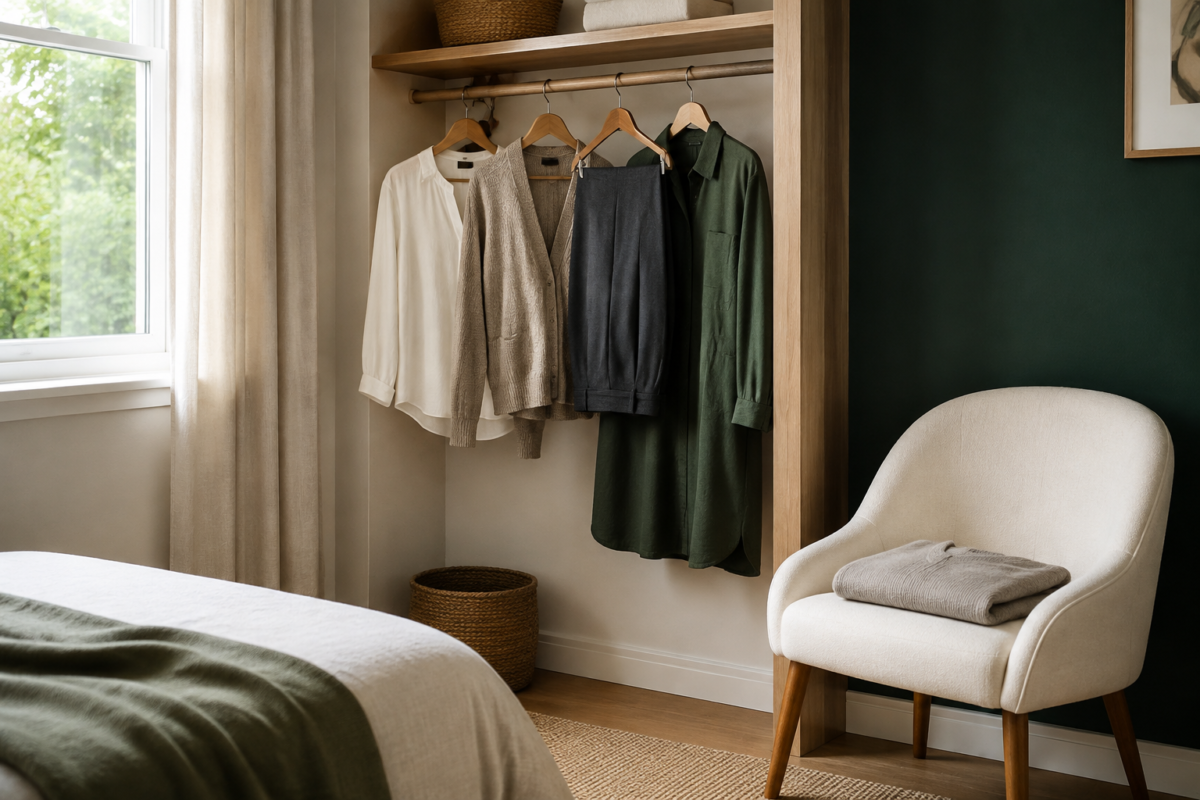
An end-of-day shutdown works the same way in reverse: close the laptop, physically close or cover the desk zone, and do one specific action that marks the day as finished before you re-enter the rest of your living space. Without this, the desk stays visually “open” all evening, which keeps pulling your attention back to it even when you’re not actively working.
Start with a two-minute task review. Jot down anything unfinished or anything you’re worried about forgetting, even on a sticky note. This isn’t for productivity. It’s so your brain has somewhere to put unfinished business other than the middle of your evening, since incomplete tasks tend to stay mentally “open” until they’re written down somewhere.
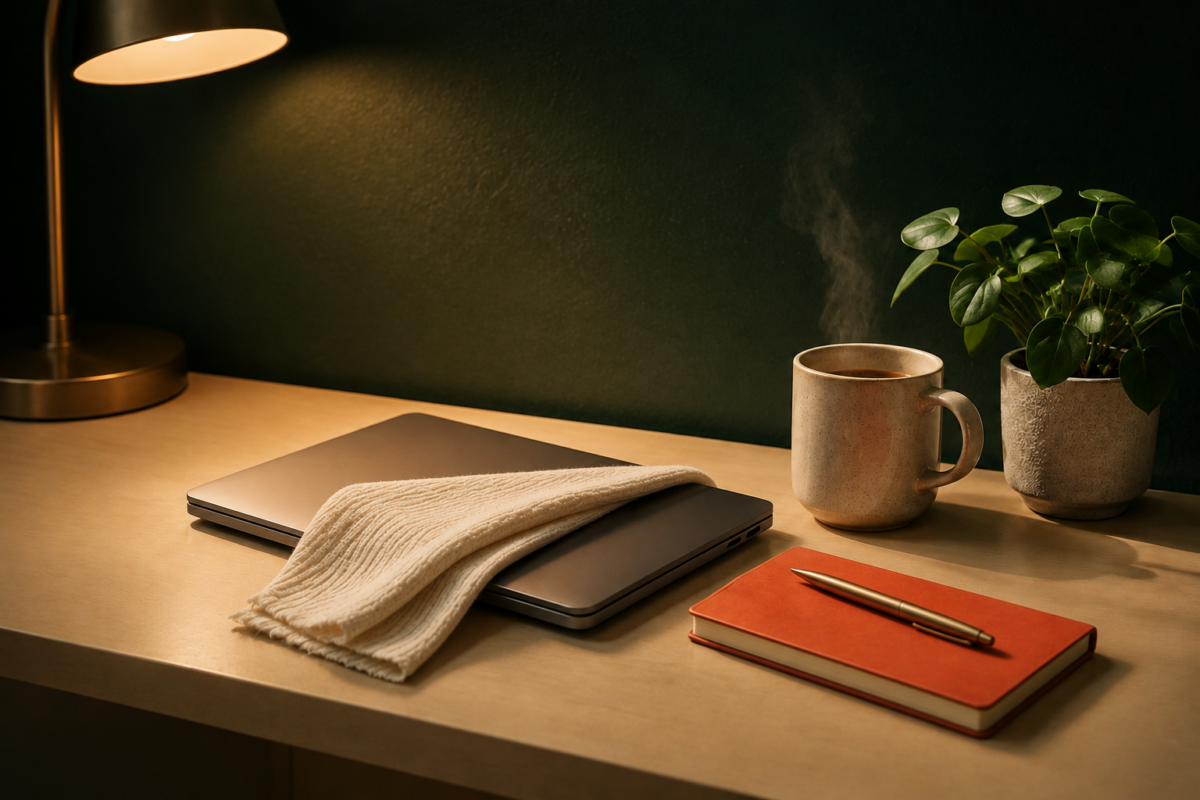
Then close the physical space. Fold the desk away, drape a cover over it, or simply close the laptop and place one object on top of it as a visual signal. <a href=”/reliable-small-home-office-tech-setup”>If your desk area doubles as your home’s tech hub, this guide to a reliable small home office setup covers keeping cables and equipment tidy enough that closing up actually takes seconds, not minutes.</a>
Finally, leave the zone and do something physical in a different part of your home for at least fifteen minutes before settling into your evening. A short walk, changing clothes, or starting dinner all work. The specific activity matters less than the fact that it happens somewhere other than your desk.
What if your schedule isn’t the same every day?
If your work hours shift or you don’t have a fixed schedule, anchor your routine to an action instead of a clock time, so it still works whether your day starts at seven or eleven. The clothes-change, the walk to the desk, the task review, and the physical shutdown all work regardless of what time they happen, because they’re triggered by the transition itself, not by the hour on the clock.
This matters especially for freelancers, shift workers, and anyone juggling more than one job from the same small space. The routine’s value comes from its consistency and order, not from happening at any particular hour.
How do you handle this if you share the space with someone else?
If you share your apartment with a partner, roommate, or family, agree on a simple signal, like a closed laptop, a specific lamp turned off, or a curtain drawn across the desk zone, that communicates “I’m off” without needing a conversation every time. In a small space, other people pick up on your work status from visual cues just as much as your own brain does, and a shared signal prevents the awkward “are you still working?” check-ins that interrupt an actual shutdown.
What this actually changes after a week or two
The first few days will feel a little forced, and that’s normal. By the second week, walking to the desk starts to feel like starting work, and closing it starts to feel like actually finishing, the same way a commute used to. The email that used to get answered from bed at 9:40 either waits until morning or doesn’t feel urgent enough to answer at all, because your evening finally has a real boundary around it.
FAQ
Do I really need a whole routine, or can I just try to work less? “Working less” is a goal, not a mechanism. A routine gives your brain the physical and visual cues it needs to actually stop, which is far more reliable than willpower alone once the workday and home life share the same six feet of space.
What if I don’t have a desk that folds away or closes up? Any consistent covering or closing action works, even draping a cloth over an open laptop or turning a chair to face away from the desk. The specific object matters less than doing the same visual “closed” signal every day.
How long should the shutdown routine actually take? Five to ten minutes is enough: a two-minute task review, a minute to close and cover the desk, and a short walk or activity elsewhere before settling in for the evening.
Is it bad to check email once in the evening if something’s urgent? Occasional, genuine urgency isn’t the problem. The pattern to watch for is checking out of habit or anxiety rather than necessity, which is exactly what a consistent shutdown routine is designed to reduce over time.
Related Reading
- The Complete Guide to Working From Home in a Small Space — the full setup this routine fits into, including desk zone selection and furniture that closes or folds away.
- The Tech Setup That Keeps a Small Home Office Reliable — for making sure your desk zone is tidy enough that the end-of-day shutdown takes seconds.
- Setting Up a Camera-Ready Background in Two Minutes or Less — a companion quick-routine for the start of your workday, before the first call.
- Parent Category: Maintenance Routines
- Parent Hub: Seasonal & Maintenance