Table of Contents
Open your top drawer right now. Can you see everything inside it without moving a single item out of the way? For most people, the honest answer is no, and that’s the whole problem with drawer organization in one question. A drawer that requires digging isn’t actually organized, no matter how neatly it looked the day it was set up. It’s just clutter with a lid on it.
The fix isn’t more bins or a bigger dresser. It’s a fold method that makes every item visible at once, a small number of dividers used only where they earn their spot, and one habit that keeps the whole thing from sliding back into a pile within a month. None of it requires new furniture, and most of it takes less time than the stacking method most people default to.
Why Most Drawer Systems Fail Within a Month
A drawer system built on flat stacking fails because every new item added to the top of a stack pushes everything below it further out of reach, so the drawer slowly turns into an archaeology project where only the top layer actually gets worn. This is the single biggest reason drawers “get messy again” even after a weekend of organizing.
Stacking looks tidy in the moment you fold and put things away. It stops looking tidy the first time you need the shirt three layers down and have to lift the two above it just to see what’s there. Do that often enough and the stack collapses into a pile, which is exactly the state the drawer was in before you organized it. The system wasn’t wrong on day one. It just wasn’t built to survive being used.
The three most common drawer mistakes, in order of how often they show up:
- Flat stacking instead of standing items upright. Anything folded flat and piled hides everything beneath the top layer.
- Mixing categories in one drawer with no boundary. Socks, undergarments, and small accessories tossed in loose drift into one tangled pile within days.
- Overfilling to the point that nothing lies flat. A drawer packed edge to edge forces every item out of shape and makes putting something back genuinely difficult.
The Fold That Makes Everything Visible
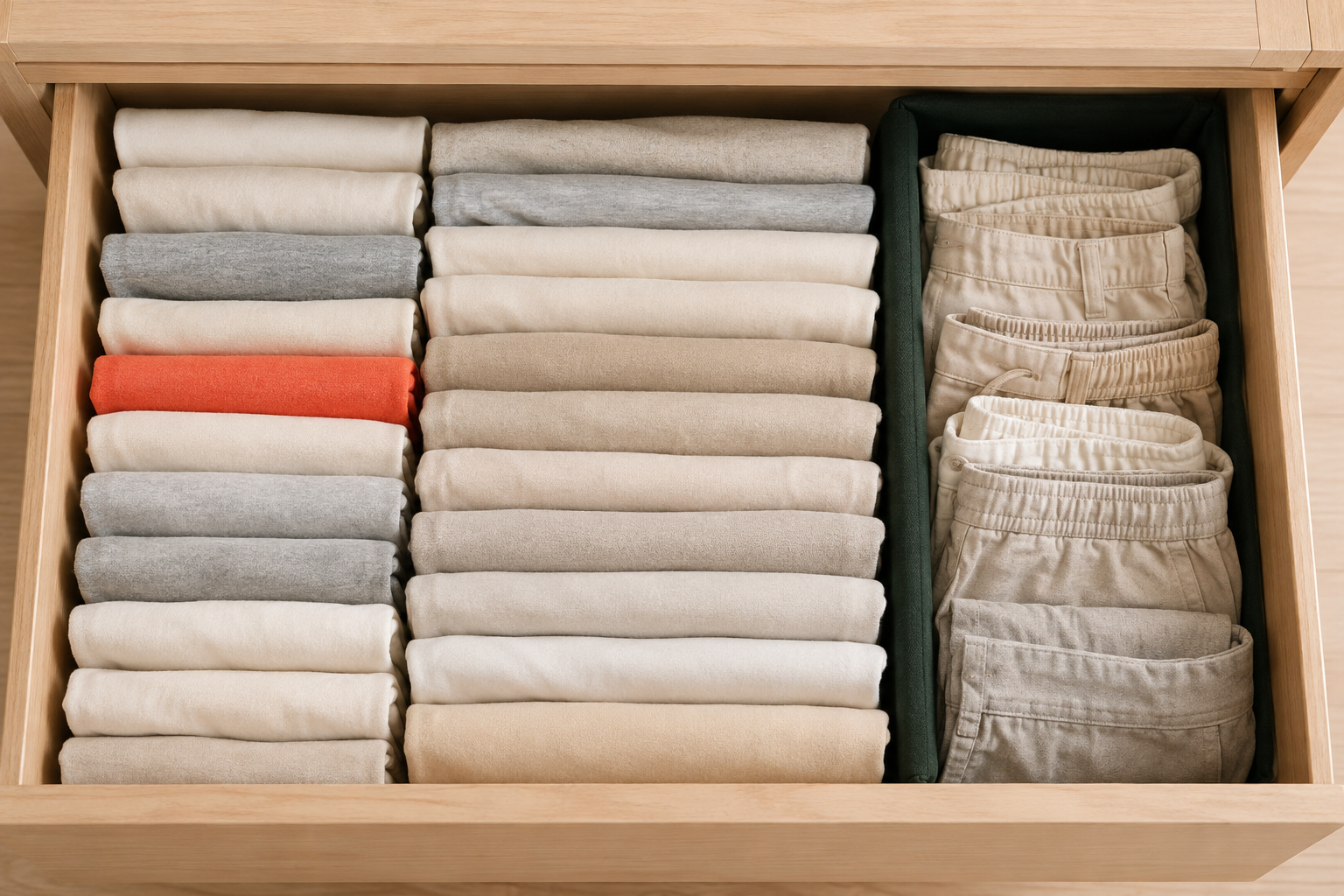
Fold each item into a rectangle roughly the height of the drawer, then stand it on its edge instead of laying it flat, so every piece is visible from above without moving anything else. The result looks close to files in a filing cabinet, and it turns “which shirt is at the bottom” into a question you never have to ask.
This one change does more for a drawer’s daily function than any organizer or bin. It works for t-shirts, folded pants, and lightweight sweaters equally well, since the method is about orientation, not the specific item. The only real skill involved is folding to a consistent height, roughly matching the drawer’s depth, so everything stands at a similar level and nothing tips over into its neighbor.
How the fold changes by item type:
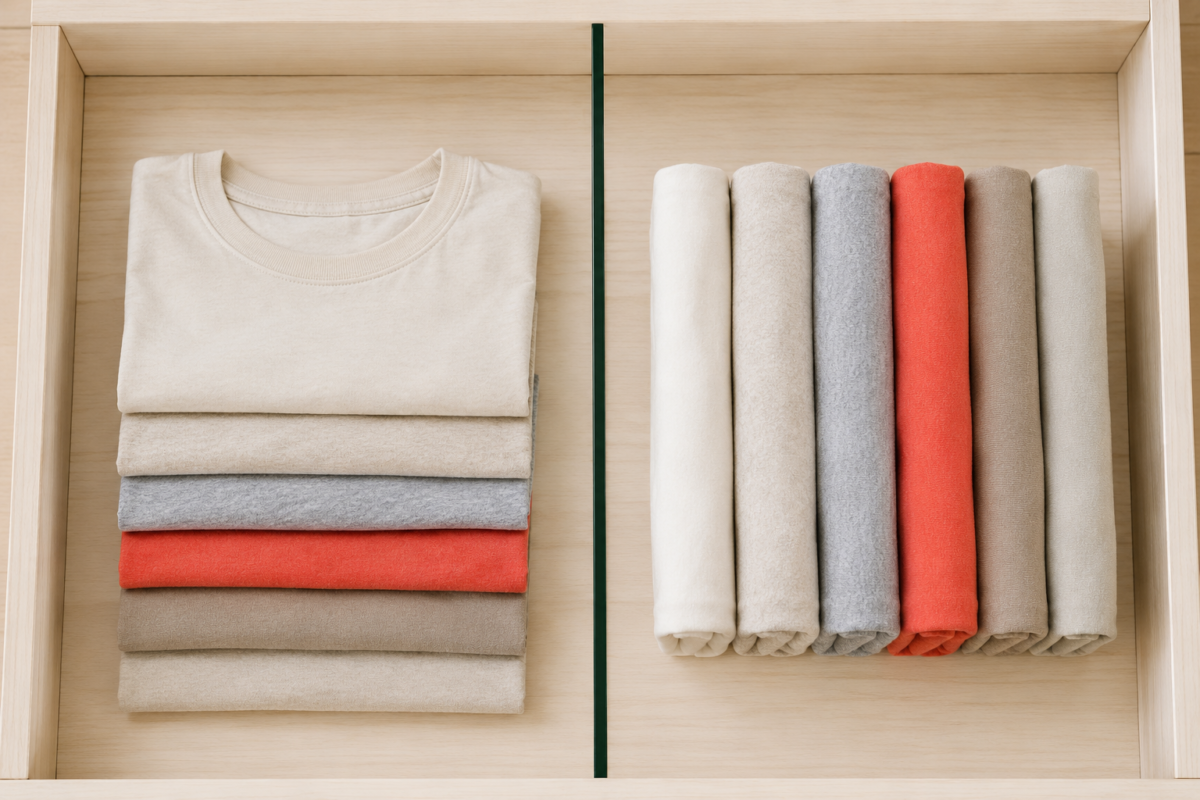
- T-shirts and light knits: fold into thirds lengthwise, then fold in half or thirds again to reach drawer height, and stand upright.
- Jeans and heavier pants: fold in half lengthwise, then roll or fold to height. Denim holds its shape well standing, which makes it one of the easiest categories to convert.
- Underwear and socks: these are usually too small to stand alone, so pair the vertical fold with a small drawer divider or tray to keep them from sliding flat again the moment the drawer opens.
Dividers: Where They Help and Where They’re Overkill
Use drawer dividers only for items too small or too soft to stand on their own, socks, underwear, jewelry, or small accessories, not for full categories of clothing that already hold their shape when folded upright. A divider grid across an entire t-shirt drawer usually just adds friction to a system that didn’t need it.
This is where a lot of drawer organizing spends money it doesn’t need to. T-shirts, folded pants, and sweaters stand on their own once folded to height, so a full grid of dividers under them does nothing but shrink the usable space. Dividers earn their spot specifically where items are too small or too loose to hold a standing fold, which is a much narrower category than most drawer organizer kits assume.
A simple rule for deciding where dividers belong:
- If it holds its shape standing upright on its own, skip the divider. Folded shirts, pants, and sweaters don’t need a boundary to stay organized.
- If it’s small, soft, or tangles easily, use one. Socks, underwear, and small accessories genuinely benefit from a physical section to keep them from sliding into a pile.
- If a drawer mixes both types, only divide the section that needs it, rather than gridding the whole drawer uniformly.
One Drawer, One Job
Assign each drawer a single category, and resist using any drawer as a catch-all for whatever doesn’t have an obvious home elsewhere. A drawer that holds pajamas, spare chargers, and a stack of old receipts stops functioning as any of those things, since nothing in it has a consistent, predictable spot.
This matters more than it sounds like it should. A single-purpose drawer is fast to put things away into, because there’s no decision to make, everything that belongs there goes there and nothing else does. A mixed drawer requires a small judgment call every time, which is exactly the kind of friction that leads to items getting set down “for now” instead of put away properly.
If you genuinely don’t have enough drawers for every category, it’s better to combine two closely related categories, like pajamas and loungewear, than to create one loose miscellaneous drawer. A miscellaneous drawer has no logic for what belongs in it, which means it never actually gets organized. It just gets reorganized.
The Habit That Keeps It From Sliding Back
Return each item to a standing position when you put it back, not laid flat “for now,” even when you’re in a hurry. The moment one item goes back flat, it becomes easier for the next person, or the next you, to do the same, and a standing system reverts to a stacked one within a couple of weeks.
This is a small habit, but it’s the one that actually determines whether the fold method lasts. It takes maybe two extra seconds per item to fold and stand something properly instead of tossing it in flat. Multiplied across a drawer used daily, that’s the entire difference between a system that survives past the first month and one that quietly collapses back into a pile the way it started.
Frequently Asked Questions
Why do my drawers get messy again so quickly after I organize them? Most drawer systems fail because they rely on flat stacking, which hides everything below the top layer and pushes people to dig instead of grab. Switching to vertical folding, where each item stands upright and stays visible, removes the digging that causes stacks to collapse into piles.
Do I need drawer dividers for every drawer? No. Dividers are worth using for small or soft items like socks and underwear that can’t hold a standing fold on their own. Full categories like t-shirts, pants, and sweaters usually stand fine without a divider, and adding one just shrinks the usable space.
What’s the best way to fold t-shirts so they stand upright? Fold lengthwise into thirds, then fold in half or thirds again until the shirt reaches roughly the height of the drawer. A consistent fold height is what keeps items standing at a similar level instead of tipping into their neighbors.
Should I use one drawer for miscellaneous items? It’s better to avoid a true miscellaneous drawer, since it has no consistent logic for what belongs there and tends to become the drawer that never gets organized. If drawer space is tight, combine two closely related categories instead, like pajamas and loungewear.
Related Reading
If drawers are only part of a bigger reset, The Complete Guide to Organizing a Small Bedroom covers the closet sort that should happen before drawers, plus the daily and weekly habits that keep the whole room from sliding back.
If your closet needs the same standing-fold logic applied to shelves and bins, A Closet System That Actually Stays Organized covers zone-based layouts and a label system built to survive laundry day.
And if drawers are consistently overfull no matter how they’re organized, Storage Furniture Guide: Beds, Benches, and Ottomans covers which furniture pieces genuinely add capacity, in case the real fix is more storage, not a better fold.
For the rest of the organization library, the Bedroom Organization category has every guide in this series, and the Small Bedrooms hub covers storage, decor, and layouts for the whole room beyond organization alone.