Table of Contents
Look at your bed right now. Can you see your desk from it without turning your head? If the answer is yes, that’s worth fixing before anything else in this guide, because it’s quietly costing you sleep even on nights you never opened your laptop.
Here’s the direct answer: a bedroom desk works when it’s positioned out of your direct sightline from the bed, closes or covers when you’re done for the day, and doesn’t compete with the room’s main job, which is helping you sleep. This guide walks through the specific obstacles that come up in a real bedroom, not a staged one: no spare wall, a partner who isn’t working from home, no closet for supplies, and the desk quietly taking over your evenings.
Why does a desk in your bedroom affect your sleep, even when you’re not working?
A visible desk in your bedroom builds a mental association between that room and work, which makes it harder to fully relax there even on nights you’re not thinking about your job. Sleep researchers have found that working in the bedroom creates exactly this kind of association, making it more difficult to mentally disconnect when you’re actually trying to fall asleep.
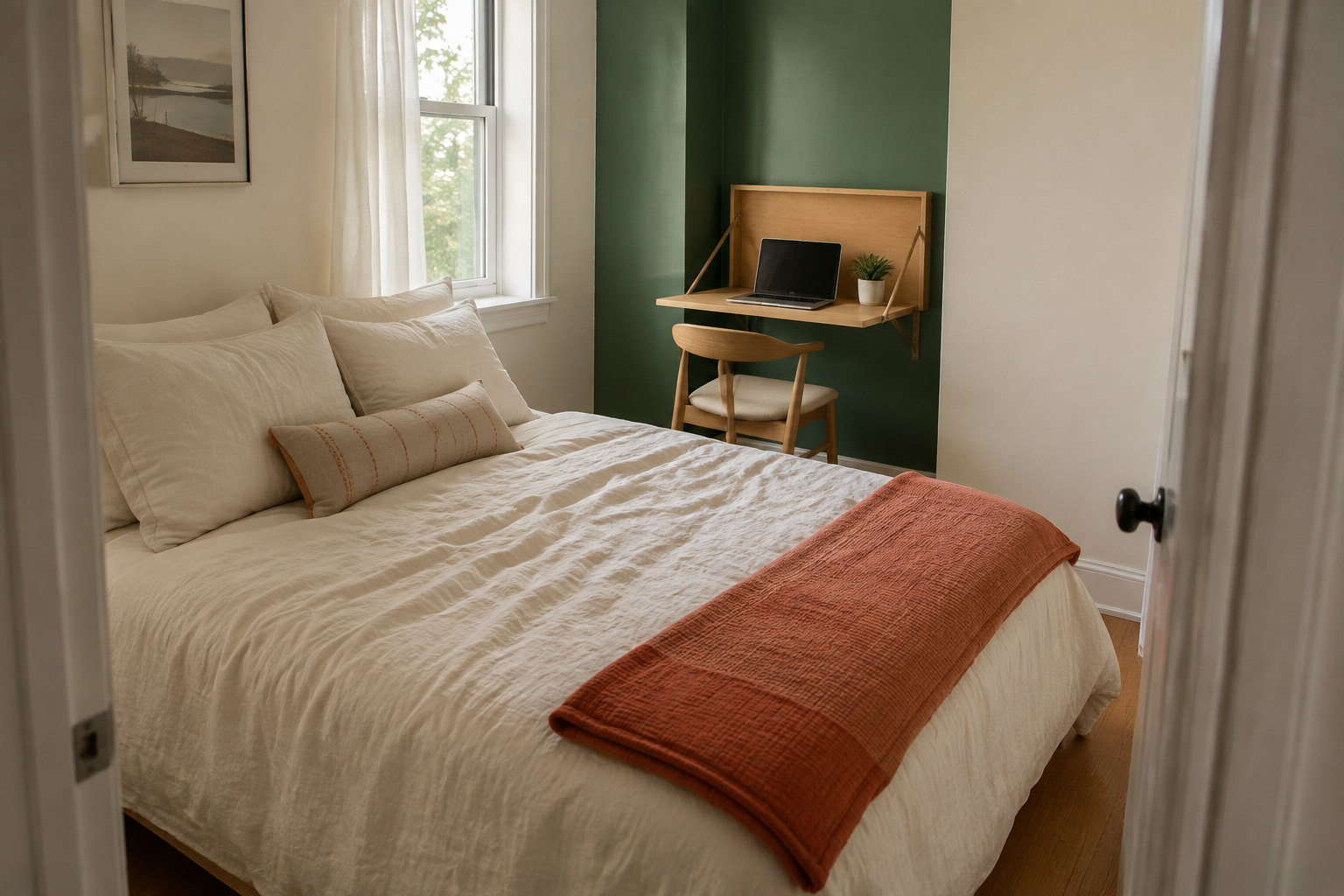
This doesn’t mean the desk has to go. It means the desk needs to visually disappear from the room outside of work hours, the same way you’d expect a hotel room’s small desk to fade into the background once you’re done using it. A closed laptop with nothing else visible on the surface does far less damage to the room’s calm than an open one with papers scattered around it.
What if there’s no wall space out of sight from the bed?
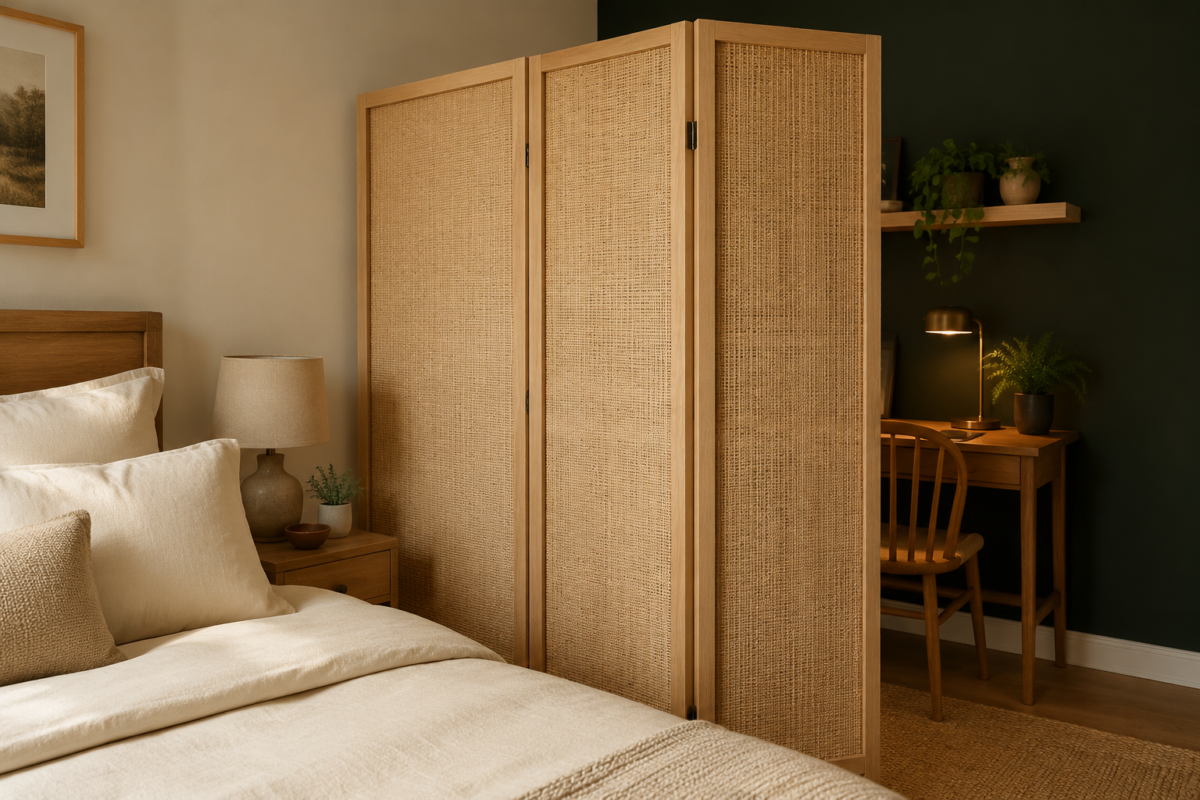
If your bedroom is small enough that every wall is within view of the pillows, use a physical barrier instead of distance to break the sightline. A tall folding screen, a curtain on a tension rod, or even a large potted plant positioned between the bed and the desk all interrupt the direct line of sight without needing a bigger room.
Corners work better than flat walls here, since a desk tucked into a corner naturally sits at more of an angle from the bed than one centered on a wall. If you have any choice in the matter, a corner perpendicular to the headboard, rather than the wall directly facing the foot of the bed, is almost always the better option. <a href=”/shared-space-home-office-guide”>This complete guide to a shared-space home office covers the full range of layout options for bedrooms and living rooms if you’re weighing more than one spot.</a>
A desk that closes matters even more here than in a larger bedroom. If a physical barrier isn’t fully practical in your layout, a fold-down wall desk or a cover draped over an open one removes the visual evidence of work even when the sightline itself can’t be fully blocked.
What if you share the bed and the room with a partner who isn’t working from home?
Agree on shared expectations for noise, video calls, and desk hours before conflicts happen, and treat the desk zone as jointly managed space rather than something one person claims unilaterally. A partner trying to sleep in while you’re on a morning call, or relax in the evening while your desk is still visibly “open,” runs into the same sightline and noise issues you’d have alone, just with another person’s schedule layered on top.
Headphones with a built-in microphone solve most of the noise half of this problem immediately, since they keep both your audio and the sound leaking into the room to a minimum. For video, position your desk so the camera faces away from the bed rather than toward it, both for your partner’s privacy on calls and so the bed doesn’t become part of your work background by accident.
Set a rough end time for desk use in the evening that you both agree on, even loosely. A bedroom that’s still functioning as an office at ten at night affects both people trying to sleep in it, not just the one who’s working.
What if the bedroom doesn’t have a closet or extra storage to hide supplies?
Use vertical wall storage and one closed container instead of relying on closet space you don’t have. A single floating shelf above the desk holds a printer, binders, or reference books without taking any floor space, and a lidded bin on that same shelf or tucked under the bed handles everything else.
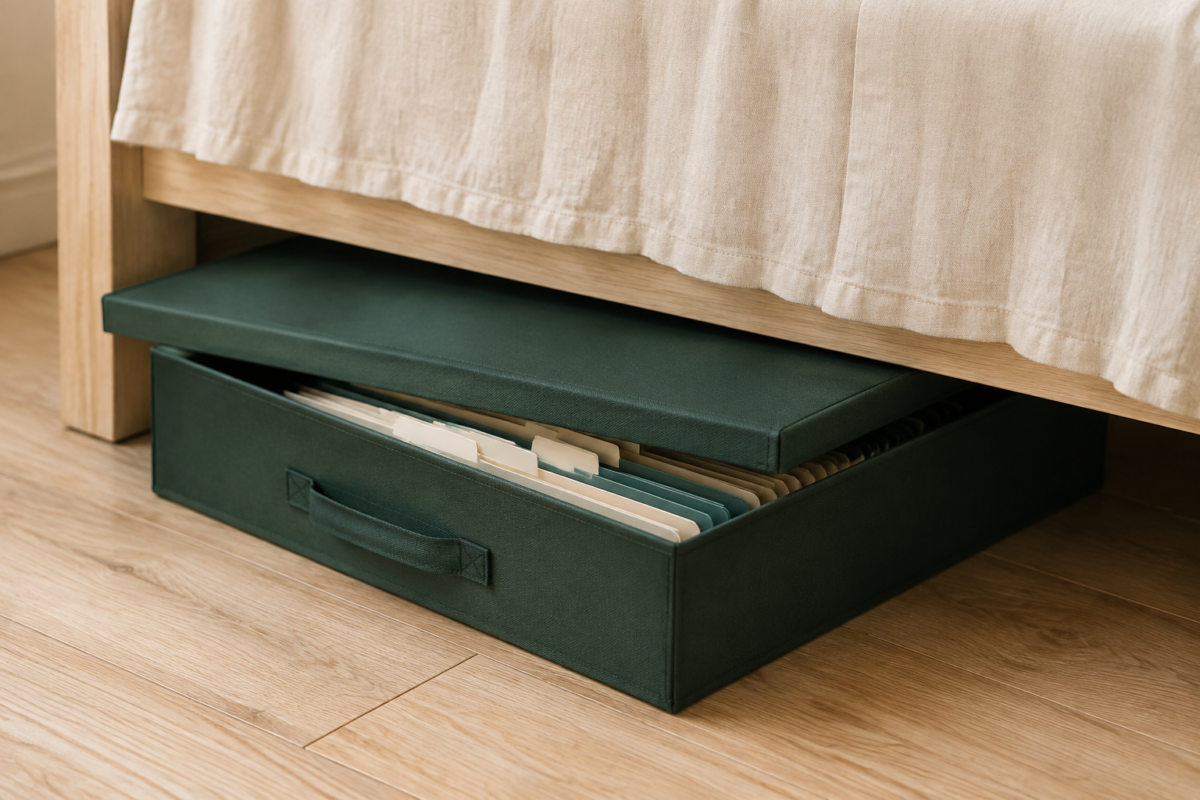
Under-bed storage is worth using here specifically because it’s storage that already exists in almost every bedroom without adding furniture. A slim, lidded under-bed box for cables, spare supplies, or paperwork keeps the desk surface clear without needing a single new piece of furniture in an already tight room. <a href=”/reliable-small-home-office-tech-setup”>If cables and tech clutter are part of what’s spilling out of your desk zone, this guide to a reliable small home office setup covers routing and storing them properly.</a>
Keep the storage pieces in the same color family as the rest of your bedroom, rather than introducing bright plastic bins that stand out. A Warm Cream or Deep Forest storage box reads as bedroom furniture. A bright white plastic tote reads as an office supply closet that wandered into the wrong room.
How do you keep the desk zone from creeping into the rest of your evening?
Close the laptop, cover the desk, and do one specific action, changing clothes, reading somewhere else in the room, that marks the bedroom as fully “off duty” for the night. Without this, the desk’s mere presence keeps a low background hum of work in a room that’s supposed to help you wind down.
A five-minute end-of-day routine at the desk itself makes this automatic rather than something you have to remember. Close the laptop, drape a cover or set one object on top of it, and physically turn your body, or your chair if it swivels, away from the desk zone entirely. That small physical shift is often enough to signal the transition even in a room too small for a real walk to another space.
What this actually looks like once it’s dialed in
Once the desk sits outside your sightline, closes up at the end of the day, and stores its supplies in containers that match the room instead of standing out, the bedroom goes back to being a bedroom every night, not a part-time office that never fully clocks out. You stop noticing the desk is there until you actually need it, which is exactly the point.
FAQ
Is it bad for my sleep to have any desk in my bedroom at all? Not necessarily. The research points to the visual and mental association with work, not the desk’s existence. Positioning it out of your sightline and closing it up at night addresses most of the concern without needing a separate room.
What’s the fastest fix if my desk is directly facing my bed and I can’t move it? A folding screen or tension-rod curtain placed between the bed and the desk blocks the sightline immediately, without needing to rearrange any furniture.
How do I stop my partner and me from disagreeing over desk hours in a shared bedroom? A short, specific conversation about rough start and end times for desk use, even a loose agreement, prevents most of the friction that builds up when one person assumes the space is always available.
Do I need to buy new furniture to store office supplies without a closet? Usually not. A single floating shelf and a lidded under-bed storage box, both inexpensive, cover most storage needs without adding furniture to an already tight room.
Related Reading
- The Complete Guide to a Shared-Space Home Office — the broader guide this bedroom-specific setup fits into, including living room layouts and privacy strategies.
- The Tech Setup That Keeps a Small Home Office Reliable — for keeping cables and equipment contained in a room with limited storage.
- A Start and End of Day Routine for Working From a Small Space — the daily habit that reinforces the “off duty” shift this guide describes.
- Parent Category: Shared-Space Offices
- Parent Hub: Home Office & Small Workspaces