Table of Contents
The coffee table has three remotes, a stack of mail you meant to sort, a phone charger with nowhere to plug in, and a candle that hasn’t been lit in months. None of it is technically clutter. It’s just stuff with nowhere assigned to live, and in a small living room, that’s the difference between a room that feels calm and one that never quite does.
Living room storage works best in this order: choose furniture that already stores things, add shelving to the wall space you’re not using, and solve the small daily stuff, remotes, cords, chargers, last. Buy storage in the reverse order, starting with bins and baskets before the furniture underneath them is settled, and you end up with containers that don’t match what’s actually cluttering the room.
Why Furniture Comes Before Shelving or Bins
Furniture goes first because it solves the largest storage need with the least visual impact. A storage ottoman or a console with drawers hides an entire category of clutter, blankets, chargers, remotes, behind a closed surface, without adding a single visible container to the room. Shelving and small bins matter, but they’re solving a smaller, more specific problem, and they work better once the big, closed storage is already handling the bulk of what needs a home.
Think about the difference between a room where the blankets live folded on an open shelf versus tucked inside a storage ottoman that also serves as the coffee table. Both technically store the blanket. Only one adds visual weight to a room that doesn’t have much floor space to spare. In a small living room, every open surface is doing double duty as both storage and decor, which means closed storage almost always outperforms open storage for anything you don’t want on permanent display.
This is the same layered logic behind the Taims Space Method™: Simplify first, then Organize. Furniture-based storage does the simplifying, clearing the bulk of what clutters a room before you organize what’s left with shelving and small fixes.
Step 1: Choose Storage Furniture That’s Already Doing Double Duty
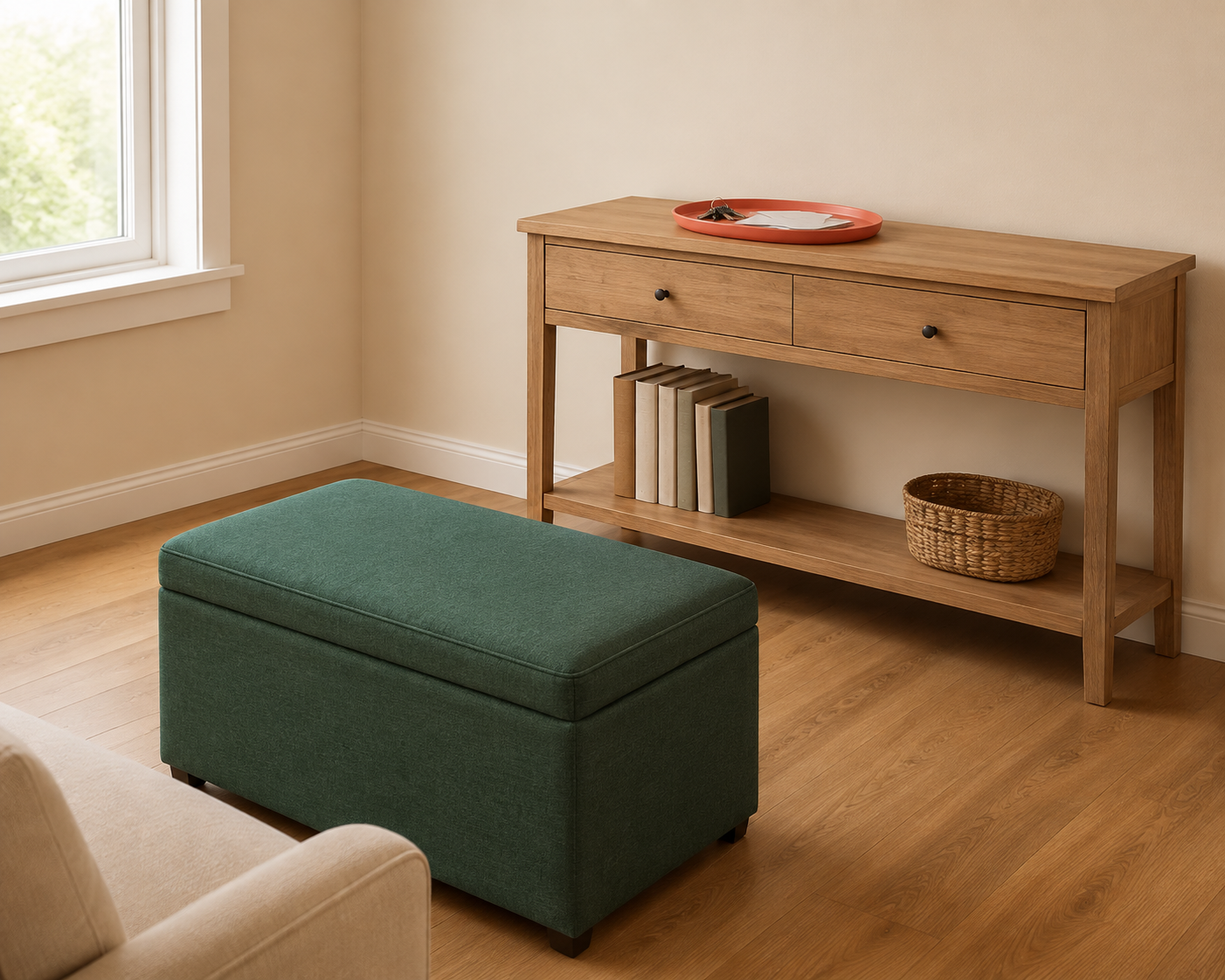
Pick one or two pieces of furniture that combine their obvious function with hidden storage, like a storage ottoman used as a coffee table, a console table with drawers, or a media stand with closed cabinets, rather than adding separate storage pieces on top of furniture you already own.
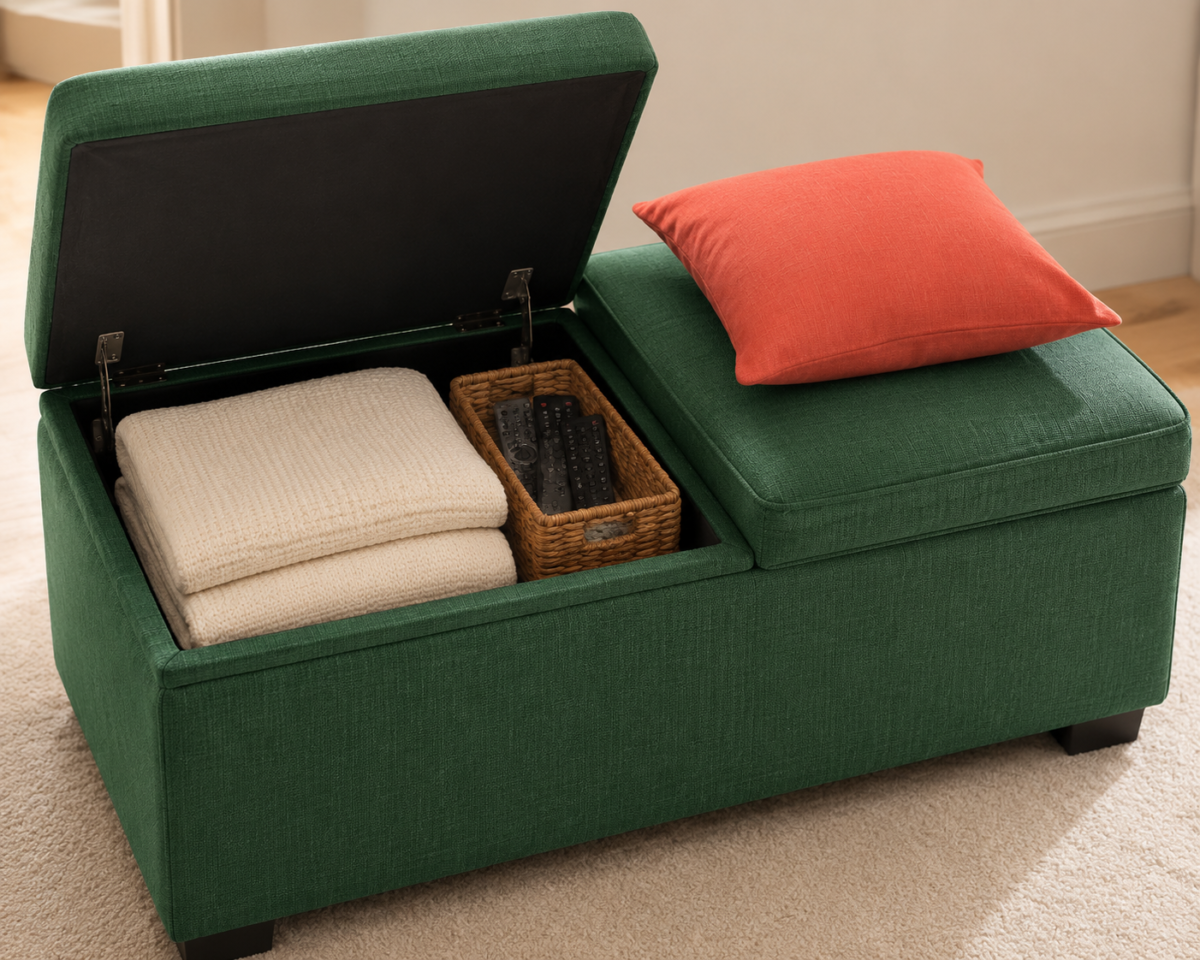
A storage ottoman is the single highest-value piece for a small living room, because it replaces a standard coffee table’s function while adding a genuinely useful hidden compartment, typically enough for several folded blankets, remotes, or a stack of magazines. Measure the space where your coffee table currently sits before buying one. Most storage ottomans run 28 to 36 inches wide, which fits the same footprint a standard coffee table already occupies without claiming any additional floor.
A console table against a wall behind the sofa, or beside an entry point, does similar work for smaller items. Two drawers hold chargers, coasters, and mail without a single item visible on the surface above. If your living room doubles as a landing spot for keys and mail when you walk in, a console with at least one drawer solves that specific daily habit better than a decorative tray ever will, since the tray still leaves the clutter visible.
A few placement notes worth knowing before buying:
- Choose an ottoman with a removable or hinged lid over one with a fixed cushion top, since a fixed top means digging under a cushion every time you need something inside.
- Size a media stand’s cabinet space to your actual remote and cord count, not a generic estimate. Three remotes and two chargers need less depth than most people assume.
- If floor space is genuinely tight, a console table as narrow as 10 to 12 inches deep still fits two drawers and works against almost any wall.
For a deeper look at ottomans, console tables, and benches specifically chosen to blend into the room instead of announcing themselves as storage, Storage Furniture That Doesn’t Look Like Storage covers exact dimensions and what to look for before buying.
Step 2: Add Shelving to the Wall Space You’re Already Wasting
Once your furniture-based storage is handling the bulk of hidden items, add open shelving to at least one wall that’s currently doing nothing, sized to hold books, a few styled objects, and one or two baskets for anything that doesn’t need a home behind a closed door.
Most small living rooms have at least one wall, often beside a doorway, above a console, or flanking a window, that sits empty simply because it was never considered part of the room’s usable space. A single floating shelf, roughly 24 to 36 inches, mounted at a height that clears any furniture below it, adds real storage capacity without touching the floor plan at all. This matters specifically in a small room, where floor space is the scarcest resource and wall space is often the most underused one.
Shelving works best when it mixes function and display rather than becoming either a pure bookshelf or a pure decor shelf. A shelf holding six books, one small basket for loose items like coasters or a spare remote, and two or three styled objects reads as considered. The same shelf holding either all books or all decorative objects tends to feel either too utilitarian or too precious for a room people actually live in every day.
If your walls are rental-restricted, meaning no drilling or only adhesive-rated hanging methods are allowed, a leaning ladder shelf or a slim freestanding bookcase against the wall accomplishes the same vertical storage without a single hole.
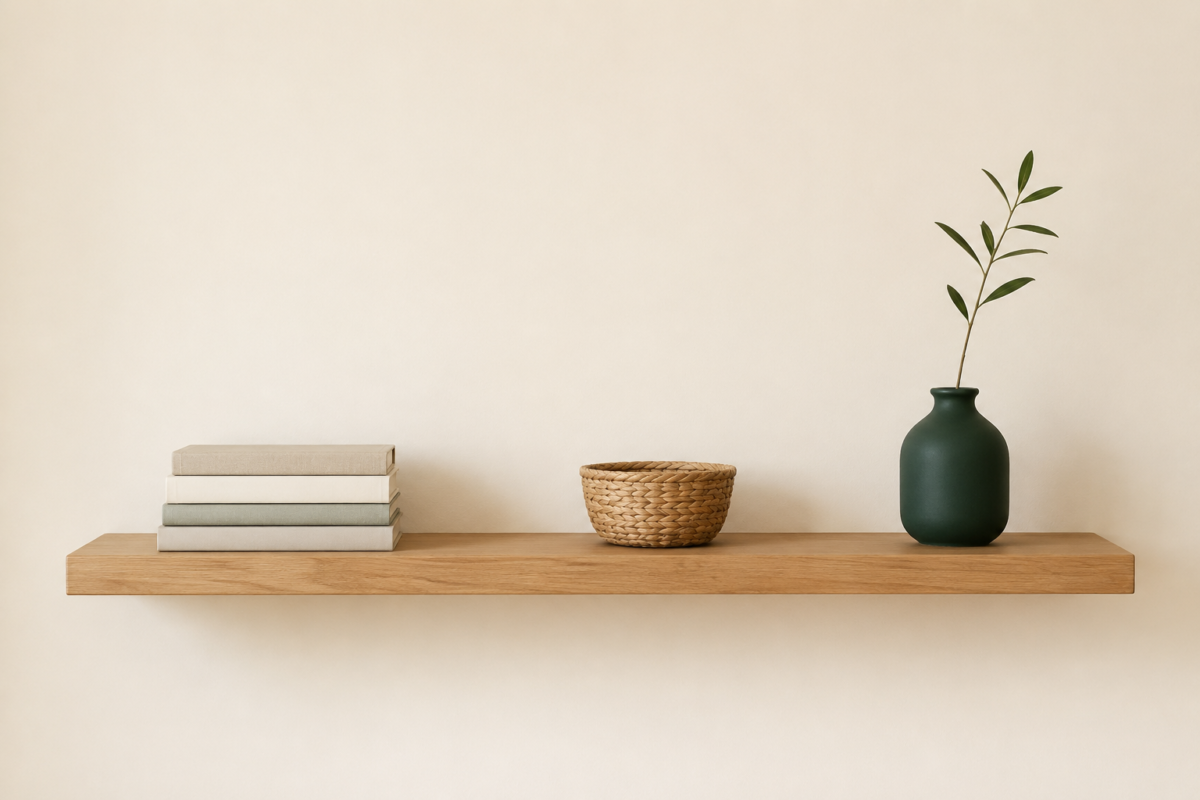
For a full breakdown of shelf placement, spacing, and which walls in a small living room are worth using, Shelving Ideas for Walls You’re Not Using covers exact heights and how to style a shelf so it reads as decor first.
Step 3: Solve the Small Stuff Last
After furniture and shelving are handling the bulk of storage, address the small daily items, remotes, cords, chargers, and loose mail, with a handful of specific, low-cost fixes rather than one large catch-all bin that becomes its own kind of clutter.
This step goes last because it’s the easiest to over-solve too early. Buying a large decorative basket for “everything else” before the furniture and shelving are settled usually results in a basket that becomes a dumping ground for anything without an assigned spot, rather than solving the actual problem. Once the bigger pieces are in place, the remaining small stuff usually needs targeted five-minute fixes: a cord clip under the console, a small remote caddy inside the ottoman, a shallow tray by the entry for keys and mail.
A few specific small-stuff fixes that consistently work in a small living room:
- Adhesive cord clips along the back or underside of furniture, keeping charging cables from trailing across the floor or coiling visibly on a side table.
- A slim remote caddy, either a small tray or a fabric organizer, placed inside the ottoman or a console drawer rather than loose on the coffee table.
- One shallow catch-all tray, sized for keys and a single day’s mail, not a week’s worth, placed near the entry point so it never becomes its own pile.
For the specific five-minute fixes that clear a coffee table and side table permanently, Small Storage Wins for Remotes, Cords, and Clutter covers the exact tools and placement that make this step stick.
Three Storage Setups for Common Living Room Sizes
| Room Size | Furniture Storage | Shelving | Small Stuff |
| Under 100 sq ft | One storage ottoman only | Single 24-inch floating shelf | Cord clips plus one small remote caddy |
| 100–150 sq ft | Storage ottoman plus a console with 2 drawers | Two 24 to 30-inch shelves on one wall | Caddy inside ottoman, entry tray by the door |
| Open-plan zone | Console with cabinets plus a storage bench | Shelving on the wall shared with the seating zone | Entry tray, cord clips, one styled basket on a shelf |
Every one of these setups follows the same three-step order. What changes is how much you add at each step, not the sequence itself.
What to Skip When Storing a Small Living Room
Skip large catch-all baskets bought before the furniture storage is settled, skip open shelving that becomes entirely decorative with no real storage function, and skip buying bins sized for a generic room instead of your actual remote, charger, and mail volume.
Specifically worth avoiding in a small footprint:
- A coffee table with no storage function at all, when a storage ottoman does the same job for roughly the same footprint and cost.
- Multiple small decorative boxes scattered across shelves and surfaces, each holding one or two items. One well-placed drawer usually replaces four scattered boxes.
- Wall shelving mounted before measuring what will actually go on it, resulting in shelves too shallow for books or too high to reach comfortably for daily items.
What the Finished Room Actually Looks Like
Walk back into that same living room once the three steps are done and the coffee table has nothing on it that doesn’t belong there. The remotes live in a caddy inside the ottoman. The mail gets sorted into a shallow tray by the door instead of spreading across the console. The shelf above the console holds a few books and one object that actually means something to you, with real space around them. Nothing about the room announces “storage.” It just quietly works.
None of it required more square footage or a dramatic decluttering weekend. It required deciding, in order, what furniture would hide the bulk of it, what the walls could hold, and what the last few loose items actually needed, and stopping at each step once it was genuinely handled.
Frequently Asked Questions
What’s the best storage solution for a small living room? Start with one piece of furniture that combines its function with hidden storage, like a storage ottoman used as a coffee table, before adding shelving or small organizers. This handles the largest volume of clutter with the least visual impact on the room.
Should I add shelving or buy storage furniture first? Furniture first. Storage furniture like an ottoman or a console with drawers hides the bulk of what clutters a room behind closed surfaces, while shelving works best as a second layer for books, display items, and smaller loose things.
How do I stop remotes and cords from cluttering the coffee table? Use a small remote caddy placed inside a storage ottoman or console drawer, and add adhesive cord clips under furniture edges to keep charging cables from trailing across the floor or coiling on a visible surface.
What size storage ottoman fits a small living room? Most storage ottomans run 28 to 36 inches wide, which fits the same footprint as a standard coffee table. Measure your current coffee table’s spot before buying, since most ottomans are sized to be a direct swap.
Is open shelving or closed storage better for a small living room? Both, used for different things. Closed storage, like an ottoman or console drawer, works best for items you don’t want on display. Open shelving works best for books and a few styled objects, mixed with one basket for loose items.
Related Reading
For furniture chosen specifically to hide storage without looking like a bin, Storage Furniture That Doesn’t Look Like Storage covers ottomans, consoles, and benches in real dimensions.
If wall space is the resource you haven’t used yet, Shelving Ideas for Walls You’re Not Using breaks down placement, spacing, and how to style a shelf so it reads as decor first.
For the five-minute fixes that keep remotes, cords, and mail from piling back up, Small Storage Wins for Remotes, Cords, and Clutter covers the exact tools that make the last step stick.
For more storage guides, visit Living Room Storage, or explore the wider Small Living Rooms hub for layout, decor, and multi-purpose ideas for the rest of the room. If clutter is a whole-home issue rather than just the living room, the Organization & Storage hub covers decluttering and daily systems room by room.