Table of Contents
Renting shouldn’t mean living in a version of your home you’re always half-apologizing for. It’s easy to fall into that habit, bare walls because you’re worried about the deposit, generic beige everything because it feels safer, decorating decisions put off because “we might move next year anyway.” None of that is required anymore, and it hasn’t been for years.
The truth is, almost everything that makes a home feel intentional, color on the walls, art hung at the right height, layered textiles, good lighting, can be done in a rental without a single hole that isn’t already there, and without losing a dollar of your security deposit. The tools exist. What’s usually missing is knowing which ones actually hold up and which ones are marketed as renter-friendly but fail the second you try to remove them.
This guide covers every layer of rental decorating in the order that actually matters: walls first, since they set the tone for everything else, then textiles, which do more visual work than almost any other purchase, then the smaller finishing details that make a space feel complete instead of assembled.
Start With Walls: The Highest-Impact, Lowest-Risk Layer
Walls set the tone for an entire room before a single piece of furniture goes in, and they’re also the layer renters avoid most, usually out of a reasonable fear of losing deposit money. The good news: modern removable wall products have gotten good enough that this fear is largely outdated, as long as you choose the right product and apply it correctly.
Peel-and-stick wallpaper is the single biggest transformation available in a rental, and quality brands now remove cleanly from painted drywall when applied and removed correctly. The two failure points that cause bad experiences: applying to a wall that hasn’t been properly cleaned and dried first, and rushing the removal by pulling instead of peeling at a low, slow angle. Test any product on a small, hidden section (behind a door, inside a closet) before committing to a full wall, since paint quality varies enough between rental units that this step genuinely matters.
Command strips and adhesive hooks handle everything walls used to need nails for: art, mirrors, shelving, even lightweight curtain rods. The critical detail most people get wrong is weight rating. A strip rated for 5 pounds holding a 12-pound framed mirror will fail, sometimes not immediately, which is worse, since it can fail weeks later and take the item down without warning. Match the rated weight to the actual item weight, with room to spare, every time.
Tension rods replace curtain rods that would otherwise need drilled brackets, and they work for far more than just curtains. A tension rod inside a closet can add a second hanging bar; one across an alcove can hold a curtain used as a soft room divider, an approach covered in more depth in Zoning a Studio Without Walls or Furniture Dividers.
What to skip: Cheap, ultra-thin peel-and-stick products, usually the ones priced dramatically below quality brands, tend to bubble on application and tear on removal, leaving adhesive residue that can genuinely cost deposit money. This is one category where spending a bit more upfront protects you on the back end.
For the full brand-by-brand breakdown of which peel-and-stick wallpaper actually performs as promised, Removable Wallpaper That Actually Comes Off Clean covers application technique and removal in detail. And for exact weight ratings and hanging techniques across everything from art to floating shelves, Command Strips and Adhesive Hooks Worth Trusting goes deeper than what fits here.
Layer Two: Textiles Do More Work Than Almost Anything Else
If walls set the tone, textiles are what actually make a rental feel warm, layered, and lived-in rather than temporary. This is also the layer with zero landlord risk at all, since nothing here touches the walls, floor, or fixtures in a way that requires removal or repair.
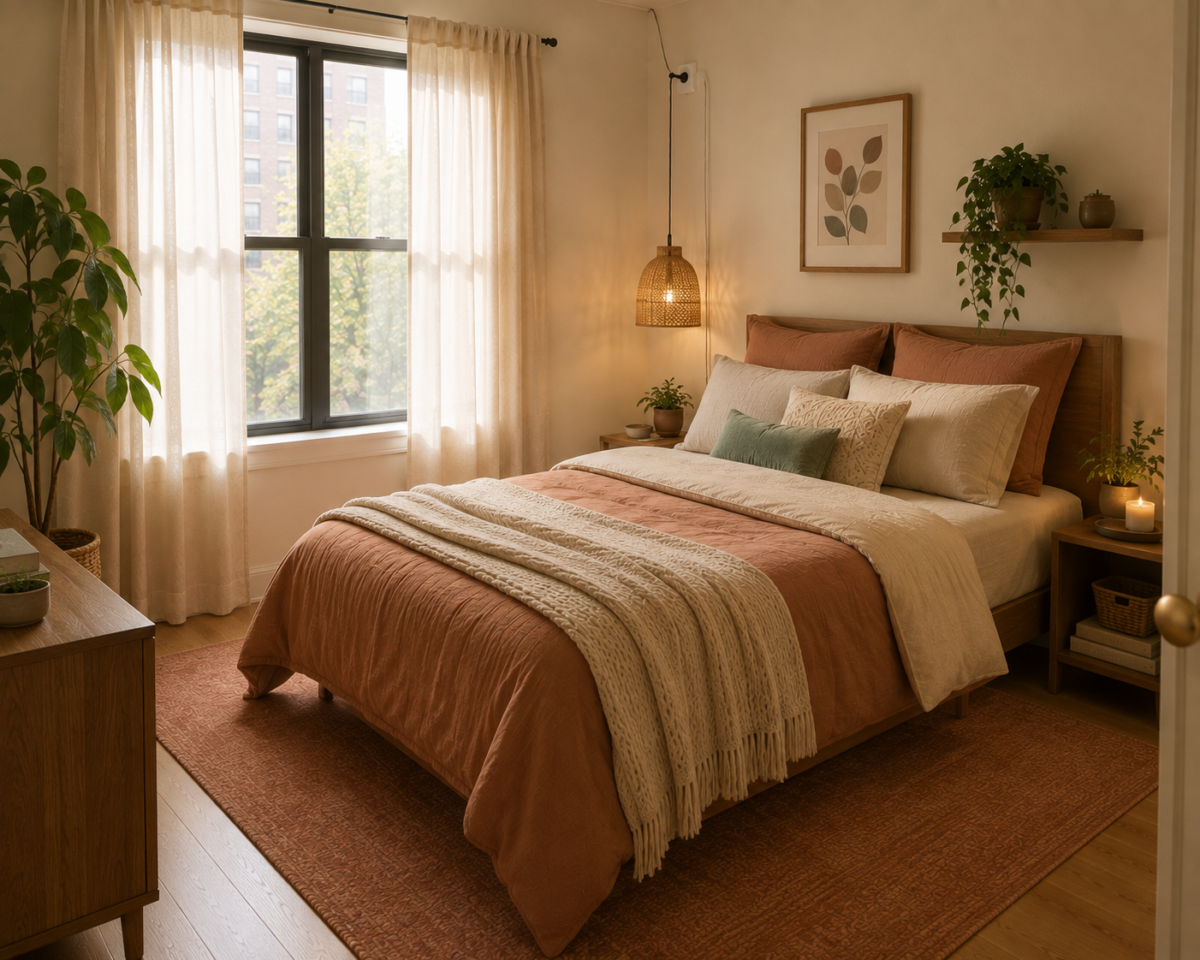
Rugs anchor a room the way paint would in a house you owned, and in a rental, they do double duty: covering flooring you might not love, and defining zones the way Zoning a Studio Without Walls or Furniture Dividers describes in more depth. Size matters more than most renters expect. A rug too small for its seating area reads as an afterthought no matter how nice the rug itself is; sizing it so all furniture legs sit on it (or at minimum the front legs) makes the difference between “decorated” and “assembled.”
Curtains change a room’s entire feel more than almost any single purchase, and they’re one of the most overlooked rental upgrades since many units come with basic mini-blinds or nothing at all. Hang curtain rods on a tension rod or a Command-rated bracket, close to the ceiling rather than at the window frame, for the added benefit of a taller-feeling room. Match the curtain color to your wall color where possible for a continuous, uninterrupted sightline.
Lighting is the textile-adjacent layer most renters underuse. Plug-in pendant lights, hung from a hook and routed along the ceiling to an outlet, bring real ambient lighting to a room without any electrical work. Floor and table lamps layered around a room replace the harsh, flat overhead lighting most rentals default to, and layered light is one of the fastest ways to make a space feel considered rather than temporary.
For the specific purchases in this category that make the biggest visible difference for the investment, Rugs, Curtains, and Lighting That Do the Heavy Lifting walks through exact recommendations by room type.
Layer Three: Hardware and Fixtures, the Reversible Upgrade
Cabinet hardware, faucet fixtures, and light fixtures in most rentals are original to the unit, functional but generic, and swapping them is one of the most underrated rental upgrades available, as long as every original piece is saved for move-out.
Cabinet hardware (knobs and pulls) is inexpensive, takes minutes per piece with a screwdriver, and changes the entire feel of a kitchen or bathroom more than almost any other single swap. Buy pulls that use the same screw spacing as your existing hardware to avoid drilling new holes, and keep every original knob and screw in a labeled bag for reinstallation before move-out.
Faucet aerators and shower heads are genuinely simple upgrades that most renters don’t realize are swappable, and they require no tools beyond hand tightening in most cases. Keep the original pieces boxed and labeled the same way as cabinet hardware.
Light fixture covers and switch plates can be swapped for a few dollars each, and a matching set of updated switch plates throughout a unit is a small detail that reads as surprisingly polished. This is one of the lowest-cost, highest-visibility upgrades on this entire list.
The universal rule for this layer: anything original comes back on before you hand over keys. This isn’t optional advice, it’s the entire reason this category of upgrade is safe. Photograph the original setup before removing anything, and store the originals somewhere they won’t get lost or damaged during your tenancy.
Layer Four: Furniture and Room Dividers
Furniture placement does real decorating work in a rental precisely because it requires zero landlord involvement at all. A bookshelf, credenza, or open shelving unit positioned perpendicular to a wall can divide a studio or open-plan rental into distinct zones without a single structural change, a system covered in depth in Zoning a Studio Without Walls or Furniture Dividers.
Beyond zoning, furniture choices in a rental benefit from the same scale principles that apply in any small space: pieces with visible legs read lighter and let more of the actual floor show, and multi-purpose pieces (a storage ottoman, a daybed that doubles as seating) earn their footprint twice over in a space where every square foot matters more than it would in a house.
Freestanding shelving solves a problem most rentals share: not enough built-in storage. A tall bookshelf or open shelving unit adds real storage capacity without a single hole in the wall, and it can double as a room divider in an open layout at the same time.
Room screens and curtain dividers work well in rentals with genuinely awkward open layouts, a studio with no natural break between sleep and living areas, for example. A folding screen or a ceiling-mounted curtain track (installed with a tension setup rather than drilled brackets) creates a soft division that comes down entirely at move-out.
Layer Five: The Finishing Details
The smallest layer of rental decorating is also the one that separates a space that feels “done” from one that feels like a work in progress. These details cost little individually but compound into a real difference.
- Art at the right height. Hang the center of framed art at roughly 57 to 60 inches from the floor, standard gallery height, using Command strips rated for the frame’s actual weight. A gallery wall of several smaller pieces, laid out on the floor first to test spacing before anything touches the wall, reads as far more intentional than one large piece hung alone.
- Greenery, real or high-quality faux. A few well-placed plants do more to make a rental feel alive and lived-in than almost any other single category of decor, and they require zero permanence at all, just a pot and a spot with the right light.
- Consistent hardware and finishes. Matching drawer pulls, switch plates, and light fixtures throughout a unit read as intentional even when individually inexpensive. Inconsistency, a mix of finishes left over from different eras of a rental’s life, is one of the fastest tells that a space hasn’t been personalized yet.
- A doormat and entry moment. The first few feet of a rental set the tone the same way they do in any home. A doormat, a small tray for keys, and one piece of art or a mirror near the entry make the whole apartment feel considered from the second the door opens.
What to Skip Entirely in a Rental
Not every “small upgrade” is worth the risk or effort in a space you don’t own. A few categories consistently cause more deposit trouble than they’re worth:
- Paint, unless explicitly approved in writing. Even landlord-friendly leases usually require written approval and a specific process for restoring the original color. Skip it unless you have that approval documented.
- Anything requiring actual drilling into tile, stone, or brick. These surfaces are expensive to repair and rarely forgiving of mistakes. Adhesive solutions rated for smooth surfaces generally aren’t rated for these either, so test carefully or avoid the surface entirely.
- Permanent flooring changes, glued-down vinyl, adhesive tile, anything that isn’t a rug or a floating floor product explicitly marketed as removable.
- Cheap adhesive products bought purely on price. As covered above, the cost difference between a quality removable product and a bargain one is small compared to what a failed, residue-leaving removal can cost at move-out.
A Rental That Feels Finished, Not Temporary
Done in this order, walls first for the biggest visual shift, then textiles for warmth and zoning, then hardware for polish, then furniture for function, then the small finishing details, a rental stops feeling like a placeholder and starts feeling like an actual home. None of it requires a renovation, a lease violation, or a compromised deposit. It requires knowing which products genuinely perform as promised and applying them the way they’re meant to be applied, which is exactly what the rest of this guide’s companion articles cover in full detail.
Frequently Asked Questions
Will peel-and-stick wallpaper damage rental walls? Not if you choose a quality brand, prep the wall properly (clean and fully dry before application), and remove it slowly at a low angle rather than pulling it straight off. Cheap, ultra-thin products are the most common cause of bubbling on application and residue on removal.
How much weight can Command strips actually hold? It depends entirely on the specific strip, which is rated by the manufacturer for a maximum weight. The most common mistake is rounding up, using a strip rated for less weight than the item actually weighs, so always match the rated capacity to the item’s real weight with room to spare.
Can I change light fixtures in a rental apartment? Cosmetic swaps like light fixture covers and switch plates are generally safe and reversible with basic tools. Full fixture replacement involving electrical wiring should only be done with landlord approval, and every original piece should be saved and reinstalled before move-out regardless.
What’s the single best rental upgrade for the money? Curtains hung close to the ceiling on a tension rod or Command-rated bracket. They change a room’s entire feel more than almost any other purchase in this price range, require zero permanent changes, and come down completely at move-out.
How do I decorate a rental without losing my security deposit? Stick to reversible layers: removable wallpaper from a tested, quality brand, weight-rated adhesive hooks and strips, swappable hardware with originals saved and labeled, and furniture-based zoning instead of built-in changes. Document everything original with photos before making any swaps.
Related Reading
- Removable Wallpaper That Actually Comes Off Clean — brand-by-brand performance and the application technique that prevents bubbling and residue.
- Command Strips and Adhesive Hooks Worth Trusting — exact weight limits and hanging techniques for art, mirrors, and shelving.
- Rugs, Curtains, and Lighting That Do the Heavy Lifting — the three purchases that change a rental most, room by room.
- Zoning a Studio Without Walls or Furniture Dividers — the furniture-based zoning system referenced throughout this guide.
- Parent Category: Rental-Friendly Decor
- Parent Hub: Apartments & Rentals