Table of Contents
It usually happens at the worst possible moment. A frame you hung months ago, one you trusted completely, comes off the wall on its own, sometimes overnight, sometimes right as someone walks past it. Nine times out of ten, the strip itself wasn’t the problem. The weight rating was.
Adhesive strips and hooks are genuinely reliable when matched to the right job, reliable enough to hold art, mirrors, shelving, even small floating cabinets, without a single hole in the wall. The failures almost always trace back to one of three things: an under-rated strip asked to hold more than it’s built for, a wall surface the adhesive was never designed to bond with, or a rushed application that never let the adhesive fully cure before weight was added. This guide covers all three, organized by how much weight you’re actually trying to hold.
Read the Weight Rating Like It’s a Hard Limit, Not a Suggestion
Every adhesive strip and hook comes with a manufacturer-rated maximum weight, and that number matters more than any other factor in whether it holds. The mistake almost everyone makes at least once: rounding up. A strip rated for 5 pounds asked to hold a 7-pound mirror might hold for a while, sometimes weeks, before it fails, which is actually worse than an immediate failure, since it happens without warning once you’ve stopped thinking about it.
Weigh the actual item, not your estimate of it. A kitchen scale works fine for anything under 20 pounds. For anything heavier, check the product’s spec sheet or the frame manufacturer’s listed weight, since visual guessing is notoriously unreliable, a small item in a heavy frame can weigh far more than it looks.
Round down, not up, when choosing a strip. If an item weighs 6 pounds, choose a strip rated for at least 7 to 8 pounds, not one rated for exactly 6. This buffer accounts for real-world variables, wall texture, temperature, humidity, that lab-tested ratings don’t always capture perfectly.
Multiple strips don’t simply add up. Two strips rated for 5 pounds each don’t reliably hold 10 pounds combined, since weight distribution across multiple strips is rarely perfectly even. For anything genuinely at the edge of a single strip’s capacity, choose a higher-rated single strip or hook system specifically designed for the combined weight, rather than stacking smaller ones and hoping the math works out.
Light-Duty: Under 5 Pounds
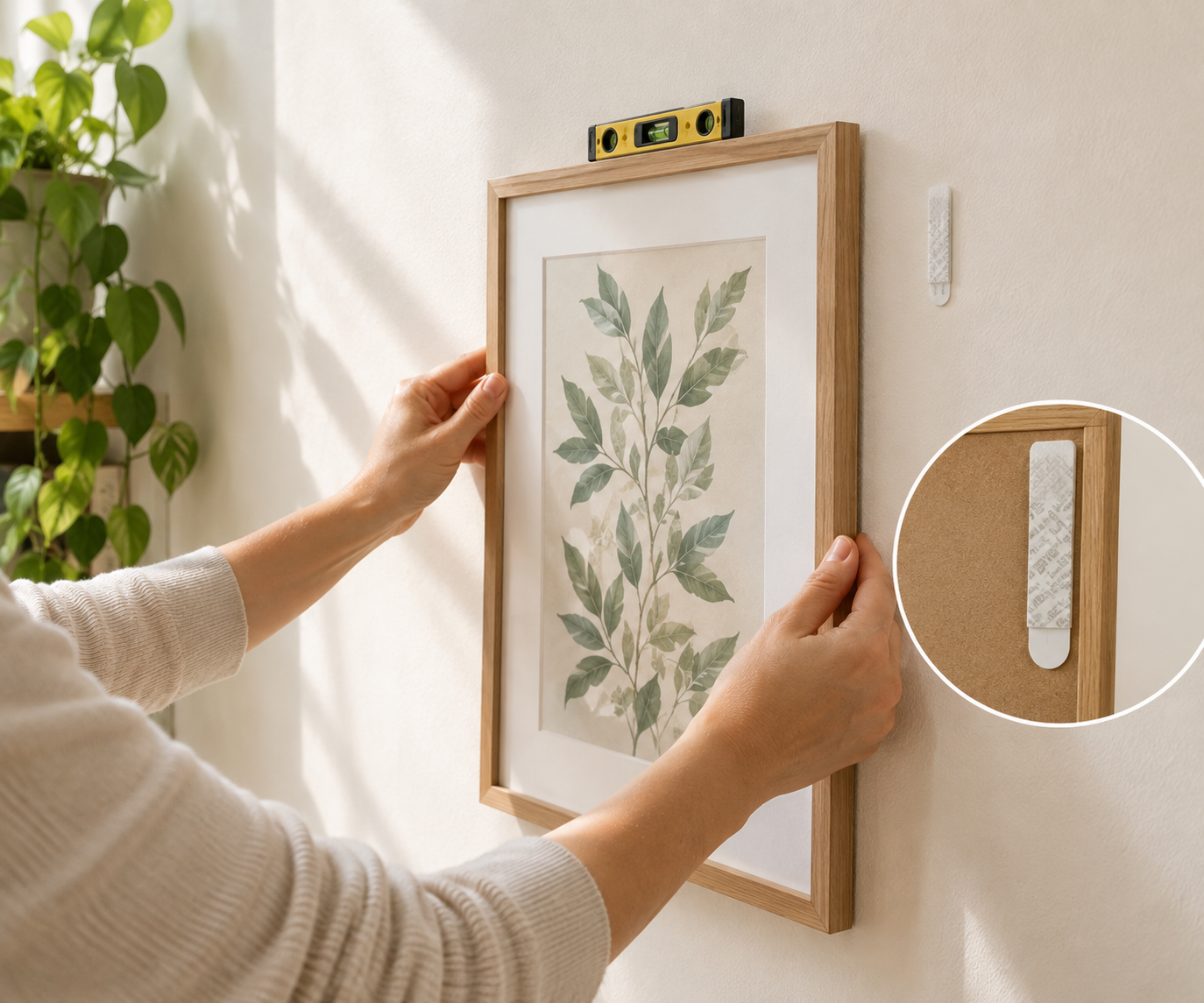
This category covers most framed art under roughly 16 by 20 inches, small mirrors, lightweight string lights, and most kitchen or bathroom organizational hooks. It’s the lowest-risk category and the one most adhesive products are genuinely built to handle well.
What works reliably here: Standard small and medium adhesive strips, typically rated for 1 to 5 pounds depending on size, handle this range without issue when applied correctly. Small adhesive hooks work well for lightweight items that hang rather than lean flat against the wall, keys, light kitchen utensils, a bathrobe.
Application specifics: Press firmly along the entire strip for a full 30 seconds, then hold the item in place (or let the strip sit unweighted, per the product’s instructions) for the full cure time listed on the packaging, usually one hour minimum. Hanging something immediately after application, before the adhesive has cured, is a common cause of early failure even with correctly rated products.
Medium-Duty: 5 to 15 Pounds
This range covers larger framed art, small to mid-size mirrors, floating shelves without much on them, and lightweight curtain rods. It’s where weight-rating mistakes become more consequential, since a failure at this weight is more likely to cause real damage on the way down.
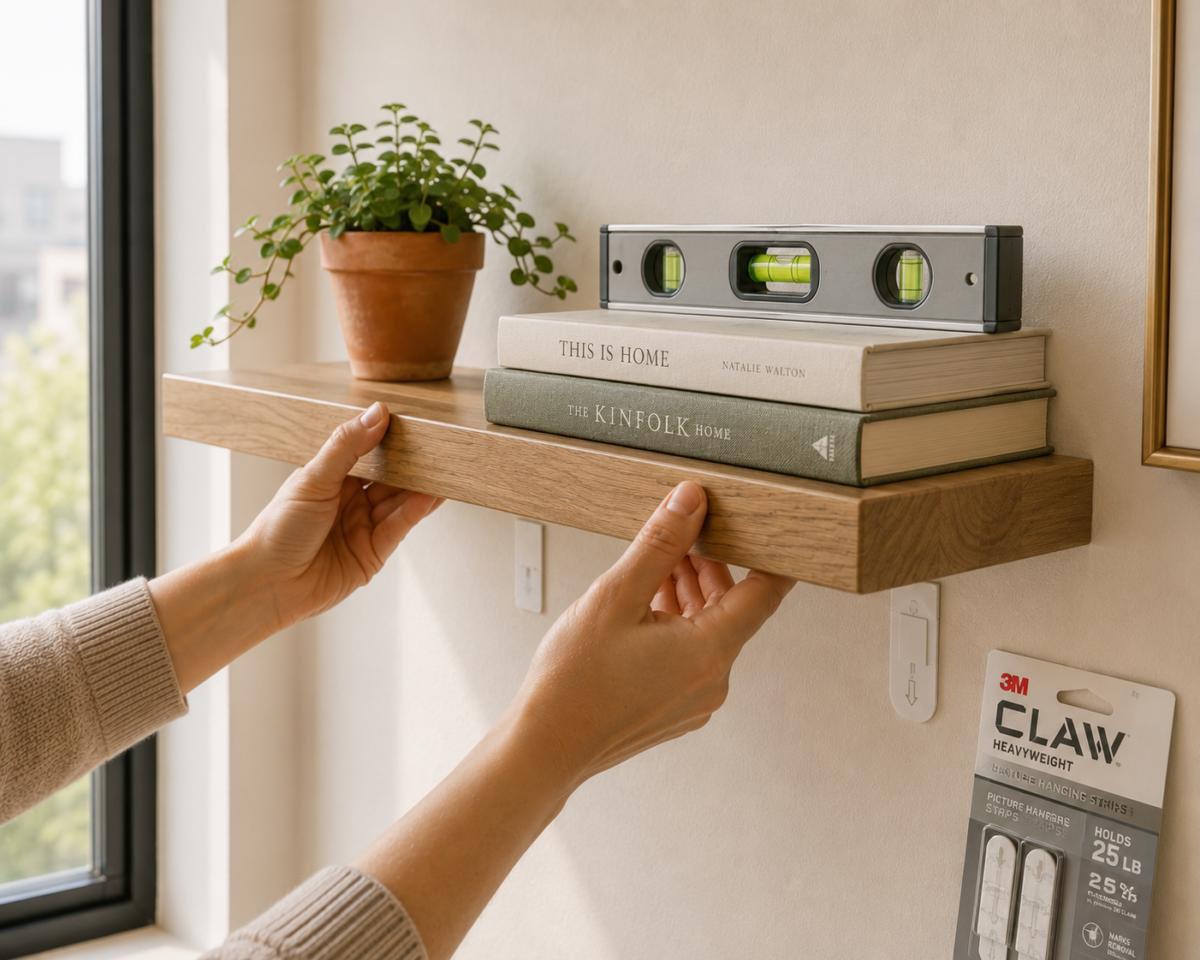
What works reliably here: Heavy-duty strip lines from established brands, specifically rated for this range, use a thicker foam core and stronger adhesive formula than light-duty versions. For floating shelves, look for adhesive-mount brackets explicitly rated for shelving use rather than repurposing picture-hanging strips, since the load distribution on a shelf is different from a flat-hanging frame.
Surface matters more at this weight. Adhesive strips bond significantly better to smooth, painted drywall than to textured surfaces, brick, or unfinished wood. If your wall has any texture at all, test a strip’s actual hold on a small, low-risk spot before committing to a medium-weight item where a failure would matter.
Consider a two-point mounting system for anything wider than about 24 inches. A single strip or hook centered on a wide mirror or shelf creates a pivot point that increases stress on the adhesive bond. Distributing the mount across two points, positioned per the manufacturer’s spacing guidance, meaningfully reduces failure risk for wider items.
Heavier Items: 15 Pounds and Above
This is the range where adhesive solutions genuinely reach their limit, and it’s worth being honest about that rather than pushing a product past what it’s designed for. Large mirrors, substantial framed art, and anything approaching furniture-adjacent weight fall here.
What can still work: The strongest heavy-duty adhesive hook and strip systems on the market are rated up to 15, sometimes 20 pounds for a single mounting point, and combining a rated system correctly across multiple points can extend that further for wide, evenly weighted items like a large mirror.
Where to draw the line. For anything meaningfully over 20 pounds, or anything that would cause real injury or damage if it fell, a hollow-wall anchor into a stud (which most leases genuinely do permit for reasonable, small holes, especially with a patch-and-paint plan at move-out) is the more honest answer than stretching an adhesive product past its tested range. Check your specific lease language, many allow small picture-hanging holes explicitly, since landlords generally expect and budget for this level of wear.
A middle-ground option: Furniture-grade Command hooks, a specific product tier designed for slightly heavier household items like small shelving units or lightweight furniture anchoring, sit between standard picture-hanging strips and true wall anchors, and are worth researching by name if your item falls in this in-between range.
Application Technique That Actually Matters
Beyond matching the right product to the right weight, a few technique details determine whether even a correctly rated strip performs as promised.
Clean the wall first, every time. Dust, grease, or residual cleaning product on the wall surface interferes with adhesion more than almost any other single factor. A quick wipe with rubbing alcohol on a cloth, allowed to fully dry, gives most strips their best possible bond.
Check the temperature. Most adhesive products are rated for a specific temperature range, typically 60 to 80 degrees Fahrenheit for application. Applying strips in a cold room, or one that’s just been heavily air conditioned, can weaken the initial bond even with a correctly rated, correctly applied product.
Press for the full recommended time, not a quick pat. Most manufacturers specify 30 seconds of firm, even pressure along the entire strip. A quick five-second press feels sufficient but genuinely doesn’t activate the adhesive the same way, and it’s one of the most common shortcuts that leads to early failure.
Respect the full cure time before adding weight. This is the step most people skip entirely. An hour (sometimes longer, check the specific product) of cure time before hanging anything lets the adhesive fully bond to the wall. Hanging an item immediately after pressing the strip is one of the single most common causes of failure, independent of whether the weight rating was correct.
Removal Without Damage
Removing adhesive strips and hooks cleanly matters just as much as applying them correctly, particularly for a security deposit.
Pull straight down, slowly, not out and away from the wall. Most quality strips are engineered to stretch and release cleanly when pulled down at a controlled, steady pace, rather than yanked outward, which is far more likely to pull paint with it.
Use heat for stubborn strips. A hairdryer on low heat for 15 to 20 seconds softens the adhesive and typically makes the stretch-release removal method noticeably easier.
Address any leftover residue gently. Warm water with a small amount of dish soap, applied on a soft cloth, resolves most residue from quality brands. Avoid abrasive scrubbing, which risks damaging the paint itself rather than just removing the adhesive.
Common Failure Scenarios and What Actually Went Wrong
A few specific failure patterns show up again and again, and each one traces back to a fixable cause rather than the product being fundamentally unreliable.
The strip held for weeks, then failed overnight. This is almost always a weight-rating issue rather than a defect. Adhesive bonds don’t typically weaken gradually once cured; they hold at full strength until the load exceeds what the bond can support, which can happen well after installation if the item was slightly heavier than assumed or if humidity shifted the wall surface over time. Re-check the actual weight against the rating, and size up if there’s any doubt.
The strip peeled away with a layer of paint attached. This points to either under-cured paint at the time of application or a paint finish (flat or eggshell, in particular) that’s more porous and prone to lifting than a satin or semi-gloss finish. The hidden-spot test described for wallpaper applies just as much here, and it’s worth running before committing to a visible wall, especially in an older rental where the paint history is unknown.
The item felt secure but shifted slightly over time. Gradual shifting, rather than a full fall, usually means the strip was pressed for too short a time during application, or the full cure period wasn’t respected before weight was added. The fix isn’t a stronger strip; it’s redoing the application with the full 30-second press and complete cure time before hanging anything again.
The hook worked fine in one room but failed in another. Temperature and humidity differences between rooms, a bathroom versus a bedroom, for example, genuinely affect adhesive performance. A strip that performs well in a climate-controlled living room may need a humidity-rated version to perform the same way in a bathroom or an uninsulated space.
Matching the Product to the Room
Different rooms in a rental put different demands on adhesive products, and choosing accordingly avoids most of the failures above before they happen.
- Bathrooms need moisture and humidity-rated adhesive products specifically, since standard strips can weaken over time from ambient dampness even without direct water contact. Look for packaging that explicitly mentions bathroom or high-humidity suitability.
- Kitchens deal with grease in the air even away from the stove, which can settle on walls over time and interfere with a clean bond. Wipe the intended wall spot more thoroughly than usual in a kitchen, and expect to reapply strips somewhat more often in this room than in a bedroom or living area.
- Closets are generally the easiest environment for adhesive products, stable temperature, low humidity, minimal light exposure, which makes them a reliable spot for extra hooks and light organizational shelving without much added risk.
- Exterior-facing walls in older or poorly insulated rentals can run colder than interior walls, especially in winter, which affects both application (cure time) and long-term hold. If a wall feels noticeably cold to the touch, warm the room before applying anything adhesive-backed to it.
Before hanging anything, run through this order: weigh the item honestly, choose a strip or hook rated with a buffer above that weight, check the wall surface for texture or recent paint, and confirm the room temperature is within the product’s application range. If the item is genuinely heavy, over roughly 20 pounds, consider whether a small, lease-permitted anchor point is the more honest solution rather than stretching an adhesive product past what it’s built for.
Frequently Asked Questions
How much weight can Command strips actually hold? It depends entirely on the specific product line and size, ranging from about 1 pound for the smallest strips up to 15 or 20 pounds for the heaviest-duty options. Always check the specific rating printed on the packaging rather than assuming based on the general “Command strip” category.
Why did my Command strip fail even though it was rated for the weight? The most common causes are skipping the full cure time before hanging the item, applying to a dusty or unclean wall, or applying in a room outside the product’s rated temperature range. A correctly rated strip applied correctly rarely fails.
Can adhesive hooks hold a mirror? Small to medium mirrors, generally under 15 pounds, can be hung safely with heavy-duty adhesive strips rated for that weight, ideally using a two-point mounting system for anything wider than about 24 inches. Larger, heavier mirrors are usually a better fit for a small wall anchor.
Do Command strips damage rental walls when removed? Not when removed correctly, pulled straight down slowly rather than out and away from the wall, with heat applied to stubborn spots if needed. Most damage happens from rushed removal technique rather than the product itself.
Are adhesive hooks strong enough for kitchen or bathroom items? Yes, for lightweight items like towels, utensils, or small organizational tools, though bathroom humidity can weaken some adhesive bonds over time. Look for products specifically rated for bathroom or high-humidity use if you’re hanging anything in that room long-term.
Related Reading
- The Complete Guide to Rental-Friendly Decor — the full system this adhesive guidance fits into, covering wallpaper, textiles, and hardware too.
- Removable Wallpaper That Actually Comes Off Clean — the wall-covering layer that pairs with these hanging techniques for a finished room.
- Rugs, Curtains, and Lighting That Do the Heavy Lifting — where adhesive-mounted curtain rods and lighting fit into a full rental decorating plan.
- Closet Organization — more uses for weight-rated adhesive hooks inside closets and small storage spaces, from the Organization & Storage hub.
- Parent Category: Rental-Friendly Decor
- Parent Hub: Apartments & Rentals