Table of Contents
Moving day has a way of exposing which furniture purchases were actually good decisions. The heavy, fully assembled dresser that needs two people and a dolly to get down three flights of stairs was a fine piece of furniture right up until the exact moment it needed to leave the building. The flat-pack shelving unit that breaks down to its original panels in twenty minutes, by contrast, barely registers as a moving-day problem at all.
Storage furniture in an apartment has to clear two bars, not one. It has to genuinely earn its footprint today, holding real items, doing double duty as seating or a surface, and it has to survive the next move without becoming the thing everyone dreads loading into the truck. This guide covers the categories that consistently clear both bars, organized by furniture type, with specific guidance on what to look for and what tends to disappoint.
Why “Moves With You” Is a Real Design Category, Not Just a Nice-to-Have
Renters move more often than homeowners, and apartment life in particular tends to mean a shorter timeline between addresses than a house does. Furniture bought without portability in mind often ends up either abandoned at the curb before a move (a real financial loss) or hauled at real cost and effort despite barely being worth the trouble on the other end.
Two features separate furniture that survives multiple moves from furniture that doesn’t: genuine knock-down or flat-pack construction, and weight that one person can reasonably manage alone if needed. Neither feature costs much extra at purchase time, and both pay off directly the next time an apartment number changes.
Knock-down construction means a piece disassembles into flat panels or a small number of components using basic tools, typically the included hex key, rather than requiring it to travel as one large, permanently assembled unit. This is standard in most flat-pack furniture but worth explicitly confirming before buying, since some pieces marketed as “modern” or “modular” still ship and remain as one bulky assembled unit.
Manageable weight per piece matters more in a walk-up apartment or a building with stairs than most people account for at purchase time. A piece that breaks into components under roughly 30 to 40 pounds each can generally be moved by one person without help, which removes a real logistical obstacle when moving day inevitably doesn’t line up perfectly with when friends are available to help.
Ottomans: The Highest-Value Piece in This Entire Category
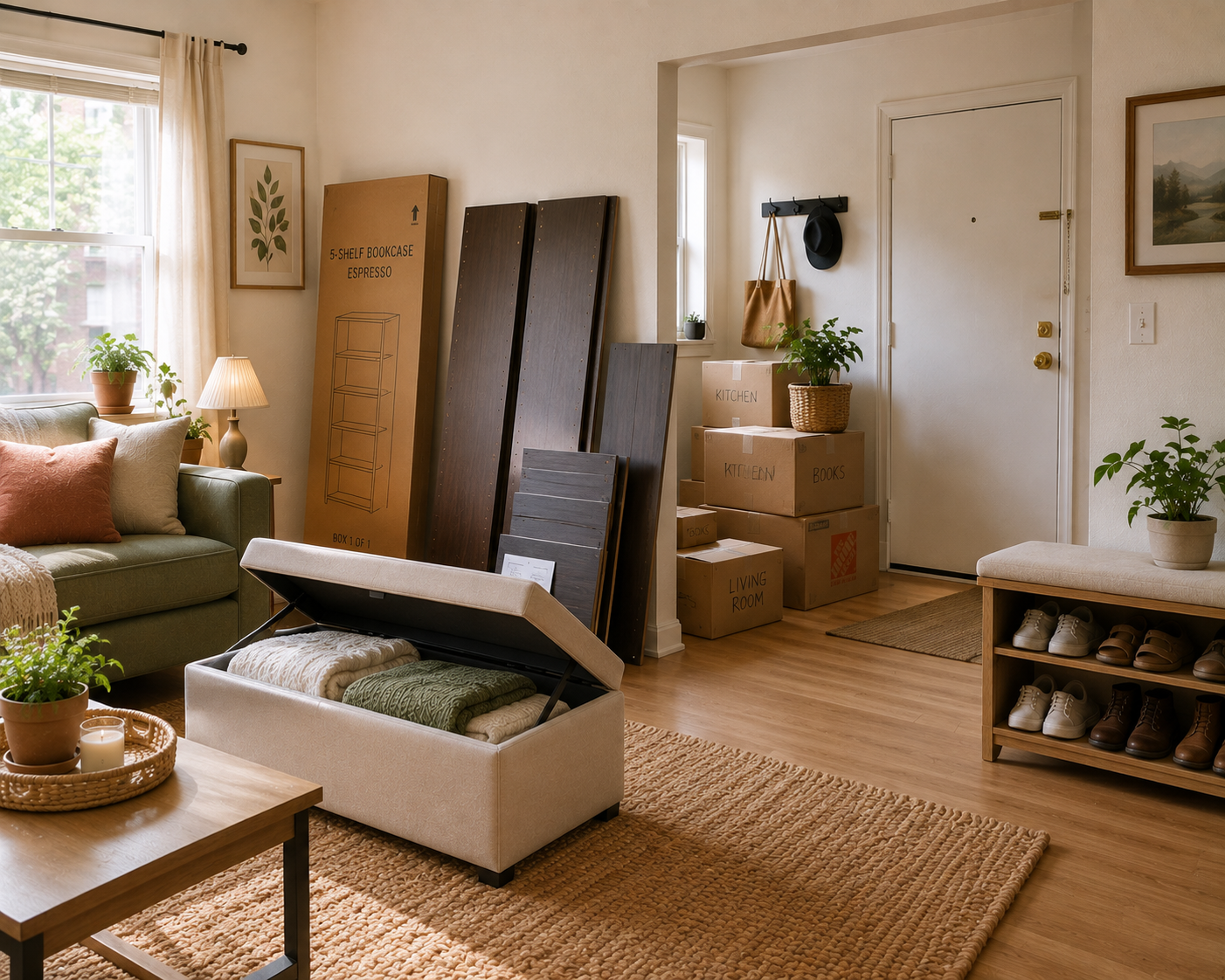
A storage ottoman does more per square foot of footprint than almost any other piece of apartment furniture, functioning as a coffee table, extra seating, and hidden storage all at once, while remaining genuinely easy to relocate.
What to look for: A lift-off or hinged lid gives full access to the interior without needing to move the ottoman itself, and a sturdy, removable tray-style lid (rather than one permanently attached with weak hinges) tends to hold up better over repeated use and moves. Interior dimensions matter more than exterior size when shopping, since some ottomans look large but have a surprisingly shallow or narrow storage cavity once the padding and frame are accounted for.
Materials that travel well: A wood or engineered-wood frame with a removable fabric or leather-look cover holds up better to moving-day bumps than an all-foam or all-fabric construction, which can lose its shape after being compressed in a moving truck or storage unit between leases. Look specifically for a rigid internal frame, even if the exterior feels soft and upholstered.
What tends to disappoint: Very inexpensive ottomans with thin particleboard frames and non-removable lids often crack at the hinge point within the first year or two of regular use, well before a first move even happens. This is one category where a modest step up in price meaningfully improves both daily durability and how well the piece survives transport.
Benches: Function at the Entry, Bedroom, or Foot of the Bed
A storage bench earns its place in an apartment by solving a specific, recurring problem, somewhere to sit while putting on shoes, somewhere to catch a bag or a stack of mail, while hiding the actual clutter underneath or inside.
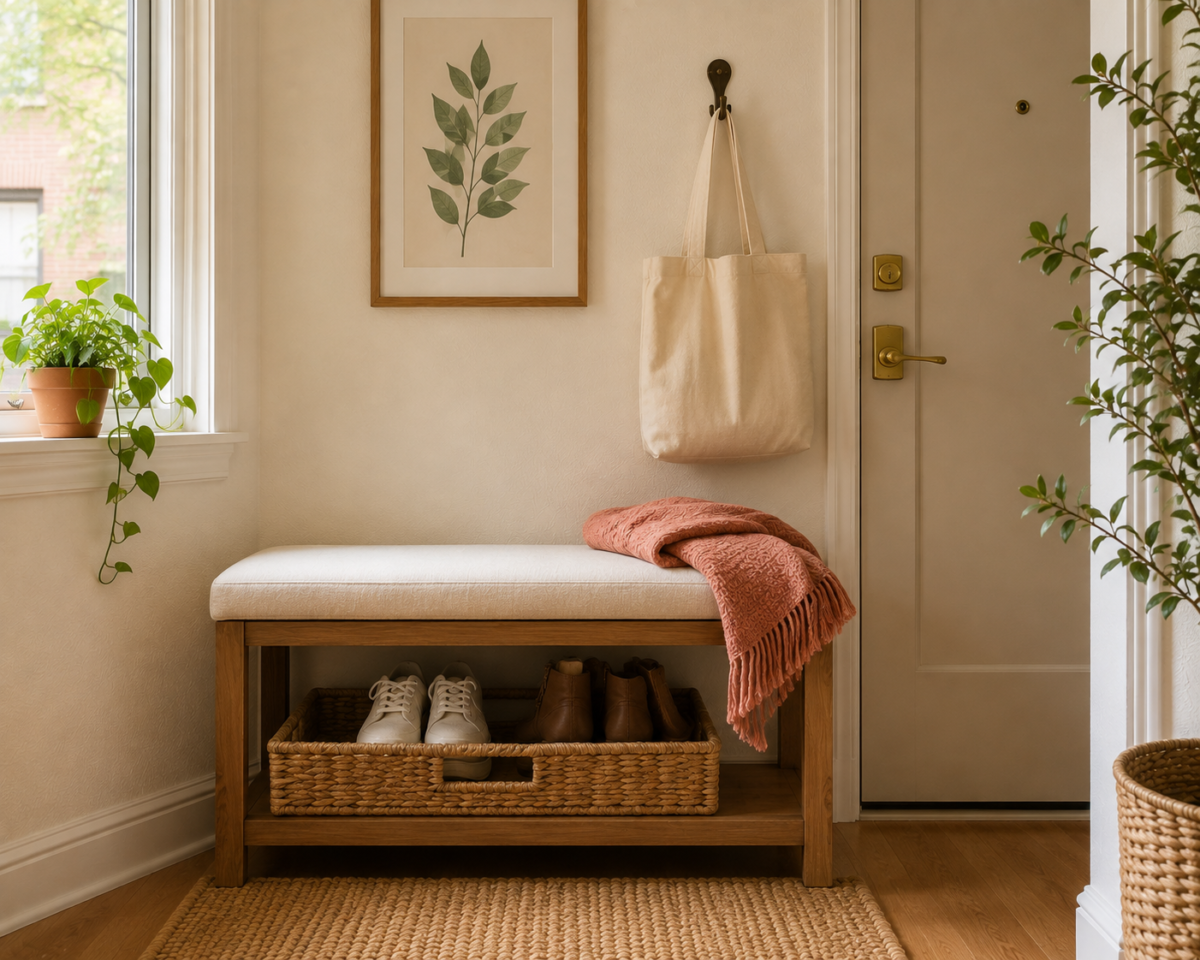
Bench with baskets underneath is the simplest, most move-friendly version of this category. A slatted or open-frame bench paired with removable woven or fabric baskets separates into lightweight components instantly, no disassembly tools required, and the baskets themselves are useful on their own in a new apartment even if the bench’s exact spot changes.
Bench with an enclosed storage compartment (a hinged seat lifting to reveal a cavity underneath) holds more per square foot than the open-basket version but is generally heavier and less flexible to reconfigure. This style works best when you’re confident about its long-term spot in the apartment, since it’s a bit more of a commitment than the basket version.
Sizing for the entry specifically: A bench between 30 and 42 inches wide fits most apartment entries without blocking the door swing or a hallway walking path. Measure the actual clearance before buying, since entry areas in apartments are often narrower than they first appear once a door’s full swing radius is accounted for.
Shelving: The Piece That Does the Most Long-Term Work
Open shelving and bookshelves are the backbone of apartment storage, and they’re also one of the easiest categories to get genuinely wrong on the portability question, since some styles that look similar on a retail website differ enormously in how they handle a real move.
True flat-pack shelving ships as separate panels, side pieces, shelves, back panel, and assembles with basic cam locks or included hardware. This style disassembles back to its original flat panels for a move nearly as easily as it assembled, and it’s consistently the most move-friendly option in this entire furniture category.
Modular cube storage systems (individual cube units that connect to form larger configurations) offer a specific advantage beyond standard flat-pack shelving: they can be reconfigured into a different shape entirely for a new apartment’s layout, rather than needing to fit the exact same footprint every time. A 3-by-3 cube grid in one apartment can become a 2-by-4 or a single vertical column in the next, without buying anything new.
Solid wood or metal-frame shelving without knock-down joinery tends to be sturdier day-to-day but is significantly harder to move, since it typically has to travel as one assembled unit. This trade-off is worth making consciously: if the piece is genuinely going to stay in one place for years, the sturdier option can be worth it, but if a move is likely within a year or two, flat-pack or modular options are almost always the better call.
A quick way to check before buying: Look at the product’s assembly instructions or exploded-view diagram, available on most retailer listings, before purchasing. If the diagram shows the piece coming apart into a small number of flat, manageable components, it’s genuinely built for repeated moves. If it shows a single welded or permanently joined structure, plan on that piece being harder to relocate later.
Dressers and Wardrobes: The Category Where Weight Adds Up Fast
Dressers deserve a closer look on their own, since they’re one of the heaviest single pieces in most apartments and one of the most common regrets on moving day, particularly solid wood dressers bought for their durability without much thought given to how that same durability translates into weight.
Flat-pack dressers are widely available now in styles that don’t read as flat-pack once assembled, and they offer the same disassembly advantage as flat-pack shelving: panels, drawer fronts, and hardware that pack down to a manageable stack rather than traveling as one heavy, fully built unit. The trade-off is generally a lighter-duty drawer glide system compared to a solid wood dresser, which matters if the dresser sees heavy daily use.
Solid wood dressers last longer and handle daily wear better, but a six-drawer solid wood dresser can easily weigh 150 pounds or more even empty, which means professional movers or at minimum several strong friends for every single move. If a piece like this is genuinely going to be a long-term investment, that trade-off can make sense. If moving frequency is high, it’s worth weighing that cost honestly against a quality flat-pack alternative.
A middle-ground option: Canvas or fabric wardrobe systems with a metal frame, essentially a portable closet, offer real hanging and shelf storage capacity while breaking down to a small number of lightweight components. These work particularly well in an apartment with limited or awkward closet space, doubling as both a storage solution today and one of the easiest pieces in the entire apartment to move later.
Budgeting for Furniture That Actually Lasts Through a Move
Price alone doesn’t predict which pieces survive multiple apartments, but a few patterns hold up consistently enough to guide a budget sensibly across this category.
The middle tier usually outperforms both extremes. The cheapest option in any given category, an ottoman, a bookshelf, a dresser, tends to use the thinnest materials and the weakest hardware, which shows up first as daily wear and then as damage during a move. The most expensive option often prioritizes finish and design over practical portability, solid wood, heavy hardware, permanent joinery, which can mean a beautiful piece that’s genuinely difficult to relocate. A well-reviewed mid-tier piece, particularly one explicitly designed with knock-down construction, tends to balance durability and portability better than either extreme.
Spend where daily use is heaviest. A storage ottoman or bench that gets sat on and opened daily benefits from a slightly higher budget than a shelving unit that mostly just holds items in place, since the moving parts (hinges, cushioning, drawer glides) are what wear out first under regular use.
Factor in the cost of NOT moving something. A heavy, difficult-to-disassemble piece often ends up abandoned at the curb before a move rather than transported, which means its true cost includes replacing it in the new apartment on top of whatever was originally paid. A slightly pricier, genuinely portable alternative can work out cheaper across two or three moves than repeatedly buying and abandoning the cheapest option each time.
Multi-Purpose and Nesting Furniture: Storage That Compresses
A category worth calling out on its own: furniture explicitly designed to take up less space when not in active use, which pays off both in daily apartment living and at moving time.
Nesting tables (a set of two or three tables that stack into one footprint) give you the flexibility of extra surfaces when guests are over, without permanently dedicating floor space to tables you use only occasionally. At moving time, a nested set of three tables takes up roughly the same truck space as one, which is a real, practical advantage over a single large coffee table offering the same total surface area.
Stacking storage bins with lids (rather than fixed shelving units) let you scale your storage up or down as your actual needs change, and they nest inside each other when empty, which matters if you ever need to temporarily reduce your footprint, moving into a smaller place, staging for a move, or storing items off-site for a period.
Fold-flat or collapsible shelving units, a newer category in apartment-focused furniture, assemble without tools and fold back down to a slim, nearly flat profile for transport or storage. These trade some structural rigidity for genuine portability, and they’re a reasonable choice for a temporary living situation or a first apartment where the long-term footprint isn’t yet certain.
What to Check Before Buying Any Piece in This Category
A short checklist, run through before any storage furniture purchase, catches most of the problems that show up later, either in daily use or at the next move.
- Does it disassemble, and how many components result? Fewer, larger flat panels are easier to move than many small pieces, but both are better than a single non-disassembling unit.
- What’s the heaviest single component once broken down? Under roughly 30 to 40 pounds means one person can reasonably manage it without help.
- Does the interior storage capacity match what the exterior size suggests? Padding, internal framing, and design choices can significantly reduce usable interior space compared to what the overall dimensions imply.
- Is the frame material genuinely durable, or just styled to look sturdy? A quick look at the frame material (particleboard versus solid wood or metal) and the hardware used for joints tells you more about long-term durability than the finish or upholstery does.
- Would this piece still make sense in a differently shaped room? Modular or reconfigurable pieces adapt to a new apartment’s layout far more easily than fixed-dimension furniture built for one specific spot.
Frequently Asked Questions
What’s the most versatile storage furniture piece for a small apartment? A storage ottoman, since it functions as seating, a coffee table, and hidden storage all in one footprint, while remaining light enough and simply constructed enough to move easily between apartments.
Does flat-pack furniture actually hold up as well as solid pre-assembled pieces? Quality flat-pack furniture, using solid cam-lock joinery and real wood or heavy-duty engineered wood panels, holds up well to years of regular use and repeated disassembly. The main risk is with very inexpensive lines using thin particleboard and weak fasteners, which can loosen after multiple moves.
How do I know if storage furniture will fit through my apartment’s doorways and stairwells? Check the assembled dimensions against your doorway and stairwell width before buying, but also check whether the piece ships and disassembles in smaller components, since flat-pack furniture can often navigate tight spaces that a single pre-assembled unit couldn’t.
Are modular cube storage systems worth it over standard shelving? They’re worth the modest price premium if you expect to move more than once or if your apartment’s layout might change, since they can reconfigure into different shapes rather than being locked into one fixed footprint the way standard shelving is.
What storage furniture should I avoid buying for an apartment I might move out of soon? Avoid heavy, permanently assembled pieces without knock-down joinery, solid non-flat-pack dressers or bookshelves in particular, since these are the hardest and most expensive to relocate. Prioritize flat-pack, modular, or nesting options instead.
Related Reading
- The Complete Guide to Apartment Storage — the full three-layer storage system this furniture guidance fits into.
- Vertical Storage for Apartments With No Extra Closets — the wall-mounted layer that pairs with this furniture for maximum capacity.
- Under-Bed and Under-Furniture Storage That Actually Works — activating the space underneath the furniture covered here.
- Command Strips and Adhesive Hooks Worth Trusting — weight-rated hanging solutions for lightweight storage that doesn’t need floor space at all.
- Parent Category: Apartment Storage
- Parent Hub: Apartments & Rentals