Table of Contents
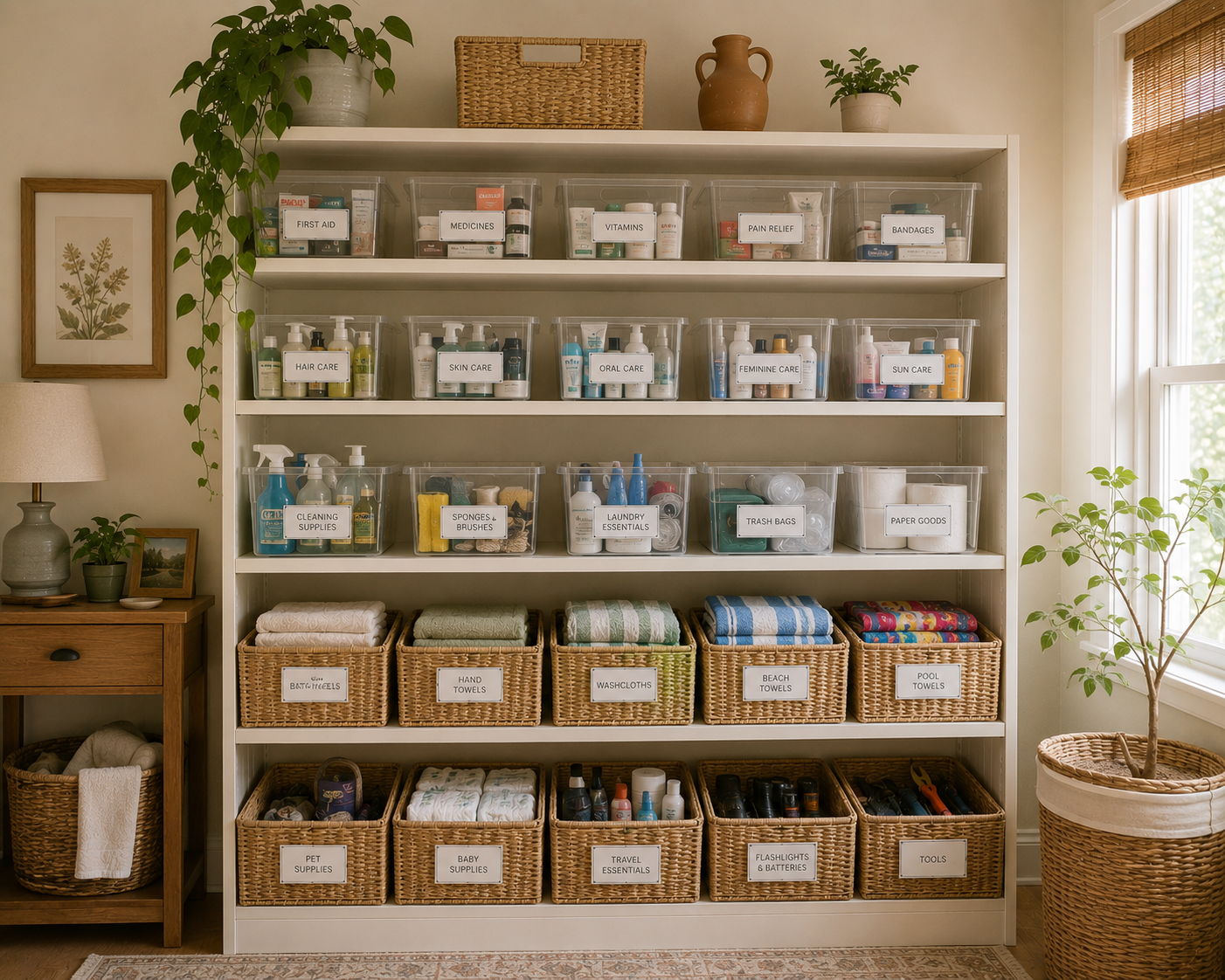
There’s a familiar pattern with bin and basket systems. Week one, everything looks great, every basket has a clear purpose, every bin is neatly filled, the whole shelf looks like something out of a home organization feature. Week three, half the bins hold a mix of things that don’t belong together, a few items have migrated onto the shelf surface instead of inside any bin at all, and the system that looked so promising has quietly stopped functioning.
This isn’t a failure of willpower or consistency. It’s almost always a design problem, specifically, bins that were sized or labeled in a way that made the system genuinely hard to maintain, regardless of how motivated anyone was to keep it up. A bin and basket system that actually survives past the first few weeks needs to be built around a few specific principles from the start, not fixed after the fact once it’s already fallen apart.
Why Most Bin Systems Fail Within a Month
Before getting into what works, it’s worth understanding the specific failure points that undo most bin and basket systems, since avoiding these matters more than any particular product choice.
Bins sized around what looked good on a shelf, rather than what actually needed to fit inside them. A uniform set of matching bins looks appealing in a store or a photo, but if the bins don’t match the actual volume and shape of what’s going in them, the system starts breaking down the moment real items go in, either through overstuffing or through wasted, underused space.
No labels, or labels too vague to actually help. A system that relies on remembering which bin holds what works fine for the person who set it up, for about two weeks. After that, or for anyone else using the space, an unlabeled or vaguely labeled bin becomes a guessing game, and guessing games get skipped in favor of just leaving something out.
Too many categories crammed into too few bins. When a single bin has to hold “miscellaneous bathroom stuff” spanning five unrelated categories, it becomes a junk drawer in bin form, technically containing everything but functionally organizing nothing.
No accounting for how items actually get retrieved and returned. A bin that’s hard to reach, heavy to pull out, or awkward to open discourages the exact behavior, actually putting things back, that makes any organization system work in the first place.
Sizing Bins to Their Actual Contents
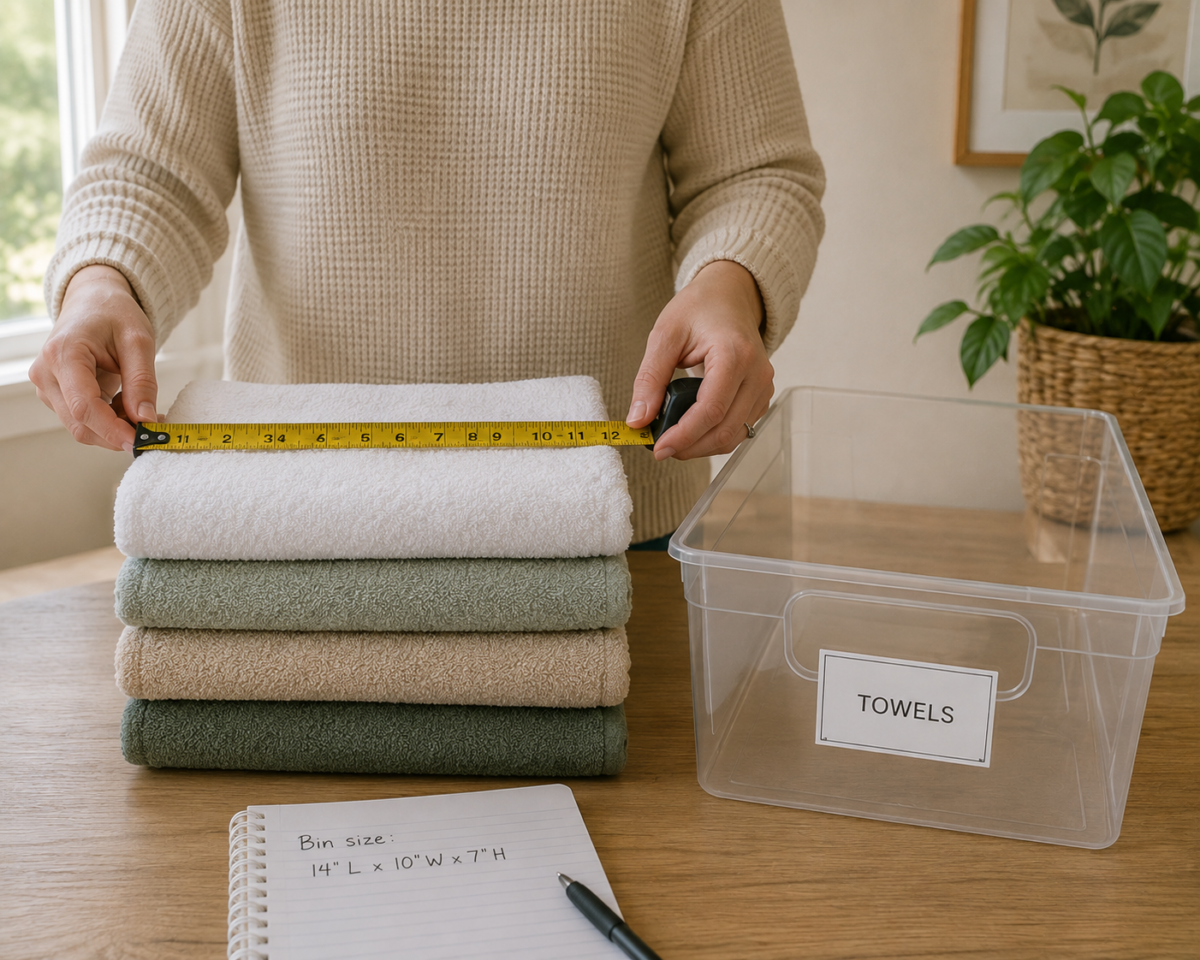
Getting the size right before buying is the single most important step in building a bin system that actually lasts, and it’s also the step most people skip in favor of grabbing a matching set that looks coordinated.
Group items by category first, then measure the actual volume of each group. Rather than deciding on a bin size and then figuring out what fits, start with what needs to be stored, all the hand towels, all the extra chargers and cables, all the winter accessories, and measure roughly how much physical space that category actually takes up before shopping for a container.
Leave a bit of extra room, not a lot. A bin that’s exactly the size of its contents becomes difficult to use, since there’s no room to see what’s inside or pull individual items out without unpacking the whole thing. A bin with roughly 15 to 20 percent more capacity than the current contents allows room to actually use the space without feeling immediately overstuffed, while still being appropriately sized rather than mostly empty.
Match bin shape to shelf depth, not just to what’s available at the store. A bin deeper than the shelf it sits on either sticks out awkwardly or gets pushed back so far it’s hard to reach, while a bin significantly shallower than the shelf wastes usable depth. Measuring the shelf before buying prevents both problems.
Different categories genuinely need different bin styles, and that’s fine. Not every bin in a system needs to match, an open basket for frequently grabbed items, a lidded bin for less-often-needed storage, a clear container for anything you want to identify at a glance, serves the system better than forcing every category into the same style of container for the sake of visual uniformity.
Building a Labeling System That Actually Gets Used
Labels are what separate a bin system that survives from one that quietly stops working, and the specific approach to labeling matters more than most people initially assume.
Be specific rather than general. A label reading “Miscellaneous” or “Extra Stuff” provides almost no actual guidance about what belongs inside, which means new items get added based on guesswork rather than an actual category, and the bin slowly becomes exactly the kind of catch-all it was meant to prevent. A label reading “Winter Scarves & Gloves” or “Phone Chargers & Cables” gives a clear, specific boundary for what does and doesn’t belong.
Make labels visible from a normal viewing angle, not just from directly in front. A label on the top of a lidded bin that’s stacked below eye level, or a label on the back of an open basket facing the wall, provides essentially no benefit, since it’s never actually seen during normal use. Position labels where they’ll genuinely be seen, typically on the front-facing side at whatever height the bin sits.
Choose a labeling method that matches how often the system’s contents change. A frequently rotating category, seasonal clothing, changing craft supplies, benefits from an erasable or easily replaceable label, a chalkboard-style tag, a label maker with removable tape, rather than something permanent that becomes wrong or misleading once the contents shift.
Involve everyone who uses the space in understanding the labeling system, not just whoever set it up. A system that only makes sense to one person in a household inevitably breaks down when someone else needs to find or put away an item and can’t interpret the labels the way the original organizer intended.
The Three-Category Sorting Approach That Prevents Overcrowding
Beyond sizing and labeling individual bins, the overall system benefits from a consistent sorting logic applied across every bin in a given space, which keeps the whole system coherent rather than a collection of individually organized but disconnected containers.
Frequency of use should determine placement, not just category. Items used daily or weekly belong in the most accessible bins, at eye level or within easy reach, while items used only occasionally can go in bins positioned higher, lower, or further back, where slightly less convenient access is a reasonable trade-off for items that don’t need to be grabbed quickly and often.
Keep related categories physically near each other, even across separate bins. Grouping all bathroom-related bins together, all craft supply bins together, rather than scattering related categories across a shelf based on whatever fit where, makes the whole system more intuitive to navigate, both for finding items and for deciding where something new belongs.
Leave at least one bin’s worth of flexible, unassigned capacity. A system built to exactly the current volume of belongings, with zero spare room anywhere, breaks down the moment anything new needs a home. A small amount of deliberate flexibility, either an intentionally underfilled bin or genuinely empty shelf space, absorbs new items without forcing an immediate reorganization of the entire system.
Maintaining the System Once It’s Built
A quick weekly check, even just two or three minutes, catches drift before it becomes a full breakdown. Glancing over the bins and returning anything that’s ended up outside the system, a stray item on the shelf surface instead of inside its bin, prevents small deviations from compounding into a fully collapsed system weeks later.
Assign the check to a specific, low-friction moment rather than an open-ended intention. A weekly check that happens right before trash day, or while putting away laundry, is far more likely to actually occur than one left as a vague “I’ll do it sometime this week” plan with no anchor to an existing routine.
When a bin consistently overflows, that’s information, not a failure. An overflowing bin usually means either the category genuinely has more volume than initially planned for, worth sizing up, or the category itself needs to be split into two more specific bins rather than one broad one. Either fix is better than simply cramming the existing bin fuller than it should hold.
Revisit the whole system every few months, not just when something visibly breaks down. Belongings shift over time, seasonal items rotate, new categories emerge, old ones shrink, and a system built for last year’s contents may need adjusting even if nothing has gone visibly wrong yet. A periodic check-in keeps the system matched to actual current needs rather than a snapshot from whenever it was first set up.
Accept that some drift is normal, and a quick reset is fine. No bin system stays in its exact original state indefinitely, and treating an occasional reorganization as routine maintenance, rather than evidence the whole system failed, keeps the process sustainable rather than something to dread or avoid.
Choosing Materials for Different Rooms and Uses
Beyond size and labeling, the actual material a bin or basket is made from affects how well it holds up in a specific room, and matching material to environment prevents a whole separate category of premature failure.
Woven natural fiber baskets work well in living rooms and bedrooms for lightweight items, blankets, books, decorative pieces, but they hold up poorly to moisture and can be harder to wipe clean than a plastic or fabric alternative, making them a weaker choice for a kitchen or bathroom.
Clear or opaque hard plastic bins handle moisture, weight, and frequent handling better than most other materials, which makes them the more reliable choice for kitchens, bathrooms, and any storage area subject to humidity or heavier contents.
Fabric bins with reinforced structure strike a middle ground, lighter and often less expensive than hard plastic, while holding their shape better than a fully soft, unstructured fabric bag. These work well for closets and bedrooms where moisture isn’t a major concern but some structural reliability still matters.
Metal wire baskets suit pantry and kitchen use particularly well, since they allow airflow around contents, useful for produce or items that benefit from ventilation, while still offering more structure and durability than woven natural fiber.
Adapting the System as a Household Grows or Changes
A bin and basket system built for one point in a household’s life rarely stays perfectly matched as circumstances shift, and building in some flexibility from the start makes those transitions far less disruptive than starting over from scratch.
Children’s storage needs change faster than almost any other category. A bin system built around toddler toys will need substantial revision within a year or two as interests and belongings shift toward different categories entirely. Choosing adjustable shelving and modular bins, rather than a fully custom, fixed setup, makes these transitions easier to accommodate without replacing the entire system.
A household gaining or losing a member shifts capacity needs in both directions. Moving in with a partner, welcoming a new family member, or a child moving out all change how much of a given category actually needs storage. Building in that flexible, unassigned capacity mentioned earlier pays off especially well during these transitions, since it absorbs a shift in either direction without requiring an immediate system overhaul.
Seasonal rotation deserves its own semi-permanent bin category, rather than being folded into general storage. A dedicated set of bins for seasonal items, swapped twice a year as the seasons change, keeps this naturally rotating category from disrupting the rest of the system, which can stay stable and consistent while only the seasonal bins actually change contents.
Frequently Asked Questions
Why do bin and basket organization systems usually fall apart after a few weeks? Most commonly because bins were sized around appearance rather than actual contents, or because labels were too vague to give clear guidance about what belongs where. Both issues make the system harder to maintain than it needs to be, regardless of initial motivation.
Should all my storage bins match, or can I mix styles? Mixing styles is genuinely fine, and often works better than forcing every category into the same container type. Open baskets suit frequently accessed items, lidded bins suit less-often-needed storage, and clear containers help with quick visual identification, each serving a different practical purpose within the same overall system.
How much extra space should a storage bin have beyond its current contents? Roughly 15 to 20 percent more capacity than the current contents strikes a reasonable balance, enough room to actually use the space without immediate overstuffing, without being so oversized that it wastes shelf space or looks mostly empty.
What’s the best way to label storage bins so the system actually gets used? Be specific rather than general, and position labels where they’re genuinely visible during normal use, typically the front-facing side at the bin’s actual height on the shelf. Choose an erasable or replaceable labeling method for any category that changes contents frequently.
How often should I check or reorganize a bin and basket system? A quick weekly glance catches small issues before they compound, while a more thorough review every few months keeps the system matched to how belongings have actually changed over time. Occasional drift and reorganization are a normal, expected part of maintaining any system, not a sign it failed.
Related Reading
- The Complete Small-Space Storage Guide — the full three-layer storage system this bin and basket approach fits into.
- Vertical Storage Ideas for Rooms With No Floor Space Left — the shelving layer this bin system typically sits on.
- Storage Furniture That Pulls Double Duty — where a bin system fits inside multi-purpose furniture like a storage ottoman or bench.
- The Complete Small-Space Decluttering Guide — the decluttering process worth completing before sizing and building out this bin system.
- Parent Category: Small-Space Storage
- Parent Hub: Organization & Storage