Table of Contents
Open the closet door in most small bedrooms and you already know what you’re going to see before you look: clothes packed so tight the hangers won’t slide, a shelf above that’s become a catch-all for things you forgot you owned, and shoes in a pile on the floor because there was never really a spot for them in the first place. That closet is doing its best. It’s just also doing the job of about four different storage systems at once, and no reach-in closet was ever built for that.
Here’s the good news — the closet isn’t actually your only option, and in most small bedrooms, it isn’t even your best one. The floor space under your bed, the wall you’ve been ignoring, and a couple of pieces of furniture that could be working twice as hard are all sitting there unused. This guide walks through where to look first, second, and third, and how it all comes together in a bedroom that’s genuinely small — not a magazine-sized “small” bedroom that’s secretly 200 square feet.
The Space You’re Already Not Using
Before you touch the closet, look under the bed. It’s the single most overlooked storage zone in almost every small bedroom, and unlike the closet, it’s usually sitting completely empty.
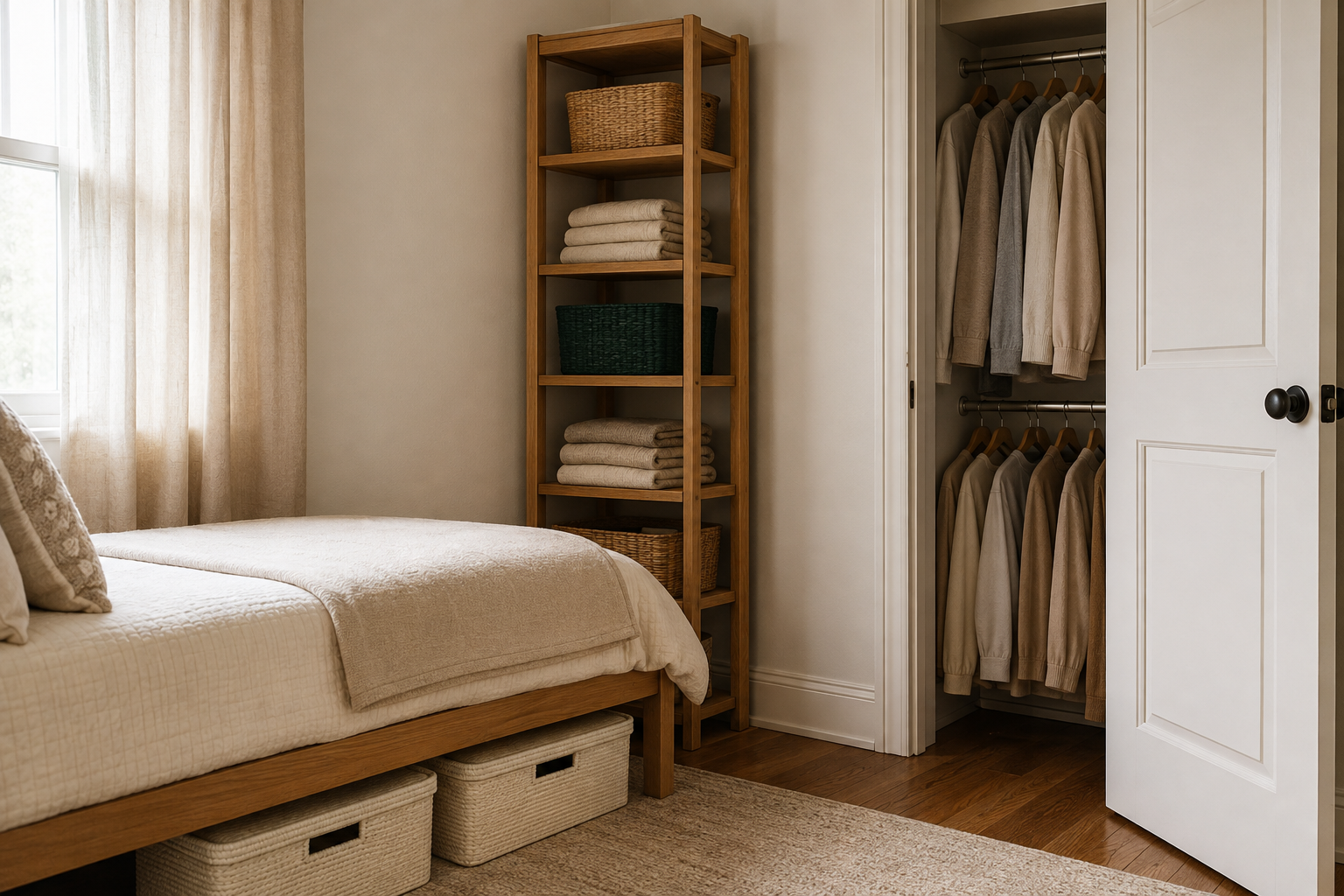
A standard bed frame with a box spring or platform typically leaves somewhere between 6 and 14 inches of clearance underneath, depending on the frame style — enough for flat storage bins, vacuum-sealed bags for off-season clothing, or a purpose-built rolling bin with a lid. If your current frame sits too low to fit anything, bed risers (small, inexpensive stands that lift the frame a few inches) solve that in about ten minutes, no tools required.
What goes here matters as much as the storage itself. Off-season clothing, extra bedding, and things you reach for occasionally but not daily are perfect candidates. Daily-use items belong somewhere more accessible — bending down and pulling out a bin every morning gets old fast, and a storage system that’s annoying to use stops getting used within a couple of weeks.
If you’re starting from scratch and haven’t bought a bed frame yet, a storage bed (built-in drawers or a lift-up frame with hidden space beneath the mattress) does this job automatically, without needing separate bins at all.
Going Up Instead of Out
Once under-bed storage is handled, the next-best space in a small bedroom is directly above your head — vertical space that almost nobody uses because low, wide furniture is what most stores sell by default. A tall, narrow shelving unit or dresser claims the same floor footprint as a short one but holds two or three times as much.
Look specifically for furniture described as “narrow” or “slim profile” rather than standard dimensions — a dresser that’s 24 inches wide and 60 inches tall stores roughly the same volume as one that’s 48 inches wide and 30 inches tall, but the tall version leaves twice the floor space free for walking. In a room where every square foot of floor is doing double duty, that difference matters more than it sounds like it should.
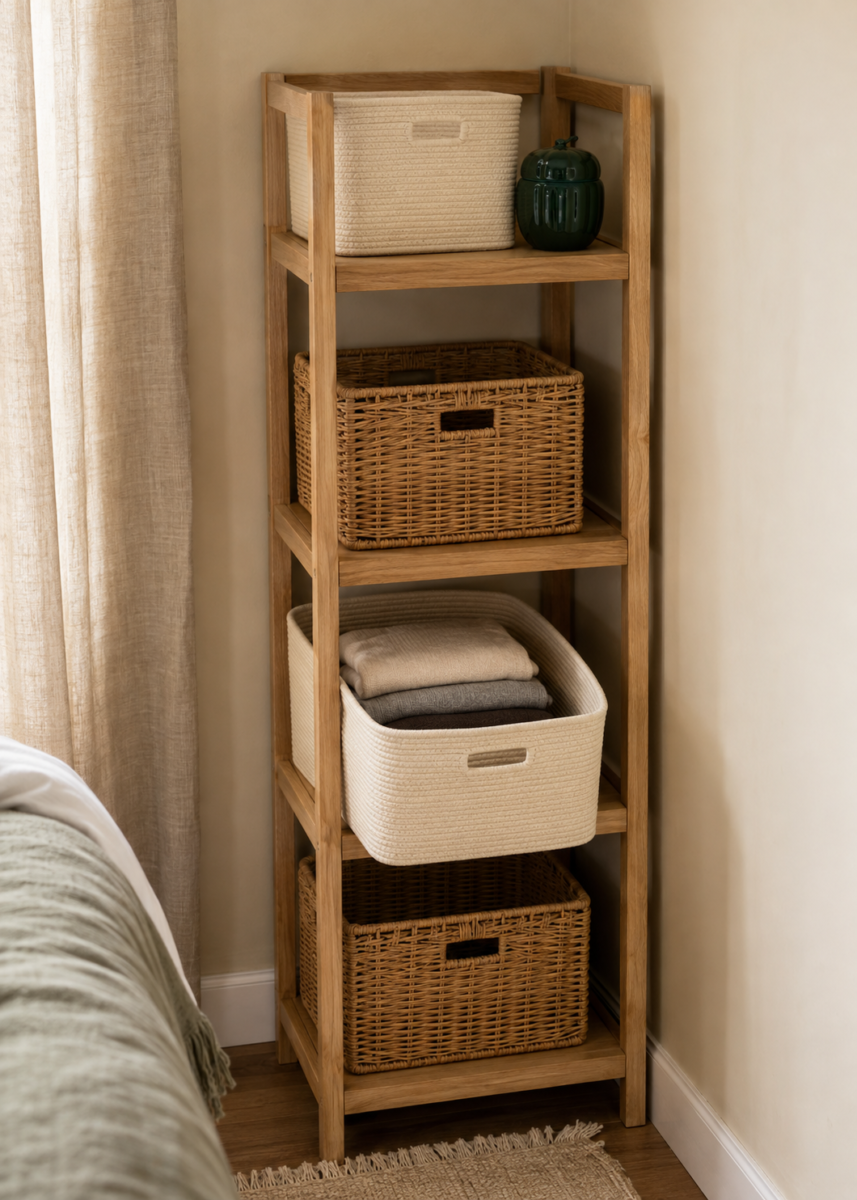
Open shelving works particularly well in a corner that would otherwise sit empty — a spot too small for a full dresser but plenty big enough for a slim bookshelf-style unit holding folded clothes in matching baskets. The trick is using baskets or bins on open shelving rather than stacking loose items directly on the shelves; loose stacks slump and look cluttered within days, while a basket keeps the same items looking intentional indefinitely.
Making the Closet Work Harder
A standard reach-in closet holds roughly twice as much once it’s organized for double-hanging and vertical stacking instead of a single rod and one shelf, which is usually how it comes from the builder. This is the cheapest, highest-impact closet upgrade available, and it typically takes an afternoon, not a weekend.
A double-hanging rod (installed below the existing one, splitting the closet into an upper and lower hanging zone) roughly doubles hanging capacity for shirts, folded pants, and shorter items — anything that doesn’t need full-length hanging space. Stackable bins or a small set of drawers on the closet floor reclaim the space below the hanging clothes that usually just collects a pile of shoes. Over-door organizers, hung on the back of the closet door itself, add storage that costs nothing in floor or shelf space at all, since the door was otherwise doing nothing but opening and closing.
The order to tackle these matters less than doing them at all — but if you’re starting with just one, the double-hanging rod tends to free up the most usable space for the least effort, since it’s solving the closet’s most common bottleneck: full-length hanging space being used for things that don’t actually need it.
Furniture That Pulls Double Duty
A storage ottoman, a bench with a lift-up seat, or a bed frame with built-in drawers all do the same thing: they give a piece of furniture you already needed a second job, instead of adding a separate storage piece that takes up its own floor space. In a small bedroom, this kind of dual-purpose furniture is worth prioritizing over standalone storage almost every time.
A bench at the foot of the bed with hidden storage underneath solves two problems at once — somewhere to sit while getting dressed, and a spot for extra blankets or out-of-rotation shoes. A storage ottoman does something similar in a smaller footprint, and can double as a nightstand in a genuinely tight layout. None of these require giving up floor space you weren’t already planning to use for a chair or side table anyway.
The Bins-and-Baskets Trap
Here’s something worth saying plainly: buying more bins doesn’t fix a storage problem on its own, and it’s one of the easiest ways to spend money without actually solving anything. A bin without a clear job — “stuff that doesn’t have anywhere else to go” — just becomes a nicer-looking version of the same clutter, one layer removed.
Every bin, basket, or bin-adjacent purchase should have one specific category assigned to it before it comes home. Off-season sweaters. Extra bedsheets. Shoes you wear twice a year. If you can’t name what’s going in a bin before you buy it, that’s usually a sign you’re buying storage to feel like you’re making progress, rather than actually solving where a specific set of things belongs.
Storage for the Things That Don’t Fit Anywhere Else
Clothes and bedding get most of the attention in a storage plan, but shoes, jewelry, and books tend to be the categories that end up piled on a dresser top or the closet floor because nobody planned a home for them in the first place. Each one has a fix that doesn’t need much space.
Shoes rarely need floor space if you don’t want them to. An over-door shoe organizer uses the same “free” real estate as the over-door bins mentioned above, and a slim under-bed shoe box keeps a rotating seasonal set out of sight without competing with clothing storage. If you wear the same three or four pairs on repeat, a small tray by the door (even outside the bedroom entirely) often serves better than any bedroom storage solution — daily-use shoes belong somewhere you actually pass on your way out, not tucked away where retrieving them becomes its own small chore.
Jewelry and small accessories get lost in drawers more than almost anything else in a bedroom, mostly because a deep drawer treats a delicate necklace the same way it treats a folded sweater. A shallow, divided tray — even a repurposed one, not necessarily a “jewelry box” — solves this by giving small items enough visual space that they don’t tangle or disappear into a pile. Keep it somewhere you’ll actually see it daily, like on top of the dresser or inside a shallow top drawer, rather than in with everything else.
Books, if you have more than a handful, deserve their own small vertical shelf rather than getting distributed across a nightstand, a windowsill, and the floor. A single narrow shelf holding your current reading and a few favorites keeps the collection from creeping into other zones of the room — and if the collection grows past what one small shelf holds, that’s usually a sign it’s time to donate the ones you’re not going back to, rather than finding a fourth surface for them to live on.
Storage That Works for Renters
Every storage solution in this guide is fully renter-safe, which matters as much as how much space something creates, since a storage system that costs you your deposit isn’t actually saving you anything. Under-bed bins, freestanding shelving, over-door organizers, and a double-hanging closet rod (which typically clips onto the existing rod rather than requiring any drilling) all come out cleanly at move-out with zero patching required.
The one item worth double-checking before installing: some over-door organizers use a bracket that rests over the top of the door rather than screwing into it, which is worth confirming before you buy if you want to avoid any marks at all. If you do need a wall-mounted shelf for the vertical storage section above, look for a lease clause about small nail holes — most standard leases allow a reasonable number of picture-hanging holes, which is typically enough for one or two small shelf brackets without needing special permission.
Putting It Together in a Real Small Bedroom
Say your bedroom is a fairly standard 10-by-10 layout with a single reach-in closet, no walk-in, and a queen bed that takes up a meaningful chunk of the floor. Here’s roughly how the space breaks down once all of this comes together: under-bed bins handle off-season and occasional-use items, a tall narrow shelving unit in whichever corner the bed’s placement leaves free handles folded clothing and everyday basics, the reorganized closet with a double-hung rod handles the bulk of hanging clothes, and a small bench or ottoman at the foot of the bed picks up whatever’s left — extra blankets, out-of-season shoes, or anything that doesn’t fit neatly into the first three categories.
That’s four distinct storage zones doing the work a single overstuffed closet was trying to handle alone. None of them require knocking down a wall or finding a spare room that doesn’t exist. They just require looking at the space you already have a little differently than “the closet is where storage happens, and everywhere else is just floor.”
FAQ
What’s the single best storage upgrade for a small bedroom on a tight budget? Under-bed bins, almost always. The space is usually sitting completely empty, bins cost very little, and it solves the most common storage bottleneck — off-season and occasional-use items with nowhere else to go.
Is a double-hanging closet rod worth installing myself? Yes, for most standard closets. It typically requires basic tools and roughly an hour, and it approximately doubles usable hanging space for shorter items like shirts and folded pants.
How do I stop buying bins that don’t actually help? Assign each bin a specific category before buying it — name exactly what will go inside. If you can’t name it, the bin is solving a feeling of progress rather than an actual storage problem.
Do storage beds actually hold as much as separate under-bed bins? Often more, since the storage is built into the frame’s full footprint rather than limited by whatever clearance a standard frame happens to leave. They’re a strong option if you’re buying a bed frame from scratch anyway.
What if my closet is too small even after reorganizing it? Shift more of the load to vertical shelving and under-bed storage rather than trying to force everything into the closet. A reach-in closet was never designed to hold an entire wardrobe on its own, especially in a smaller apartment.
Related Reading
- The Complete Small Bedroom Guide — the full layout → storage → decor sequence this guide fits into
- Small Bedroom Layout Guide — bed placement and furniture arrangements that work around one window and one door
- Small Bedroom Decor Guide — making a small bedroom feel calm and finished
- Small Bedroom Storage Guide (In the Right Order) — related Taims Space guide.
- Under-Bed Storage Ideas — related Taims Space guide.
- Vertical Storage Solutions for Every Wall — related Taims Space guide.
- Storage Furniture: Beds, Benches and Ottomans — related Taims Space guide.
- A Closet System That Stays Organized — related Taims Space guide.
Category: Bedroom Storage Hub: /small-bedrooms/
Reviewed by the Taims Space editorial team.