Table of Contents
The usual story about bedroom clutter is that it happens all at once, a busy week, a trip you haven’t unpacked from, a stretch where life got in the way. That’s rarely the real cause. Most small bedroom clutter builds two minutes at a time: a jacket that doesn’t quite make it to the closet, a mug that stays on the nightstand one more night, a stack of mail set down “just for now.” None of those moments look like a mess in the moment. Repeated daily, they are the mess.
That’s actually good news, because it means the fix isn’t a weekend overhaul. It’s three small habits, each under two minutes, aimed at the exact moments clutter usually starts, not the cleanup that happens after it’s already everywhere.
Why Prevention Beats a Bigger Cleanup
A small bedroom stays clutter-free when the daily habits happen before things land in the wrong spot, not after. Cleaning up clutter that’s already accumulated always takes longer than redirecting an item in the two seconds before it gets set down somewhere it doesn’t belong.
This is the distinction most organizing advice misses. A Sunday reset is useful, but it’s reactive by definition, it’s cleaning up a week’s worth of small decisions that already happened. The habits below work upstream of that, at the exact moment an item enters the room or a surface starts to collect something it shouldn’t. Get those three moments right most days, and there’s rarely much left for a weekend reset to catch.
Habit One: The Landing Zone by the Door
Give every item you carry into the bedroom a single designated spot, right at the point where you enter, so nothing has to travel further into the room before finding a home. A bag, a jacket, keys, whatever’s in your hands when you walk in should have one obvious place to go, a hook, a small tray, a chair reserved for exactly that and nothing else.
This works because it removes the decision entirely. Without a landing zone, every item requires a small judgment call, where does this actually go, and judgment calls under time pressure default to “wherever’s closest,” which is usually the bed, the floor, or the nearest flat surface. A landing zone answers the question before it’s asked. The item goes there because that’s its spot, not because you paused to think about it.
What makes a landing zone actually work:
- Put it at the entry point, not across the room. If the spot requires walking past the bed first, items will land on the bed before they reach it.
- Keep it to one designated spot, not a general area. “Somewhere near the door” isn’t specific enough to become automatic. A single hook or tray is.
- Empty it daily, so it never becomes its own pile. The landing zone is a transfer point, not permanent storage.
Habit Two: The One-Touch Rule for What Comes In
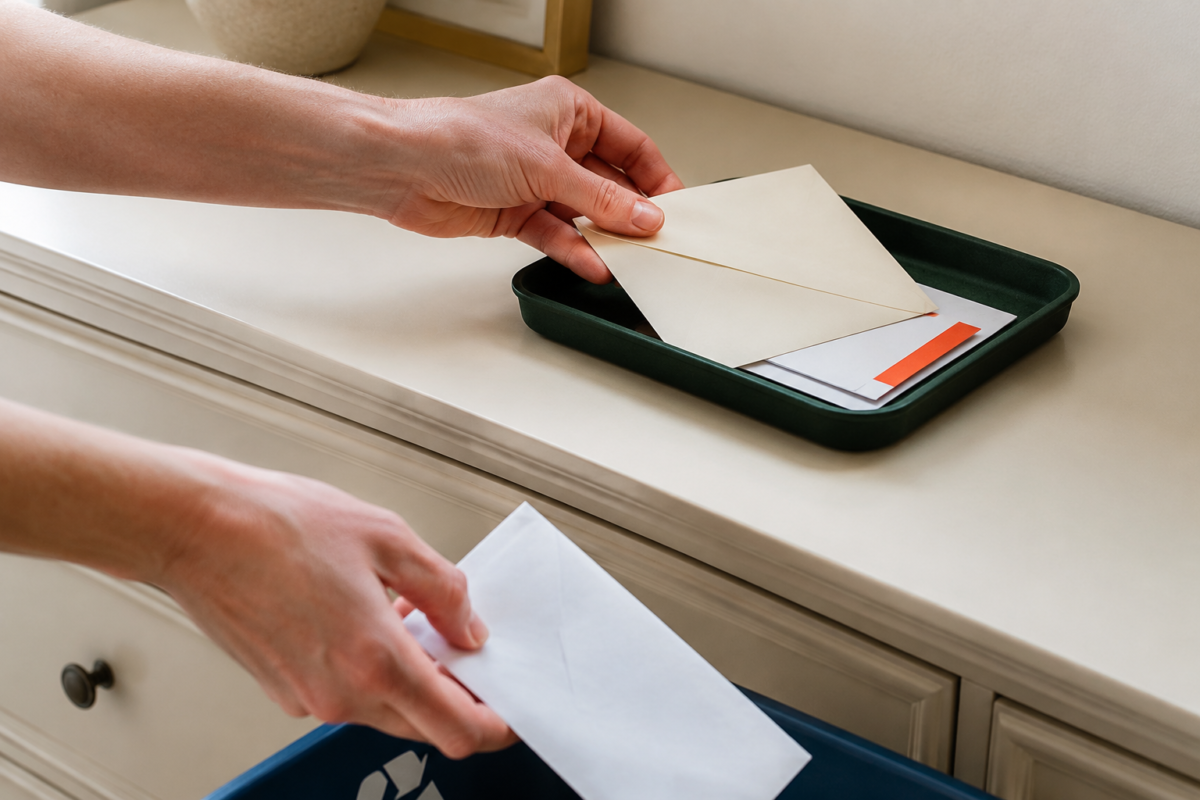
When something new enters the room, mail, laundry, a package, decide where it belongs the first time you touch it, rather than setting it down to deal with “later.” Later is exactly how a single piece of mail becomes a small stack, since each new item makes the pile look like an established, acceptable spot for the next one.
This habit takes seconds longer than setting something down, and that’s precisely the point. Opening mail and either filing or discarding it, hanging up a jacket instead of draping it on a chair, putting folded laundry directly into its drawer rather than onto the dresser top, each of these decisions costs almost nothing in the moment and prevents the pile that would otherwise need a separate cleanup later.
Where the one-touch rule matters most:
- Mail and paper. These accumulate fastest because a stack of paper doesn’t look urgent until it’s several inches tall.
- Laundry, clean or dirty. A basket set down “to deal with later” tends to become a second, informal storage spot within days.
- Anything removed while getting ready. Jewelry, a belt, a jacket taken off mid-routine are the items most likely to land on a flat surface instead of their actual home.
Habit Three: The 90-Second Surface Sweep Before Bed
Spend 90 seconds before bed clearing whatever’s landed on visible surfaces during the day, the nightstand, the dresser top, the chair, and putting each item back where it actually belongs. This is the shortest of the three habits, and it’s the one that prevents the small daily drift from ever becoming visible clutter in the first place.
The key difference between this and a weekend reset is scale. A surface sweep only ever deals with one day’s worth of drift, which is small enough to genuinely take under two minutes. Skip it for a week and the same task multiplies into something that takes twenty minutes and feels like a chore instead of a habit, which is usually the point where people give up on the system altogether.
Do this at the same time every night, right before getting into bed works well for most people, since it’s a natural transition point and it means the room starts tomorrow already clear.
What Happens When You Skip a Day
Missing one day of these habits doesn’t undo the system, since one day’s worth of drift is still small and quick to catch up on the next evening. The real risk is skipping several days in a row, since that’s when the pile gets big enough to feel like a project instead of a two-minute task, and a project is much easier to keep postponing.
If a habit gets skipped for more than two or three days, don’t wait for a bigger block of free time to fix it. Do a slightly longer version, five minutes instead of two, the next time you’re in the room, rather than letting it stretch into a full weekend cleanup. Catching drift at three days instead of three weeks is the difference between a quick reset and the kind of overhaul that makes the whole system feel like too much effort to maintain.
Frequently Asked Questions
How long do these habits actually take each day? Each one takes under two minutes on its own, and together they add up to well under five minutes of total daily effort. The time investment is intentionally small, since habits that take longer are harder to keep up consistently.
What if I don’t have a spot near my door for a landing zone? Any consistent surface works, a small tray on top of a dresser near the entrance, a single hook on the back of the door, even a designated chair. What matters is that it’s one specific, repeatable spot, not the exact type of furniture used.
Do these habits replace a weekly or seasonal cleaning routine? No. These three habits are aimed at daily prevention, stopping clutter before it accumulates. A weekly reset and seasonal decluttering still handle deeper maintenance, like checking closet zones or clearing out the “unsure” pile from an earlier sort.
What’s the most common reason these habits stop working? Usually the landing zone gets skipped for a few days and starts collecting extra items instead of getting emptied daily, or the one-touch rule quietly slips back into “I’ll deal with it later.” Catching either within a few days keeps it a quick fix instead of a bigger cleanup.
Related Reading
If you’re setting up the room’s overall system before adding daily habits on top of it, The Complete Guide to Organizing a Small Bedroom covers the closet and drawer sort that gives these habits something to actually maintain.
If laundry specifically keeps landing on the floor or a chair instead of making it into drawers, Dresser and Drawer Organization That Sticks covers the fold system that makes putting things away faster than setting them down.
And if the closet is where drift tends to show up first, A Closet System That Actually Stays Organized covers the zone layout built to survive daily use, not just the first week after setup.
For the rest of the organization library, the Bedroom Organization category has every guide in this series, and the Small Bedrooms hub covers storage, decor, and layouts for the whole room beyond daily habits alone.