Table of Contents
Stand in the middle of any apartment and look up. Most of the room’s actual volume, everything above about five feet, sits completely empty in a typical apartment, and it’s the single largest untapped storage resource most renters never think to use. Floor space gets fought over constantly. Vertical space, in almost every apartment, just sits there.
The reason it goes unused isn’t that it’s hard to access, it’s that most people assume storage requires either a closet or a drill, and an apartment with neither feels like it’s out of options. It isn’t. Tension-mounted shelving, over-the-door systems, and weight-rated adhesive brackets all add genuine, load-bearing storage capacity using height instead of floor space, and none of them require a single hole in the wall.
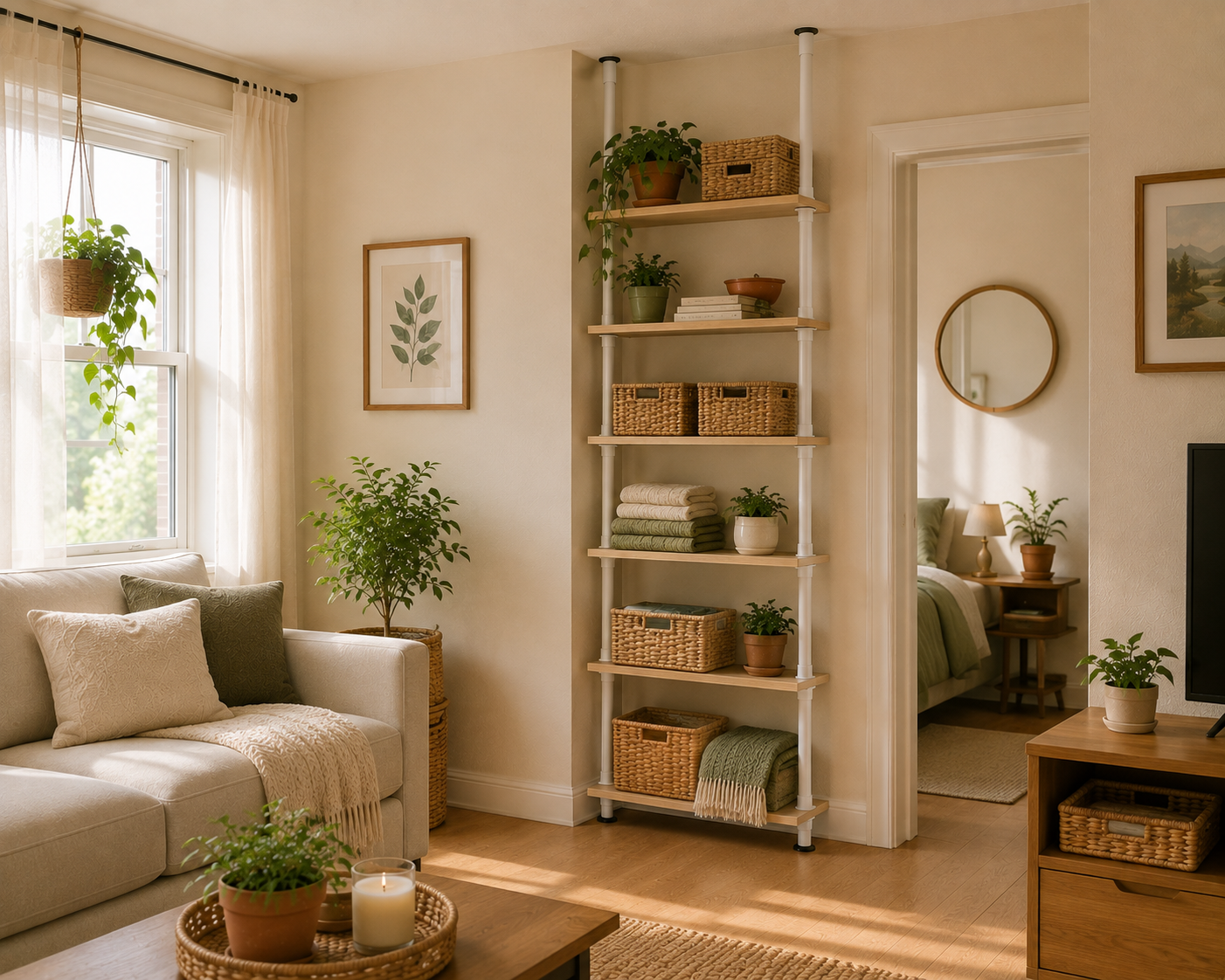
Tension-Mounted Shelving: The Biggest Single Addition
A tension shelving unit wedges between floor and ceiling using spring-loaded pressure rather than screws, brackets, or anchors, and a correctly installed, correctly rated system holds genuine weight, not just lightweight decorative items.
How the weight rating actually works. Tension systems distribute load through the vertical poles down to the floor, rather than relying on the wall at all, which is why a quality system can hold significantly more than a wall-mounted adhesive shelf of similar size. The rated capacity is usually listed per shelf rather than for the unit overall, so check that figure specifically against what you intend to store on each level.
Ceiling height matters for stability. Most tension systems are adjustable within a specific height range, and a unit installed near the very top or very bottom of its adjustable range tends to be less stable than one comfortably within the middle of its range. If your ceiling height falls right at the edge of a product’s listed range, sizing up to the next model tier, rather than maxing out the smallest one, typically performs better.
Floor surface affects grip. Tension poles rely on friction against both the floor and ceiling to stay locked in place, and a slick surface, polished concrete, certain tile finishes, can reduce that grip meaningfully. A small rubber pad or the product’s included floor cap, positioned correctly, usually resolves this, but it’s worth checking on move-in day before loading a tension unit with anything heavy.
Best rooms for this system: Kitchens (for pantry-style storage above counter height), bathrooms (a genuinely difficult room to add storage to any other way), and closets, where a tension system can add an entirely second shelving zone alongside an existing rod without any structural change.
Over-the-Door Organizers: Recovering Completely Dead Space
The back of a door is one of the few genuinely unused surfaces in almost every apartment, and over-the-door organizers convert that dead space into real storage capacity without touching the door itself in any permanent way.
Hook-style over-door systems work well for bulkier items, coats, bags, towels, and typically hold more weight per hook than most people expect, since the load transfers directly onto the door itself rather than through an adhesive bond. Confirm the door can handle the combined weight before loading it heavily, particularly on a hollow-core door, which is standard in most apartments.
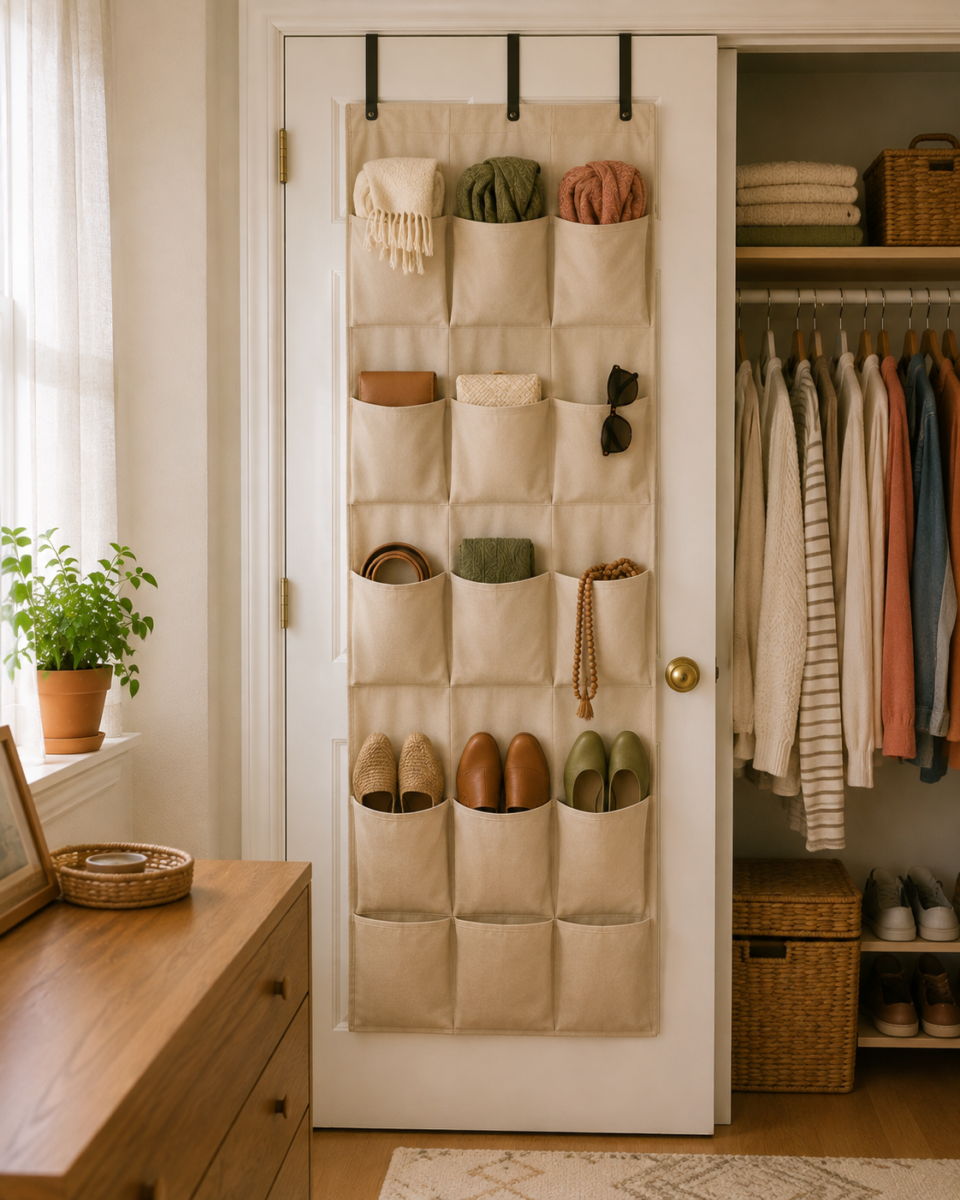
Pocket-style organizers (canvas or fabric with multiple compartments) suit smaller, lighter items: shoes, toiletries, craft supplies, cleaning products. These distribute weight more evenly across the door’s surface than a few heavily loaded hooks would, which makes them a safer choice for a hollow-core door carrying a genuinely full load.
Which doors work best. Closet doors and pantry doors are the most common targets, but a bedroom door or even a bathroom door can work equally well if the organizer’s style fits the room’s actual storage needs. Avoid loading a frequently slammed or heavily used door (like a front entry door swinging against wind or a draft) too heavily, since repeated jarring motion can work an over-door hook loose faster than normal use would.
Weight distribution matters on hollow-core doors specifically. Most apartment interior doors are hollow-core, lightweight, and not built to handle significant concentrated weight at any single point. Spreading the load across multiple hooks or a full pocket organizer, rather than hanging one very heavy item from a single hook, reduces the strain on both the door and the organizer’s mounting hardware.
Wall-Mounted Shelving With Weight-Rated Adhesive Brackets
For vertical storage that needs to sit flush against a wall rather than in a doorway or floor-to-ceiling gap, weight-rated adhesive brackets extend real shelving capacity above furniture height without any drilling.
Match the bracket rating to the fully loaded shelf, not just the empty shelf. This is the single most common mistake in this category. A shelf that weighs 2 pounds empty but will hold 15 pounds of books needs brackets rated for at least 17 pounds with a buffer, not brackets rated for the shelf alone. Command Strips and Adhesive Hooks Worth Trusting covers exact weight-rating guidance and application technique that applies directly to this use case.
Use two-point mounting for anything wider than about 18 to 24 inches. A single bracket centered under a wide shelf creates a pivot point that stresses the adhesive bond unevenly. Distributing the load across two properly spaced brackets, positioned per the manufacturer’s guidance, meaningfully improves reliability for wider shelving.
Stack shelves vertically for maximum use of a narrow wall. A column of two or three adhesive-mounted shelves, spaced to fit the specific items each level will hold, books on one, folded towels on another, uses a single narrow strip of wall far more efficiently than one wide shelf would use the same square footage of floor space.
Above-Cabinet and Above-Closet-Rod Space
The gap between the top of kitchen cabinets and the ceiling, and the space above a closet’s hanging rod, are two of the most consistently wasted vertical zones in any apartment, and both are simple to activate with the right containers.
Above kitchen cabinets: This space works well for items accessed only occasionally, large serving platters, extra small appliances, decorative pieces used seasonally. Stack items in matching, labeled bins or baskets rather than loose objects, both for a cleaner look and because pulling down a single labeled bin is far easier than digging through a mismatched pile every time something’s needed.
Above a closet rod: Most closets have several feet of unused vertical space between the hanging rod and the ceiling. A shelf added at this height, either a tension-mounted unit or one resting on adjustable closet rod brackets designed for this exact purpose, can hold folded items, out-of-season clothing, or bins, all above the primary hanging zone without interfering with it.
Labeling matters more here than almost anywhere else. Items stored in genuinely hard-to-reach vertical space are the most likely in the entire apartment to be forgotten or become difficult to identify without pulling everything down. A simple, visible label on the front of each bin saves real time and frustration later.
Bathroom-Specific Vertical Storage
Bathrooms deserve their own section here since they’re consistently the most space-constrained room in an apartment and the one where floor-based storage solutions are the least practical, given moisture and typically minimal square footage.
Over-the-toilet shelving units, either freestanding (straddling the toilet tank) or tension-mounted between floor and ceiling in the space directly above it, use one of the only genuinely available vertical zones in most apartment bathrooms.
Tension rods inside the shower or across a narrow gap between a vanity and a wall can hold a second towel bar, hanging baskets, or shower caddies without any adhesive or drilling in a room where moisture makes adhesive-mounted solutions less reliable long-term.
Moisture-rated adhesive products specifically, rather than standard indoor-rated strips, hold up meaningfully better in a bathroom’s humidity over time. This is one room where checking for an explicit bathroom or high-humidity rating on any adhesive product is worth the extra minute before purchasing.
Checking Installation Before You Fully Commit
A few checks before finalizing any vertical storage installation prevent the most common failures in this category.
Test tension systems unloaded first. Install and leave a tension shelving unit in place for 24 to 48 hours before adding any real weight, checking periodically that it hasn’t shifted or loosened. This catches a poor initial installation before it’s holding anything valuable.
Confirm door hardware before loading over-door organizers heavily. Some apartment doors have unusual hinge placement or trim that interferes with certain over-door hook designs. Hang the organizer and test with the door’s full range of motion, fully open, fully closed, before loading it with items.
Recheck adhesive bracket cure time. As covered in more depth in the adhesive-specific guide, most brackets need a full hour or more of cure time before bearing weight. Skipping this step is one of the most common causes of a bracket failing despite being correctly rated for the load.
Combining Systems for Maximum Capacity in One Room
The systems above aren’t mutually exclusive, and combining two or three of them in the same room typically adds up to more total capacity than maxing out any single one on its own.
In a small bathroom, a tension-mounted shelf above the toilet, an over-the-door organizer on the back of the bathroom door, and a small adhesive-mounted shelf beside the mirror can together provide meaningfully more storage than any one solution alone, while each individually staying within a reasonable, safely rated load.
In a kitchen without a pantry, above-cabinet bins, a tension shelving unit in an unused corner, and adhesive-mounted rail systems along an open wall segment can collectively function as a genuine substitute pantry, distributed across several small zones rather than concentrated in one large installation.
In a closet, layering a tension system above the existing rod, an over-the-door shoe organizer on the closet door itself, and adhesive hooks along one interior side wall for accessories or bags can roughly double a standard closet’s functional capacity without any structural modification at all.
The key to combining systems successfully is distributing weight across multiple installation points rather than concentrating everything on one. A room with three moderately loaded storage zones is generally more stable and more resilient to any single point of failure than one zone loaded to its absolute maximum capacity.
When Vertical Storage Isn’t the Right Answer
A few situations call for a different approach even within a genuinely storage-tight apartment.
Very heavy or bulky items (large suitcases, bulk household supplies, sports equipment) are usually better suited to under-bed storage, covered in Under-Bed and Under-Furniture Storage That Actually Works, than to any vertical, wall-mounted, or over-door system, since these items exceed what most vertical installations are rated to handle safely.
Items needed daily benefit more from accessible, eye-level storage than from a high shelf or above-cabinet zone that requires a step stool every single use. Reserve the harder-to-reach vertical space for items accessed occasionally, and keep daily essentials at a height that doesn’t add friction to using them.
Ceilings under roughly 7.5 feet can make tension shelving systems impractical, since most are designed for standard 8-to-9-foot ceiling heights and may not adjust down far enough for a shorter room. In this case, wall-mounted adhesive shelving or over-door systems are usually the more reliable choice.
Renting Versus Owning: What Actually Changes
Every system in this guide is built specifically around renter constraints, no drilling, no permanent modification, full reversibility at move-out, which means almost nothing needs to change if you own your unit instead. The main difference for owners is optionality: permanent wall-anchored shelving becomes available as an additional option alongside everything covered here, since weight limits designed for temporary, damage-free mounting no longer apply.
Even for owners, though, tension systems and over-door organizers remain genuinely useful, not as a workaround for a rental restriction, but because they install and reconfigure faster than anything requiring a stud finder, anchors, and a level. A closet’s vertical storage needs change over time as its contents change, and a tension shelf can be repositioned or removed in minutes, while a permanently mounted shelf commits to one exact spot until it’s physically taken down and the wall patched.
A Quick Room-by-Room Starting Point
If it’s not obvious where to begin, start with whichever room currently frustrates you the most on a daily basis, and match it to the system above built for that specific space. A cramped bathroom benefits most from the over-toilet and tension-rod combination. A kitchen without a pantry gets the most immediate relief from above-cabinet bins paired with a corner tension unit. A closet doing double duty for two people’s belongings sees the biggest single improvement from adding a second shelf above the existing rod. Pick one room, install one system, and let the daily improvement guide whether the next room gets the same treatment or a different combination entirely.
Frequently Asked Questions
How much weight can a tension shelving unit actually hold? It varies by product and by shelf level, so check the manufacturer’s specific rating per shelf rather than assuming a flat number for the whole unit. Quality tension systems, installed within the middle of their adjustable height range and on a floor surface with good grip, can hold genuine weight comparable to many wall-mounted shelving systems.
Are over-the-door organizers safe for hollow-core apartment doors? Yes, when weight is distributed across multiple hooks or a full pocket organizer rather than concentrated on a single heavily loaded hook. Hollow-core doors handle spread-out weight far better than concentrated point loads.
What’s the best vertical storage solution for a bathroom? Over-the-toilet shelving, either freestanding or tension-mounted, is usually the highest-capacity option in a room with limited floor space. Moisture-rated adhesive products and tension rods across narrow gaps add secondary storage without relying on standard indoor-only adhesive strength.
Can I add shelving above kitchen cabinets without drilling? Yes. This space typically just needs matching, labeled bins or baskets set directly on top of the cabinets, since the cabinets themselves already provide a stable, load-bearing surface with no mounting hardware required at all.
How long should I wait before loading weight onto adhesive-mounted vertical shelving? Most manufacturers recommend at least one hour of cure time after application before adding any weight, and longer for heavier loads. Skipping this step is one of the most common causes of an otherwise correctly rated bracket failing.
Related Reading
- The Complete Guide to Apartment Storage — the full three-layer storage system this vertical guidance fits into.
- Command Strips and Adhesive Hooks Worth Trusting — exact weight ratings and application technique for adhesive-mounted shelving.
- Storage Furniture That Moves With You — the furniture-based layer that pairs with vertical storage for maximum capacity.
- Under-Bed and Under-Furniture Storage That Actually Works — activating the layer beneath your furniture alongside the space above it.
- Parent Category: Apartment Storage
- Parent Hub: Apartments & Rentals