Table of Contents
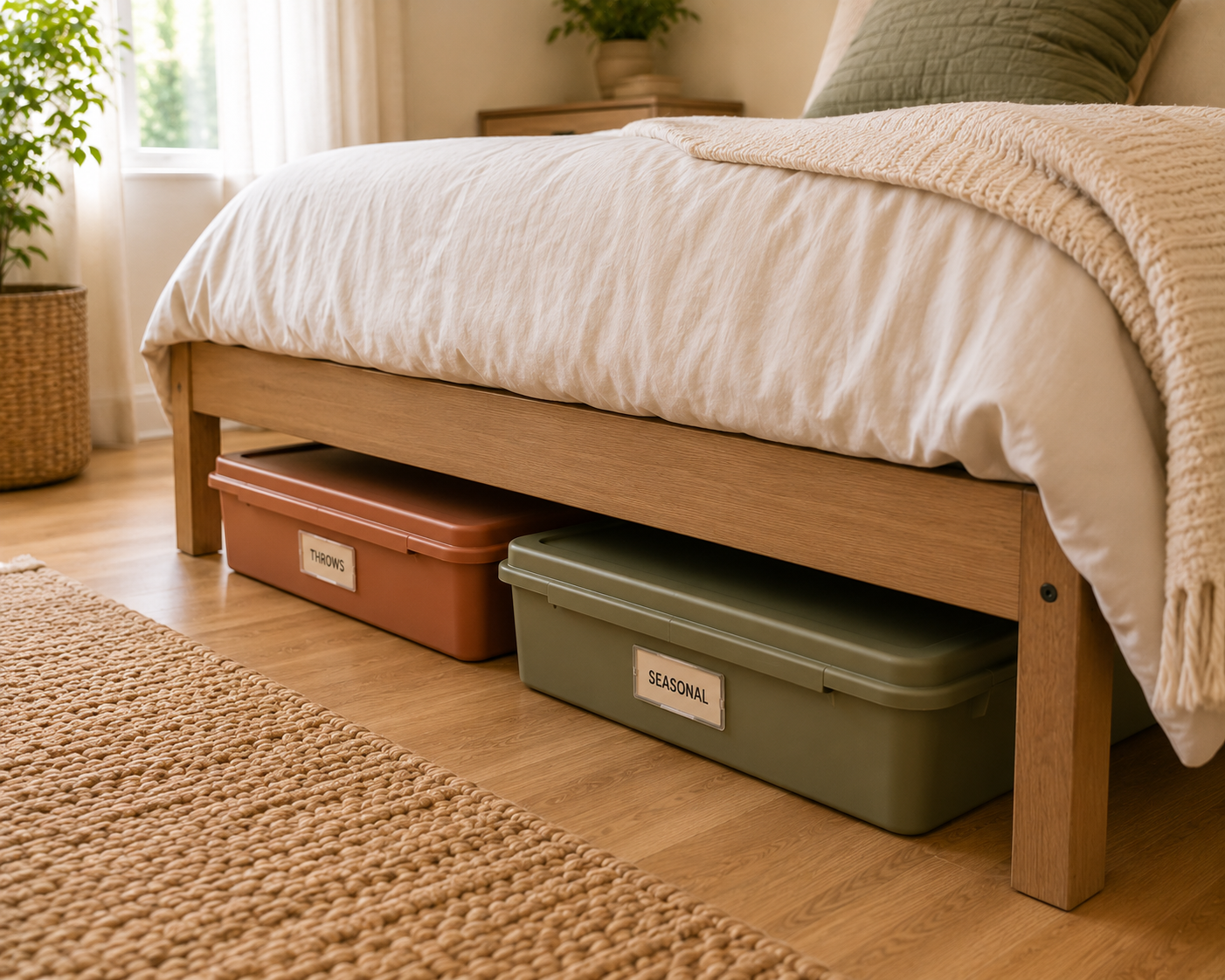
Look under most beds in most apartments and you’ll find one of two things: genuinely wasted space, or a chaotic pile of loose items shoved in without any real system, both of which mean the same amount of storage potential is going largely unused. The gap under a standard bed frame, when properly activated with the right bins and, if needed, a bit of added clearance, can absorb an amount of volume comparable to a small dresser, all without claiming a single additional square foot of the room.
The reason this space often underperforms isn’t lack of interest, it’s using the wrong containers, or not knowing the actual clearance available, or skipping the weight and material details that separate bins that hold up for years from ones that crack or collapse within months. This guide covers exactly what makes under-bed and under-furniture storage genuinely reliable, not just theoretically possible.
Measure Your Actual Clearance Before Buying Anything
The single most common mistake in this category is buying bins before measuring the actual gap under the bed, which leads to bins that either don’t fit at all or fit with so little clearance that sliding them in and out becomes a genuine hassle every time.
Measure at the lowest point, not the highest. Bed frames are rarely perfectly level with the floor along their entire length, and support legs, center rails, or a box spring’s frame can reduce clearance in specific spots even when the overall gap looks generous. Measure at several points along the frame’s width and use the smallest number as your working clearance.
Account for flooring changes. If you’re measuring on hardwood but plan to add a rug that extends partially under the bed, or if carpet in the room runs unusually thick, factor that into your usable clearance rather than measuring on bare subfloor and assuming the same number applies once furnishings are in place.
Standard clearance ranges to expect: A typical bed frame without a box spring offers roughly 7 to 10 inches of clearance. A frame with a box spring often has significantly less, sometimes under 5 inches, which usually isn’t enough for standard storage bins without adding risers. Platform beds vary widely, some sit nearly flush with the floor, offering no usable clearance at all, while others are specifically designed with a taller profile to accommodate storage.
Bed Risers: Adding Clearance Where There Isn’t Enough
Bed risers lift an entire frame by a set height, typically in the 3-to-6-inch range depending on the product, converting a previously unusable gap into space that fits standard storage bins.
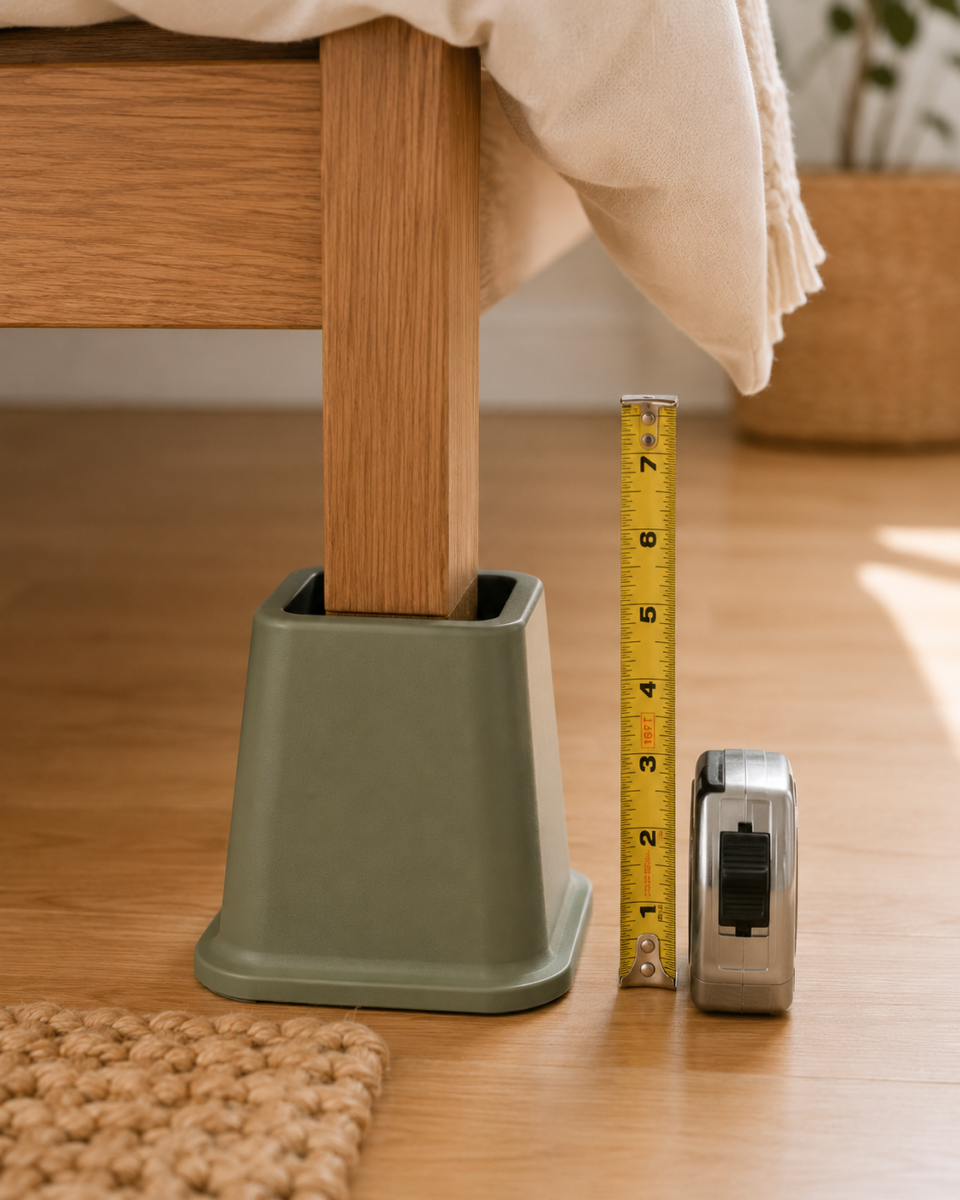
Weight rating is the detail most people skip checking. A riser needs to support its share of the combined weight of the bed frame, mattress, whoever sleeps on it, and anything stored underneath, all at once. Quality risers are rated per unit, and multiplying that rating by the number of risers used gives a rough total capacity, though it’s worth erring conservative rather than assuming the math works out exactly evenly across all four legs.
Match the riser style to the leg type. Square, round, and tapered bed legs each fit differently into riser cups, and a mismatched fit is one of the most common causes of a riser shifting or tipping under load. Measure the leg’s shape and diameter before ordering, rather than assuming a universal fit will work reliably.
Stability matters as much as rated weight. A riser that’s rated for enough weight but has a narrow, unstable base can still wobble or tip, particularly on carpet where the base doesn’t sit perfectly flat. Look for risers with a wide, low-profile base and, ideally, a locking or gripping mechanism that keeps the leg securely seated rather than just resting loosely inside a cup.
Check the finished height against door and furniture clearance. Adding several inches to a bed’s height can occasionally bring the mattress top close to a nearby windowsill, shelf, or low ceiling slope in an attic or loft-style apartment. A quick check before installing risers avoids an awkward surprise once the bed is raised.
Choosing Bins: Rigid Beats Soft, Almost Every Time
Not all under-bed storage containers perform the same, and the difference between a rigid, purpose-built bin and a repurposed soft bag or cardboard box shows up quickly, both in how much they actually hold and how well they survive being slid in and out repeatedly.
Rigid or semi-rigid plastic bins maintain their shape under load and stack or slide more predictably than soft alternatives, which matters when clearance is already tight. A bin that compresses unevenly wastes vertical inches that could otherwise hold more, exactly the opposite of what you want in a space where every inch of clearance counts.
Flat, low-profile bins built specifically for under-bed use are worth the modest price difference over a generic storage tote repurposed for the job. These are designed with the width and height ratio optimized for sliding under a bed frame, rather than a general-purpose bin that happens to technically fit.
Soft, zippered under-bed bags work well for lightweight, low-bulk items, off-season clothing, extra linens, since they compress somewhat and can be squeezed into tighter clearances than a rigid bin would tolerate. They’re a poor choice for anything with hard edges or genuine weight, books, tools, since they offer no structural protection and can tear under repeated use.
Clear versus opaque: Clear bins let you identify contents at a glance without pulling them out, which matters more under a bed than almost anywhere else in the apartment, since this is one of the least visually accessible storage zones in the home. If opaque bins are the only option available, a simple label on the end facing outward accomplishes nearly the same thing.
Handles or pull tabs matter more than they seem to. A bin without a handle or grip point becomes genuinely difficult to pull out from under a low-clearance bed frame, since there’s often no room to get a full hand underneath it. Look specifically for bins with a molded handle or grip tab positioned on the end that will face outward once slid into place.
Beyond the Bed: Under-Sofa and Under-Console Storage
The same principles apply to any furniture piece with enough leg clearance to slide something underneath, and sofas and console tables are the two most commonly overlooked options in this category.
Under-sofa storage works best with genuinely low-profile bins, generally under 4 inches tall, since most sofa frames offer less clearance than a bed does. This zone is well suited to flat items: extra throw blankets, board games, seasonal decor that doesn’t need frequent access.
Under-console and under-credenza storage in an entry or living room can hold shoes, bags, or seasonal items in flat bins or matching baskets, provided the piece has visible legs with enough clearance, one more reason leggy furniture, covered in more depth in Storage Furniture That Moves With You, consistently outperforms furniture with a solid skirt reaching the floor.
Check weight limits on furniture legs, not just the bins themselves. Furniture legs are generally rated for the weight of the piece and whoever sits or leans on it, not necessarily for significant additional weight resting directly underneath in a way that could shift the furniture’s balance. This is rarely an issue with reasonably light storage bins, but it’s worth a moment’s consideration before sliding something genuinely heavy under a lightweight piece.
A Practical System for What Goes Where
Not everything under a bed deserves equal priority in terms of accessibility, and organizing by how often something’s actually needed makes the whole system more useful day to day.
Frequently rotated items (current-season clothing, extra bedding you swap regularly) belong in the most accessible bins, closest to the edge and easiest to slide out without disturbing anything else.
Occasional-access items (off-season clothing, extra linens used a few times a year) can go in bins positioned further back or stacked, if clearance allows, since the trade-off of slightly less convenient access is reasonable for items used infrequently.
Genuinely rare-access items (special-occasion items, keepsakes, documents) are well suited to the very back or bottom of a stacked arrangement, since the goal here is maximizing capacity rather than convenience.
Keep a simple inventory if the system grows complex. Once under-bed storage holds more than three or four bins, a quick written or phone-note inventory of what’s in each one saves real time compared to pulling out multiple bins to find one specific item.
Maintaining the System Over Time
Under-bed storage tends to work well for the first few months after setup and then gradually degrade into disorganization if there’s no ongoing maintenance built into the routine. A few habits keep it functioning the way it was designed to, well past the initial organizing session.
Do a seasonal swap rather than a constant shuffle. Rotating clothing or linens under the bed twice a year, once as seasons change, keeps the system predictable and prevents the gradual drift where off-season items slowly migrate into the most accessible bins simply because that’s where there happened to be room at the time.
Reassess capacity honestly once a year. What fit comfortably when the system was first set up may not fit as well a year later, particularly with clothing or seasonal items that tend to accumulate. A brief annual check, removing anything that’s genuinely no longer needed, keeps the bins from being forced shut or overloaded past what they were designed to hold.
Wipe down the floor space periodically. Even sealed bins don’t fully prevent dust accumulation in the gap underneath a bed, and pulling everything out for a quick clean every few months, timed alongside the seasonal swap, keeps the space, and the bins themselves, in better condition long term.
What to Avoid in This Category
Cardboard boxes as a long-term solution. Cardboard degrades with humidity and repeated sliding friction against flooring, and it offers no real protection against dust or pests compared to a sealed plastic bin. It’s a reasonable short-term solution during a move, not a long-term under-bed system.
Overloading a single bin past its rated capacity. Even rigid bins have a practical weight limit before the material stresses or the bottom bows under load. Distributing weight across a few moderately loaded bins holds up better over time than one bin packed to its absolute limit.
Ignoring dust and moisture in a specific apartment’s conditions. Under-bed space, particularly near an exterior wall or in an older building, can accumulate more dust or occasional dampness than other storage zones. Sealed, lidded bins protect contents meaningfully better than open baskets in this specific location, even if open baskets look nicer elsewhere in the apartment.
Renting Versus Owning: Why This Layer Barely Changes
Under-bed and under-furniture storage is one of the few categories in apartment organizing that works almost identically whether you rent or own, since none of it involves the walls, floors, or fixtures a lease typically restricts. Bins, risers, and furniture choices are entirely within a renter’s control, and none require landlord approval or carry any deposit risk at all.
The one place ownership status can matter is flooring. Hardwood or laminate floors in an owned unit might tolerate a rug pad or furniture pad differently than a rental’s original flooring, where scuffs or wear patterns from repeatedly sliding bins in and out could matter more at move-out inspection. A simple felt pad on the base of frequently moved bins, or keeping bins on a low-pile rug rather than directly on hardwood, protects the floor either way and costs very little to add.
Quick Reference: Matching Solution to Situation
A short summary of which approach fits which scenario, useful for deciding where to start.
- Standard bed frame, generous clearance already: Skip risers entirely and go straight to rigid, labeled bins sized to the measured gap.
- Bed frame with a box spring, minimal clearance: Add risers rated for the combined weight first, then choose bins sized to the newly created clearance.
- Platform bed sitting flush to the floor: Under-bed storage isn’t a realistic option here; prioritize the furniture-based and vertical storage layers covered in the companion guides instead.
- Sofa or console with visible legs: Low-profile bins under 4 inches tall, reserved for flat, lightweight items rather than anything bulky or heavy.
- A system that’s grown disorganized over time: Pause new additions, do a full seasonal review, and reset with a simple inventory before adding anything else.
Frequently Asked Questions
How much clearance do I need under a bed for storage bins? Standard storage bins typically need at least 6 to 7 inches of clearance to slide in and out comfortably. If your current clearance is less than that, bed risers rated for your bed’s combined weight can add the extra height needed.
Are bed risers safe to use with a heavy mattress and box spring? Yes, when the risers are rated for the combined weight of the frame, mattress, box spring, and anyone sleeping on the bed, with the leg shape correctly matched to the riser’s design. Checking the weight rating and leg fit before purchasing prevents most stability issues.
What’s the best type of bin for under-bed storage? Rigid or semi-rigid plastic bins built specifically for under-bed use, ideally with a handle or grip tab for easy pulling and a clear or labeled exterior for identifying contents without opening them.
Can I store heavy items under a sofa or console table? Light to moderate weight is generally fine if the furniture has visible legs with adequate clearance, but very heavy items can affect the piece’s balance or exceed what the legs are built to support. Distribute weight across a few lighter bins rather than one very heavy one in this zone specifically.
Is under-bed storage a good place for items I use every day? It works best for items accessed occasionally to regularly, like seasonal clothing, rather than items needed daily, since sliding a bin fully out each time adds friction to a routine task. Reserve the most accessible under-bed spots for whatever gets pulled out most often, and use harder-to-reach areas for genuinely rare-access items.
Related Reading
- The Complete Guide to Apartment Storage — the full three-layer storage system this under-furniture guidance fits into.
- Storage Furniture That Moves With You — leggy, storage-integrated furniture that maximizes clearance for the bins and risers covered here.
- Vertical Storage for Apartments With No Extra Closets — the layer above furniture height that pairs with this under-furniture system.
- Furniture Scale That Actually Works in One Room — how furniture leg height and frame style affect available clearance throughout an apartment.
- Parent Category: Apartment Storage
- Parent Hub: Apartments & Rentals