Table of Contents
A decluttered space and an organized space aren’t the same thing, and it’s easy to assume that removing what you don’t need automatically solves what to do with what’s left. It doesn’t. Once the excess is gone, everything that remains still needs a genuine, functional home, and in a small space, that means being deliberate about exactly where storage capacity comes from, since there’s rarely a spare closet or empty room to simply absorb the overflow.
The good news is that most small spaces have far more usable storage capacity than they appear to at first glance. It’s just distributed across a few specific layers most people don’t think to activate all at once: the vertical space above furniture height, a properly built bin and basket system that actually survives regular use, and furniture that does double duty by hiding storage in plain sight. Get these three layers working together, in the right order, and a genuinely small space can hold more than its square footage would ever suggest.
Layer One: Vertical Space, the Most Underused Resource
Every small room has more usable volume above eye level than most people realize, and it’s consistently the first place worth looking once decluttering is done and it’s time to actually organize what’s staying.
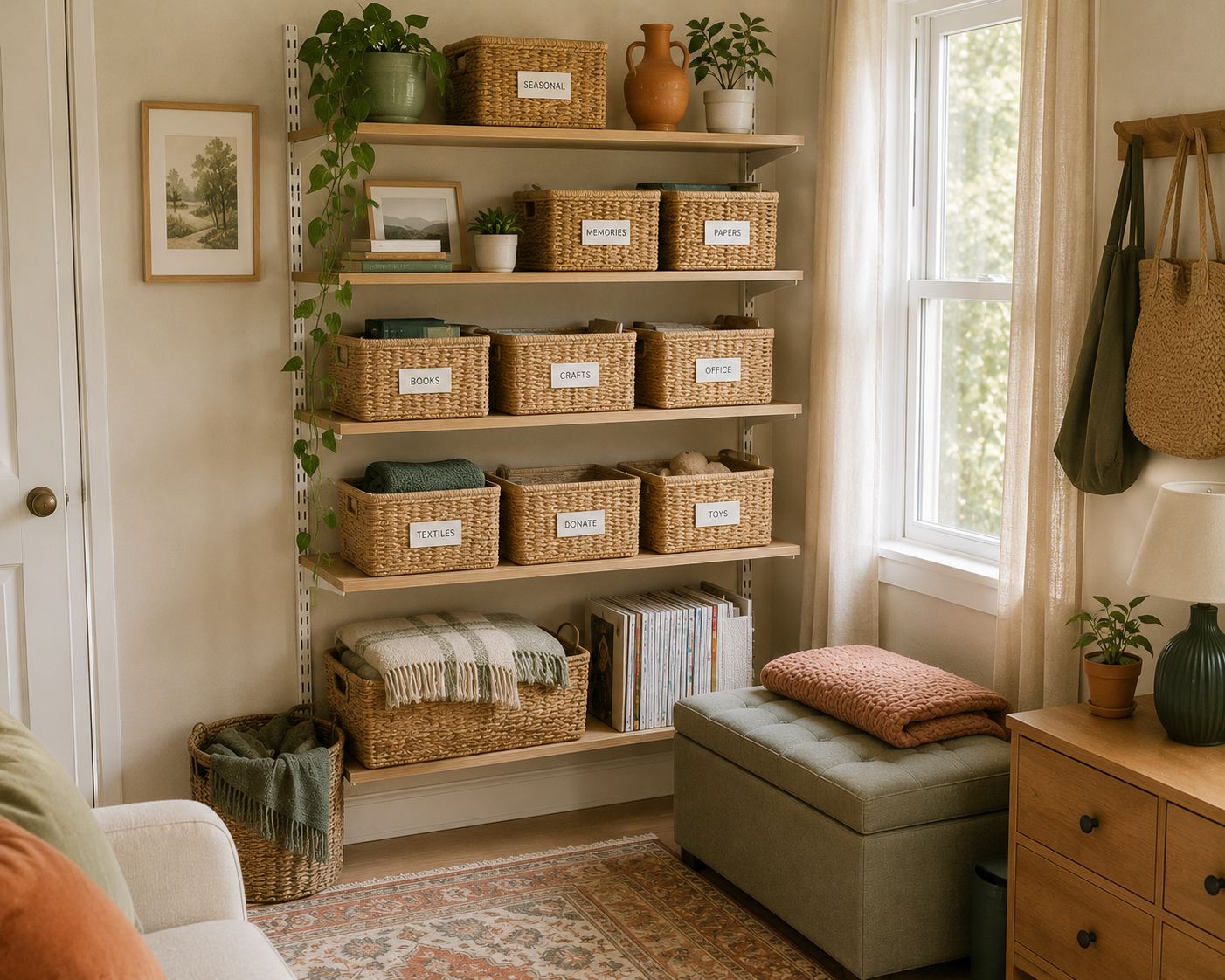
Wall-mounted shelving extends storage above furniture height without claiming any floor space at all. A tall, narrow shelving unit reaching close to the ceiling holds a genuine amount of capacity in a footprint that would otherwise sit empty. This is especially valuable in rooms where floor space is already fully committed to furniture and walking paths.
Height matters more than width in a genuinely tight room. A narrow, tall unit uses vertical space efficiently while leaving walking paths clear, whereas a wide, low shelving unit competes directly with floor space that’s usually in shorter supply than ceiling height.
Not every wall needs a permanent installation to become usable storage. Tension-mounted shelving, hanging organizers, and adhesive-mounted brackets all add real vertical capacity without drilling, which matters whether the goal is avoiding wall damage in a rented space or simply avoiding a more involved installation in a space you own.
For the specific systems that make the most of a room with genuinely no floor space left, including exact guidance on weight capacity and installation, Vertical Storage Ideas for Rooms With No Floor Space Left covers this layer in complete depth.
Layer Two: A Bin and Basket System That Actually Holds Up
Vertical shelving solves where storage capacity comes from, but bins and baskets determine whether that capacity actually stays organized over time, rather than becoming a jumbled shelf that looks tidy for exactly one week before sliding back into chaos.
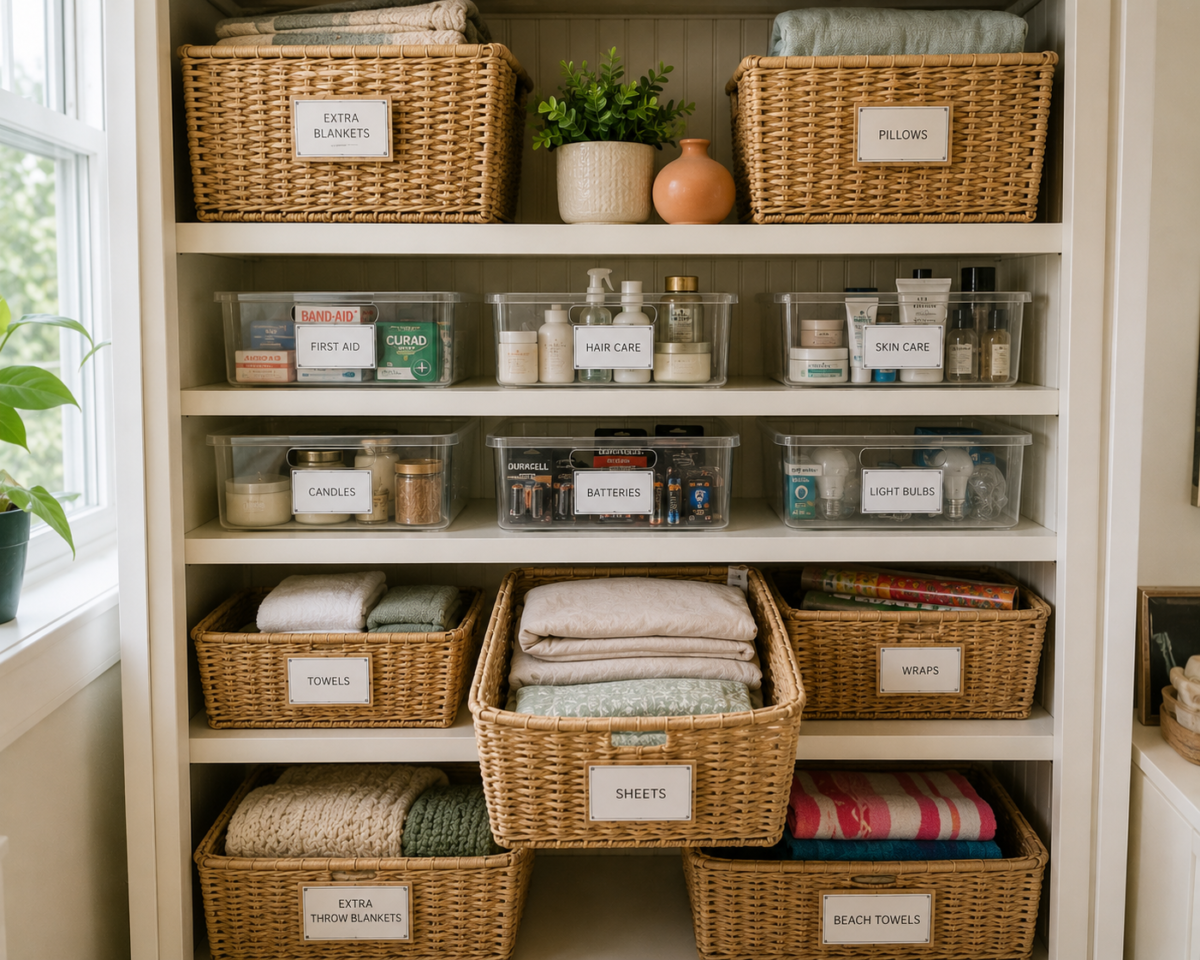
Sizing bins to their actual contents, rather than buying a uniform set, prevents the most common failure in this layer. A bin too large for its contents wastes shelf space and encourages items to shift and become disorganized inside it; a bin too small gets overstuffed and becomes difficult to use. Measuring the actual category of items going into a bin before purchasing, rather than buying based on what looks good on a shelf, produces a system that holds up.
Labeling is what separates a system that survives from one that doesn’t. A bin without a label relies entirely on memory to stay organized, and memory fails fast once a household has more than a handful of bins in rotation. Clear, visible labels, whether printed, handwritten, or on a small tag, mean anyone using the space, not just whoever set it up, can find and return items to the right spot.
Open bins and closed bins each serve a different purpose, and mixing them deliberately makes a system more functional. Open, easily accessible baskets work well for frequently used items where speed of access matters; closed, lidded bins protect and conceal items used less often or ones you’d rather not have visible on an open shelf.
The complete system for choosing, sizing, and labeling bins in a way that genuinely lasts beyond the first organizing session lives in The Bin and Basket System That Actually Stays Organized, covering the specific approach that prevents this layer from sliding back into disorder.
Layer Three: Furniture That Hides Storage in Plain Sight
The final layer isn’t about adding storage furniture in addition to everything else in a room, it’s about choosing furniture that was already going to be there anyway, and making sure it earns its footprint twice over by holding genuine storage capacity as well.
A storage ottoman replaces a plain coffee table or footstool while adding real capacity underneath its lid. This is the highest-value swap in this entire layer, since it adds storage without adding any additional furniture to the room at all, just choosing a smarter version of something that was already needed.
Beds with built-in drawer storage convert what’s normally dead space into genuine capacity. The clearance under a standard bed frame, roughly 8 to 10 inches in most cases, holds a meaningful amount when properly activated, and a platform bed with built-in drawers formalizes that space into an actual, easy-to-use storage layer rather than a gap that gets forgotten or filled haphazardly.
Benches, particularly at an entry or the foot of a bed, solve a specific access problem while hiding storage underneath or inside. Somewhere to sit while managing shoes or bags, paired with a place to store the very items causing the clutter in the first place, is a genuinely efficient use of one piece of furniture doing two jobs at once.
For the specific pieces worth prioritizing in this category, and guidance on choosing furniture that genuinely holds up to regular use rather than just looking good in a photo, Storage Furniture That Pulls Double Duty covers this layer in full detail.
Why the Order Matters
These three layers work best in sequence, not because one is inherently more important than the others, but because each layer makes the next one more effective once it’s in place.
Vertical shelving without a proper bin system inside it quickly becomes a visually cluttered wall of loose objects, since an open shelf holding unsorted items doesn’t actually solve the organization problem, it just moves it higher up. A bin and basket system without vertical shelving to hold it has nowhere to actually live, and often ends up crowding already-limited floor space instead. And multi-purpose furniture without the first two layers in place just becomes another surface that slowly accumulates its own clutter, since the underlying organization system that would keep it functional isn’t there yet.
Working through all three, vertical space first to establish where capacity comes from, then a genuine bin system to keep that capacity organized, then multi-purpose furniture to round out what’s left, produces a small space that can hold significantly more than its square footage suggests, without ever feeling crowded or chaotic.
A Realistic Starting Point for Your Own Space
Start by identifying which room in your home currently feels the most storage-strained, and apply the three layers there first, rather than trying to overhaul every room simultaneously. A tight closet, a small kitchen, or a shared living room without dedicated storage all benefit from the same underlying system, even though the specific products used in each room will look different.
Measure the room’s actual wall height and available clearance before buying anything. Vertical shelving needs an accurate sense of ceiling height, and under-furniture storage needs a real measurement of clearance, not a guess. This upfront step, though it feels like it slows things down, prevents the far more common problem of buying something that doesn’t actually fit the space once it arrives.
Build the system in the order covered above, rather than jumping straight to the most visually appealing layer. Multi-purpose furniture tends to be the most exciting layer to shop for, but without vertical shelving and a genuine bin system already in place, new furniture alone won’t solve an organization problem on its own.
Give the system a real trial period before judging whether it’s working. The first week or two after setting up a new storage system often reveals small adjustments worth making, a bin that’s slightly too small, a shelf positioned at an inconvenient height, and it’s worth treating the initial setup as a starting point rather than a finished, permanent arrangement.
Budget Priorities Across the Three Layers
Not every layer needs equal investment, and knowing where to spend versus where a basic option performs just as well helps stretch a limited budget across the full system.
Vertical shelving is worth spending on for stability. A wobbly or under-rated tension system undermines the entire layer it’s meant to support, and a modest step up in price for a genuinely sturdy, well-reviewed unit tends to pay off in both safety and how much weight it can actually hold over time.
Bins and baskets can lean budget-friendly without losing function. The labeling and sizing system matters far more to whether this layer stays organized than the specific material or brand of container used, which means basic, well-sized bins from a budget retailer work just as well as premium versions for most households.
Multi-purpose furniture is worth the investment if it replaces something you’d buy anyway. Since a storage ottoman or bench is standing in for furniture the room needed regardless, the price difference between a basic version and a storage-integrated one is usually the only real added cost, which makes this layer one of the more cost-effective places to spend a bit more for genuinely useful function.
Maintaining the System Over Time
A system only stays organized if returning items to their spot is genuinely easier than leaving them out. If a bin is hard to reach, poorly labeled, or awkward to open, items will start accumulating outside the system instead of inside it, regardless of how well-designed the original setup was.
Revisit the system every few months, not just once at setup. What worked when the system was first built might need adjusting as belongings change, seasonal items rotate in and out, or a household’s needs shift. A quick check-in, rather than assuming a storage system is a permanent, unchanging solution, keeps it functional well past the initial organizing effort.
Resist the urge to keep adding bins and shelving indefinitely. More storage capacity can sometimes just mean more room to accumulate things that don’t actually need to be kept, and pairing this guide with a genuine decluttering pass, covered in The Complete Small-Space Decluttering Guide, before building out additional storage tends to produce a more sustainable, less cluttered result than storage alone.
Room-by-Room Application
The three-layer system applies everywhere, but the specific balance between layers shifts depending on which room it’s applied to.
Bedrooms benefit most from under-bed storage as the primary capacity source, with vertical shelving above a desk or dresser as a secondary layer for frequently used items that don’t need to be stored away.
Living rooms lean heaviest on multi-purpose furniture, since floor space here is the most visibly contested by seating and walking paths, with vertical shelving along one wall rounding out additional capacity without crowding the room’s main function as a place to sit and gather.
Kitchens depend disproportionately on vertical space, since counters and cabinets are almost always the most constrained surfaces in a small home, and floor space for furniture-based storage is rarely available at all in this specific room.
Entries work best with a combination of a storage bench and vertical hooks or wall-mounted shelving, since this is typically the smallest dedicated area in a home while needing to handle the widest variety of item types in daily rotation, shoes, bags, keys, mail.
Bathrooms, often the most space-constrained room of all, rely almost entirely on vertical solutions and a tightly sized bin system, since furniture-based storage options are limited both by available floor space and by moisture considerations that rule out certain materials.
Frequently Asked Questions
What’s the best way to add storage to a small room with no closet? Start with vertical wall-mounted or tension-mounted shelving, since it uses otherwise empty wall space without claiming any floor area. Pair it with a proper bin system to keep the shelving organized, and consider multi-purpose furniture like a storage ottoman to add additional capacity within furniture the room needs anyway.
How do I keep a bin and basket organization system from falling apart after a few weeks? Size bins to their actual contents rather than buying a uniform set, and label every bin visibly so anyone using the space can find and return items correctly. A system that relies on memory alone, without labels, tends to break down quickly once more than a few bins are in rotation.
Is multi-purpose storage furniture worth the extra cost over standard furniture? Generally yes, since it replaces furniture you’d need regardless, a coffee table, a bench, a bed frame, with a version that adds real storage capacity for a modest price difference. This makes it one of the most space-efficient purchases available in a small room.
Should I declutter before building a new storage system, or organize first? Declutter first when possible. Building an elaborate storage system around items that don’t actually need to be kept just delays the same overflow problem rather than solving it, and a lighter starting point makes any storage system easier to maintain long term.
How much weight can vertical shelving actually hold in a small space? It depends on the specific system, tension-mounted units and wall-mounted adhesive shelving each have their own manufacturer-rated capacity, so checking the specific product’s rating matters more than assuming all vertical shelving performs the same.
Related Reading
- Vertical Storage Ideas for Rooms With No Floor Space Left — the full breakdown of shelving and wall-mounted systems that use height instead of square footage.
- The Bin and Basket System That Actually Stays Organized — the labeling and sizing approach that keeps a storage system functional past the first week.
- Storage Furniture That Pulls Double Duty — ottomans, benches, and beds that hide real storage capacity in plain sight.
- The Complete Small-Space Decluttering Guide — the decluttering process worth pairing with this storage system for the most sustainable result.
- Parent Category: Small-Space Storage
- Parent Hub: Organization & Storage