Table of Contents
Quick test: open your closet right now and count how many things on the rod you haven’t worn in the last two months. If it’s more than a third of what’s hanging there, your closet has a seasonal storage problem, not a space problem. Those winter sweaters and summer sundresses are taking up prime, everyday rod space for ten months out of the year while doing nothing but crowding out the clothes you actually reach for this week.
The fix isn’t a bigger closet. It’s moving off-season clothing somewhere else entirely, twice a year, using storage that lives outside the closet altogether: vacuum bags, under-bed bins, and a couple of specific rules about what actually belongs in seasonal storage versus what should stay on the rod year-round.
Why Off-Season Clothes Don’t Belong in the Closet at All
The core idea is simple: a small closet only has room to hold what’s genuinely in rotation. Anything you won’t touch for the next four to six months is, functionally, in storage already, whether or not it’s sitting on a hanger. The only question is whether that storage happens somewhere useful (under the bed, on a high shelf elsewhere in the room) or somewhere expensive (crowding out the one rod you actually use every day).
Moving seasonal clothing out frees up 20 to 30 percent of hanging space in most small closets, since a full seasonal wardrobe (heavy sweaters, coats, boots) typically takes up more physical rod width than the lighter clothes worn the rest of the year. That reclaimed space goes straight back to the everyday rotation, which is exactly the space this guide’s companion piece on the four closet zones assumes you already have.
Vacuum-Sealed Bags: Best for Bulky, Soft Items
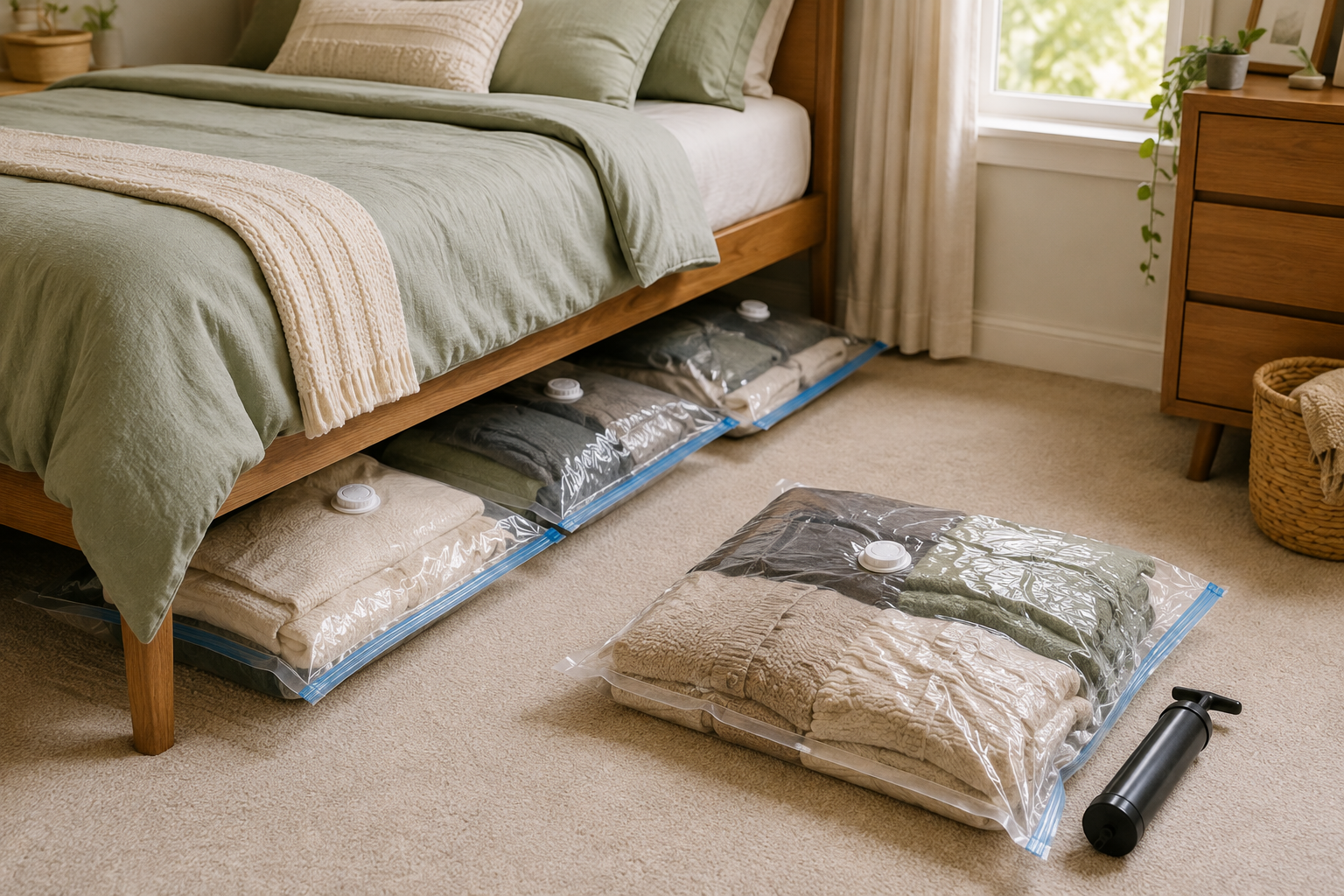
Vacuum storage bags work by compressing air out of a sealed bag, which shrinks bulky soft items like sweaters, comforters, and winter coats down to a fraction of their original size. A queen-size comforter that takes up an entire shelf uncompressed typically compresses to about the thickness of a large pillow, small enough to slide flat under a bed or stand upright in a closet corner.
These work best for anything soft and compressible: sweaters, fleece, down jackets, extra bedding. They don’t work well for anything structured or stiff, like blazers, suits, or leather, since vacuum compression can crush and permanently crease fabric that’s meant to hold its shape. Keep structured pieces on hangers in seasonal storage instead of in a vacuum bag.
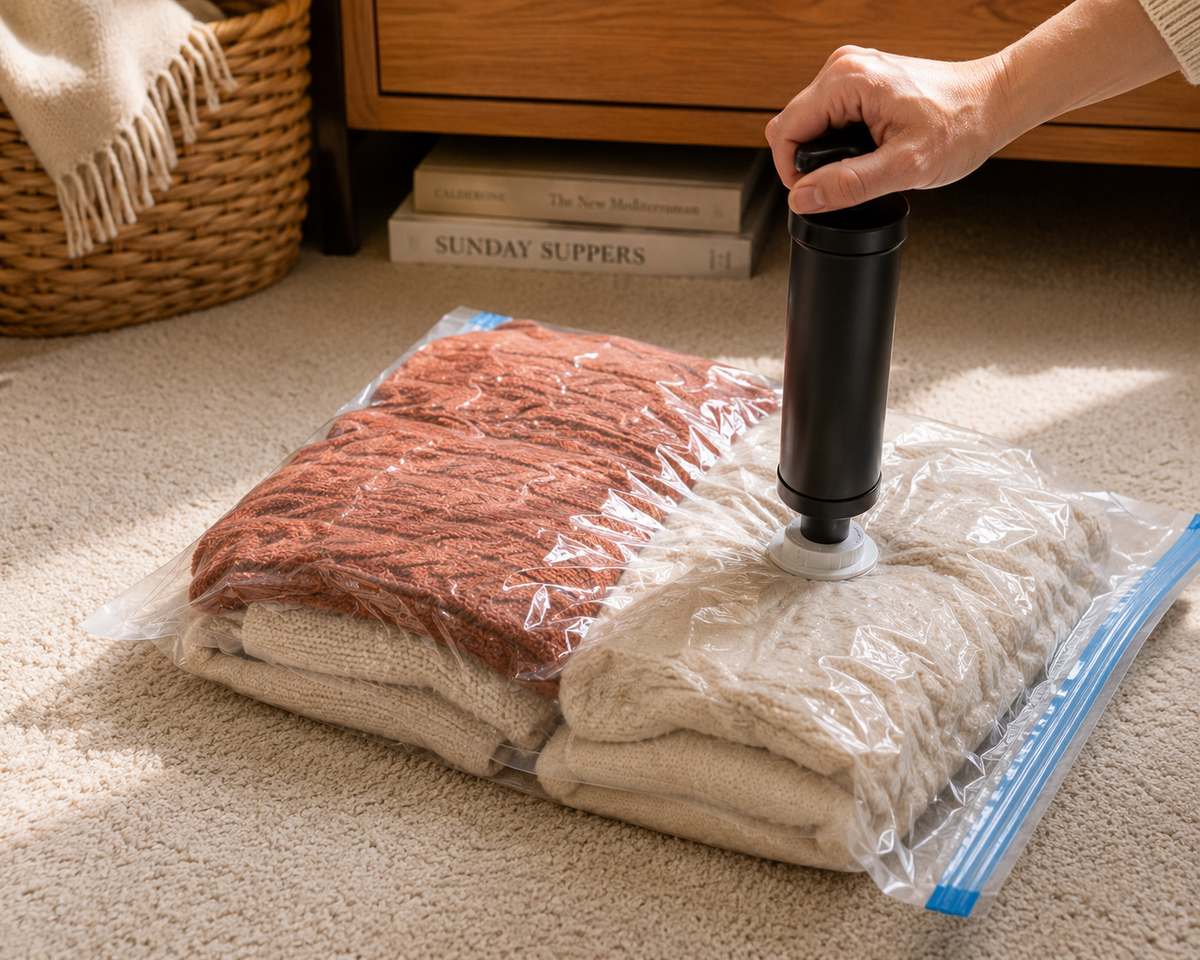
A hand pump or a vacuum cleaner hose both work to remove the air, and a bag typically holds its seal for 6 to 12 months before needing to be re-compressed, which lines up naturally with a twice-yearly seasonal swap. Store sealed bags flat under a bed, stacked in a closet on a high shelf, or under a couch if floor space allows, anywhere flat and out of direct sunlight, which can degrade the plastic over years of repeated use.
Under-Bed Bins: Best for Shoes, Boots, and Structured Items
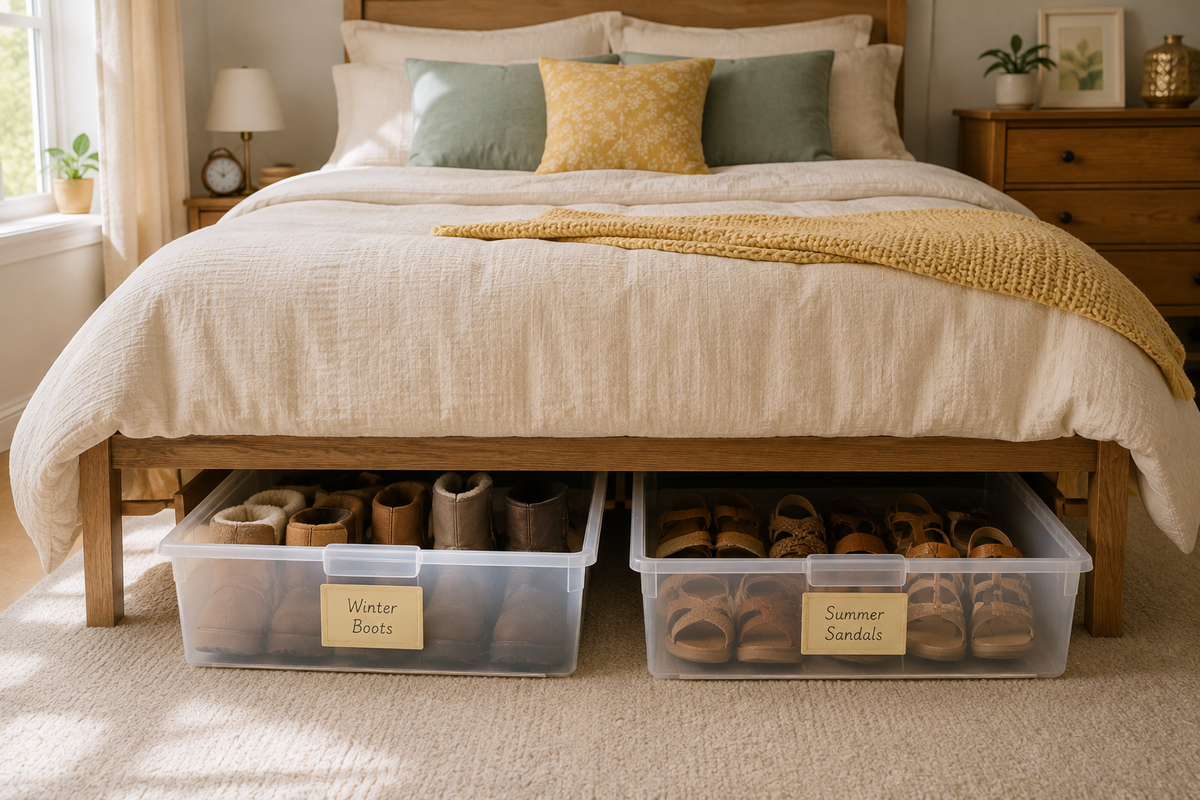
For anything that shouldn’t be compressed, a shallow under-bed storage bin (typically 4 to 6 inches deep, sized to fit the standard 12 to 14 inches of clearance under most bed frames) holds seasonal boots, structured bags, and folded sweaters that you’d rather not vacuum-seal.
Clear bins make it easy to identify contents at a glance without pulling everything out from under the bed twice a year just to check. If clearance under the bed is less than the standard 12 inches, measure before buying, since a bin that’s an inch too tall won’t slide under cleanly and will need to be forced, which damages both the bin and the bed frame’s underside over time.
Label each bin by season and category rather than a general “clothes” label. “Winter boots” and “summer sandals” mean you can grab exactly what you need at the seasonal swap without opening every bin under the bed to find the right one.
If under-bed space isn’t available (a platform bed with no clearance, for instance), a slim rolling cart with three or four drawers, tucked into an unused corner of the bedroom or a hallway closet, serves the same function without needing bed clearance at all.
The Twice-Yearly Swap: When and How to Do It
Tie the seasonal swap to an actual event rather than a vague intention to “get to it eventually.” The two most natural trigger points are the first genuinely cold week of fall and the first genuinely warm week of spring, since both give a concrete, felt reason to make the switch rather than an arbitrary calendar date that might not match the actual weather that year.
The swap itself takes about 30 to 45 minutes for a typical wardrobe: pull the current off-season bin or bag out from storage, pull the now-off-season clothes off the closet rod, do a quick check for anything that needs washing before it goes into storage for months (stored clothes should always go in clean, since stains and odors set permanently over a long storage period), and swap the two sets.
Use this moment as a natural decluttering checkpoint too. If something in the outgoing season’s clothes wasn’t worn even once, that’s the moment to decide whether it’s worth storing again or whether it should be donated instead of taking up space in either the closet or the under-bed bin for another six months.
What Should Never Go Into Seasonal Storage
Not everything benefits from being rotated out. A handful of categories should stay in the closet year-round regardless of season: neutral basics you wear across all seasons (a good pair of dark jeans, a plain white t-shirt), transitional pieces that bridge two seasons (a light jacket that works in both early fall and late spring), and anything you genuinely can’t predict needing (an interview blazer, a funeral-appropriate outfit).
The test is simple: if there’s a real chance you’d need it on short notice regardless of the season, it stays accessible. Seasonal storage is for things you know, with real confidence, you won’t need for the next four to six months, not a general decluttering dumping ground for anything you’re unsure about.
Where to Keep Seasonal Storage if the Bedroom Is Also Small
Under-bed clearance and closet shelf space aren’t the only options if the bedroom itself is tight. A slim, over-the-door shoe organizer with deeper pockets, mounted on the inside of a bedroom or hallway closet door, holds compressed vacuum bags or a couple of folded sweaters without needing any floor footprint at all. The top of a closet, if there’s a shelf, works well for stacked vacuum bags specifically because they compress flat and stack neatly, unlike loose folded clothes that slump and shift over months of storage.
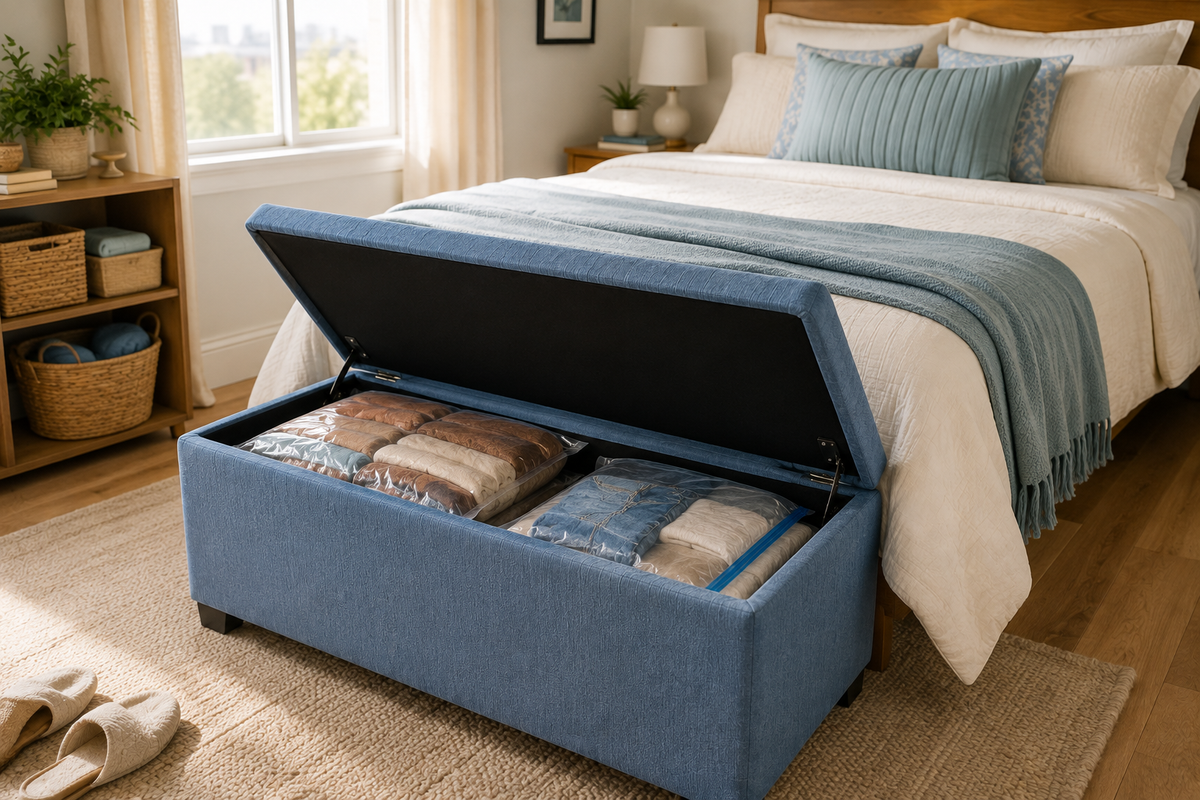
A storage ottoman at the foot of the bed is another option worth considering if under-bed clearance is limited. It does double duty as seating or a surface, while the inside holds one or two seasons’ worth of compressed bags out of sight. This works especially well in a studio or a bedroom that’s also serving as a living space, where visible storage bins would clutter a room that needs to feel calm rather than functional-looking.
If none of these are available, a small, labeled storage tote kept in a hallway closet, a coat closet, or even a car trunk during a short seasonal transition period is a reasonable last resort, as long as it’s genuinely temporary and the items move back indoors once space frees up.
Building a System That Repeats Without Becoming a Chore
The biggest reason seasonal swaps get skipped year after year isn’t lack of storage. It’s that the process feels like a bigger task than it actually is, so it gets pushed off until the closet is genuinely overflowing and the swap becomes a half-day project instead of a 30-minute one.
Keep the vacuum bags, spare labels, and hand pump together in one spot, ideally right where the storage lives (under the bed, in the closet), rather than scattered across different parts of the home. When the swap only requires walking to one spot and grabbing what’s already there, it stops feeling like a project and starts feeling like a quick task that fits into an otherwise normal Saturday.
Setting a recurring reminder on the first cold or warm week, rather than relying on memory, removes the guesswork about when to actually do it. The date will shift slightly year to year depending on the actual weather, but a rough reminder is enough to prompt the swap before the closet gets crowded enough to notice on its own.
FAQ
Do vacuum bags damage clothes over long-term storage? Soft, washable fabrics like cotton and wool sweaters hold up well in vacuum storage for 6 to 12 months at a time. Structured or delicate items, including blazers, suits, and anything with sequins or beading, should be stored on hangers instead, since compression can crush or permanently crease them.
How do I know if my under-bed clearance is enough for storage bins? Measure from the floor to the lowest point of the bed frame’s underside. Most standard bed frames offer 12 to 14 inches, enough for a standard shallow under-bed bin, but platform beds and some low-profile frames offer little to no clearance at all.
What if I don’t have under-bed space or a spare closet shelf? A slim rolling cart with drawers, stored in a hallway closet or an unused room corner, holds the same seasonal items without needing bed clearance or closet shelf space.
How often should vacuum-sealed bags be re-compressed? Most hold their seal for 6 to 12 months, which lines up with a standard twice-yearly seasonal swap. Check the seal at each swap and re-compress if any air has crept back in.
Related Reading
For the full four-zone system this seasonal storage plan plugs into, The Complete Small Closet Organization Guide covers the rod, floor, and shelf zones this frees up space for.
If the closet still needs a second rod or a shelving unit to make room for everyday clothes once seasonal items move out, Closet Systems That Fit a Small Space Without a Renovation covers the no-drill options that install in an afternoon.
And if shoes specifically are the seasonal bottleneck, boots in winter, sandals in summer, Shoe Storage Ideas for Closets With Zero Floor Space Left covers storage built specifically for footwear.
For the full category, browse Closet Organization under the Organization & Storage hub, home to every small-closet and storage-system guide on the site.