Table of Contents
Mail is unlike almost every other category of household clutter, because it never actually stops. A closet, once decluttered, mostly stays that way unless new clothes are purchased. Mail arrives constantly, every single day in most households, whether anyone wants it to or not, which means it needs an ongoing daily system rather than a one-time organizing project that eventually falls out of date.
Without that system, mail follows a predictable and frustrating pattern: it lands on whatever surface is nearest the door, since there’s no dedicated home for it, and it sits there, day after day, slowly forming a pile that becomes genuinely intimidating to sort through once it’s grown large enough. This guide covers exactly how to interrupt that pattern, where mail should land the moment it enters a home, how to sort it the same day it arrives, and what to do with the handful of specific paper subcategories that tend to cause the most buildup.
Why Mail Piles Up Even in Otherwise Organized Homes
Mail clutter isn’t really about laziness or disorganization in a general sense. It’s about a specific mismatch: mail arrives daily, but most households only have a periodic system, sorting through it once a week, or whenever the pile gets bad enough to demand attention, rather than a daily one.
A periodic system guarantees a pile will exist most of the time. If mail only gets sorted once a week, then for six out of seven days, there’s an accumulating stack sitting somewhere in the home, regardless of how well that weekly sort actually works. A daily system, by contrast, means the pile essentially never has the chance to form in the first place.
Mail doesn’t announce its own importance, which makes deferring a decision the easiest default. A bill, a piece of junk mail, and an important document all look roughly the same in a stack, an envelope, until opened. Without a system that sorts on arrival, it’s genuinely easier to set everything aside “to deal with later” than to make the small decision each item actually requires in the moment.
The pile itself becomes a barrier to dealing with the pile. Once a stack has grown large enough, sorting through it stops being a two-minute task and becomes a project requiring dedicated time and mental energy, which paradoxically makes people even less likely to start, creating exactly the kind of stall that a daily system is designed to prevent entirely.
Building the Landing Spot
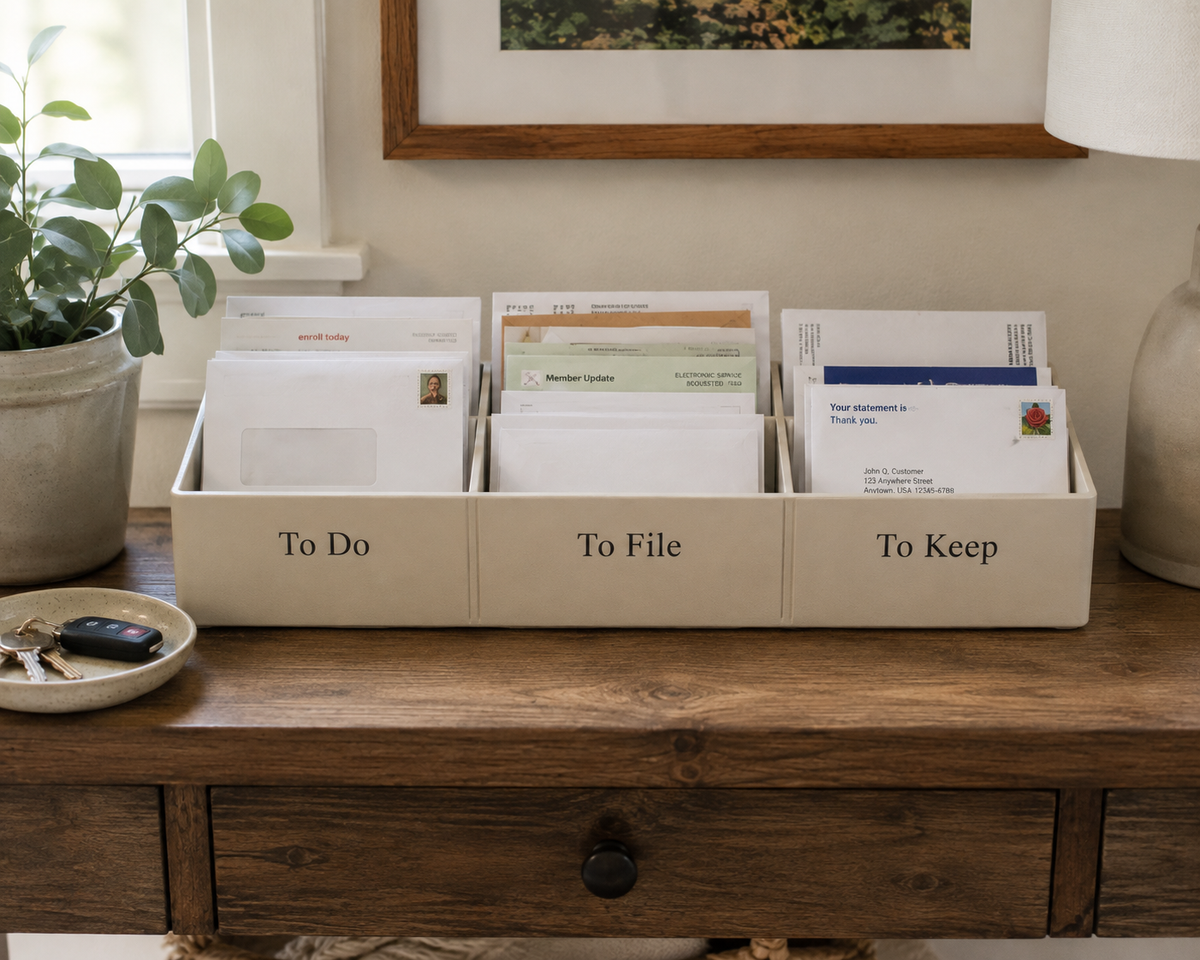
The physical location and design of a mail landing spot matters more than most people initially assume, since a poorly placed or poorly designed system gets bypassed just as easily as having no system at all.
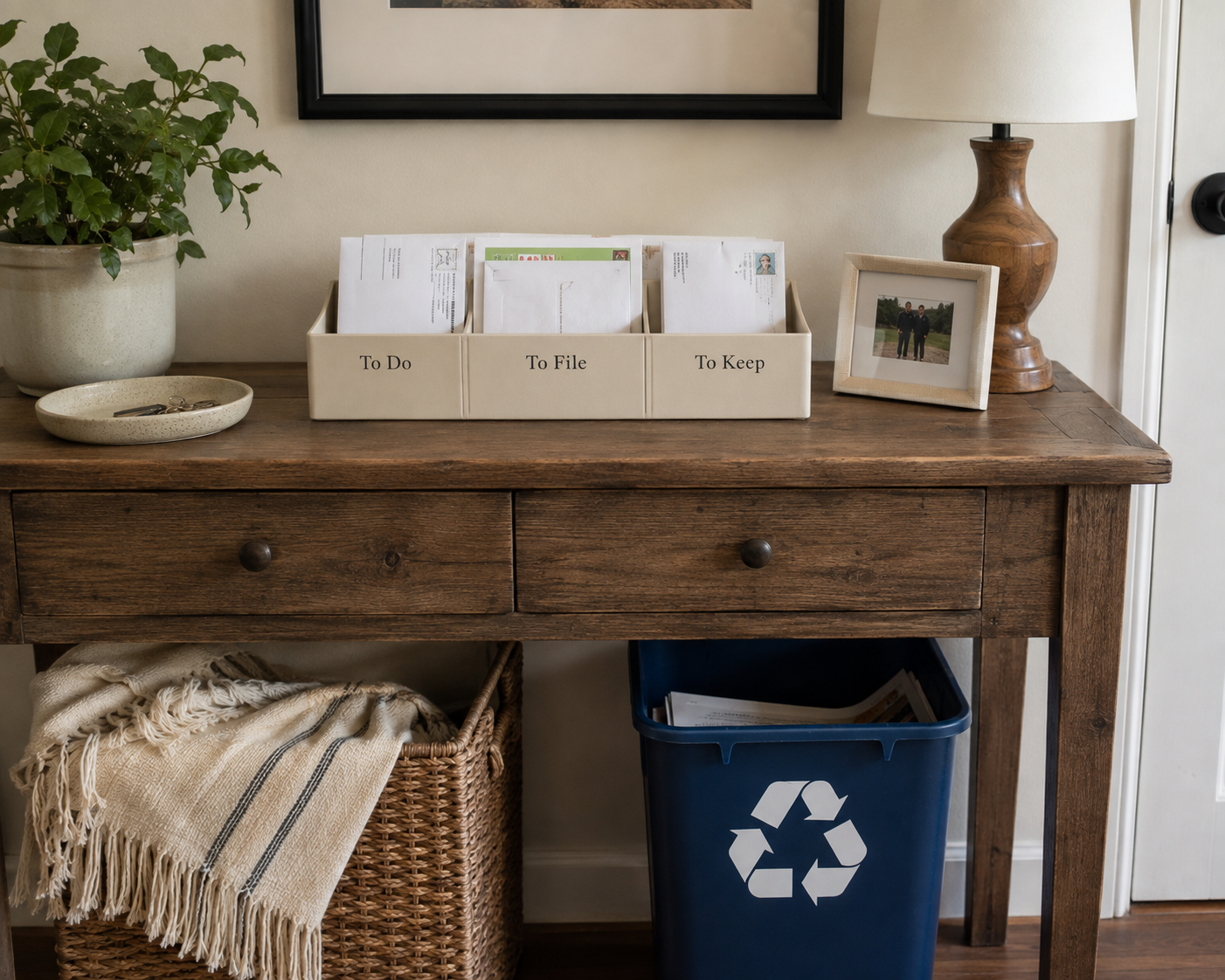
Position it as close to the actual entry point as possible. Mail should have somewhere to go the instant it comes through the door, on a console table, a wall-mounted organizer, or a small tray right by the entrance. Any additional distance between the door and the mail’s landing spot creates an opportunity for it to get set down somewhere else instead, on a kitchen counter, a random surface, wherever happens to be convenient in the moment.
A recycling bin or trash bin should live within arm’s reach of the sorting spot. A meaningful portion of daily mail, junk mail, flyers, catalogs, needs to be discarded immediately, and having no easy way to do that right at the sorting point means junk mail either gets carried further into the home or accumulates in the sorting spot itself rather than actually leaving the system.
A simple three-way sort works better than an elaborate system with many categories. Discard, action needed, and file or keep covers most of what arrives in the mail. A system with too many specific subcategories tends to create decision fatigue that discourages daily use, whereas three broad, easy-to-apply categories keep the sorting fast enough to actually happen every single day.
Make the system visually obvious, not just functionally present. A labeled tray or well-marked spot, rather than an ambiguous flat surface that could hold mail or could hold anything else, removes any uncertainty about where mail is supposed to go, which matters especially in a shared household where more than one person needs to understand and use the system correctly.
Sorting Mail the Same Day It Arrives
Discard immediately, standing right at the sorting spot. Junk mail, catalogs, and anything plainly disposable should never make it past this first sort. This single step, done consistently, prevents the majority of what causes a mail pile from ever entering the home’s actual living space at all.
Action-needed items go into a dedicated, visible spot, not a general pile. Bills to pay, forms to fill out, RSVPs to respond to, anything requiring a specific action belongs in its own designated spot, checked regularly, rather than mixed in with everything else. This prevents time-sensitive items from getting buried under lower-priority mail.
Keep or file items get a genuine home, not an indefinite holding spot. Documents worth retaining, tax records, important statements, warranties, need an actual filing system, even a simple one, a labeled folder or a small filing box, rather than a growing stack that was meant to be temporary but never actually gets processed further.
Handle this sort daily, ideally the same day mail arrives. A same-day sort takes only a minute or two, since it’s dealing with a single day’s worth of mail rather than an accumulated backlog. This is the habit that makes the entire system work, and it pairs naturally with the nightly reset routine covered in The 10-Minute Nightly Reset That Keeps Clutter From Piling Up.
Beyond Mail: Other Paper That Needs a Home
Mail is the most obvious daily paper category, but it’s rarely the only one, and the same landing-spot-plus-immediate-sort logic applies to several other common sources of paper clutter.
School papers and permission slips need a consistent home, ideally a spot separate from general mail, since these often have specific deadlines and need to be visible and findable rather than mixed into a general paper pile.
Receipts accumulate quickly and rarely need to be kept beyond a short window, unless they’re tied to a return, a warranty, or a tax-related expense. A small, dedicated spot, even just an envelope or a small drawer, keeps receipts contained until they’re either needed or safely discarded after their relevant window has passed.
Business cards and loose contact information tend to end up scattered across random surfaces without a specific system, since they don’t feel urgent enough to sort immediately. A small dedicated holder or a habit of transferring useful contacts into a phone promptly prevents this category from becoming its own small but persistent clutter problem.
Takeout menus, flyers, and event postcards are almost always disposable after their immediate relevance passes, and treating them with the same immediate discard-or-keep decision applied to junk mail prevents this category from lingering on counters and tables indefinitely.
Managing the Keep and File Category Long Term
The “keep or file” category deserves specific attention, since it’s the one most likely to grow into its own kind of clutter if it isn’t actively managed beyond the initial daily sort.
Review the filed or kept pile periodically, not just at the point of sorting. A quarterly or biannual check of whatever’s accumulated in the “keep” category catches documents that are no longer actually needed, an old statement that’s since been superseded, a warranty that’s expired, before they take up permanent space in an ever-growing file.
Digitize what can genuinely be digitized. Many documents that used to require physical retention, statements, receipts, certain records, can now be scanned or photographed and stored digitally, meaningfully reducing the physical paper volume that needs a permanent home. Check what specifically needs to be kept in physical form (some legal or official documents do) before digitizing and discarding the original.
Keep the filing system itself simple enough to actually maintain. An elaborate, highly categorized filing system sounds appealing but often becomes its own source of friction, since filing something correctly takes real thought and effort. A simpler system, a handful of broad categories rather than dozens of narrow ones, tends to actually get used consistently rather than abandoned in favor of a growing “to be filed” pile.
Handling Mail for Multiple People in One Household
A shared mailbox means mail arriving addressed to different household members, which adds a layer of complexity beyond the basic sorting system covered above.
Give each person a designated slot within the shared landing spot, rather than one combined pile. A tray with individual sections, or simply separate small stacks, keeps each person’s mail identifiable at a glance, which matters since one person handling the daily sort shouldn’t need to also decide what’s relevant to someone else in the household.
Time-sensitive mail addressed to someone else still needs to be flagged, not just filed into their slot and forgotten. A bill or an important-looking piece of mail for a roommate or family member benefits from a quick verbal or written heads-up, rather than assuming it will be noticed simply because it’s sitting in the right slot.
Junk mail addressed to a former resident or a previous occupant of the address is worth handling immediately, the same as any other junk mail. There’s no need to sort this into anyone’s individual slot; it goes straight to discard, the same as unaddressed flyers or catalogs.
What to Do With a Backlog That’s Already Built Up
If a pile has already formed before this system gets put in place, tackling it doesn’t require a single overwhelming session, and treating it that way often just delays getting started at all.
Sort the existing backlog using the same three categories, in short sessions rather than one long one. Fifteen or twenty minutes at a time, working through discard, action needed, and keep, chips away at even a substantial pile without requiring a dedicated afternoon that may never actually materialize.
Prioritize anything that looks time-sensitive first. A quick scan for bills, official-looking envelopes, or anything with a visible deadline, sorted before working through the rest of the pile methodically, catches anything genuinely urgent before it’s buried further under lower-priority mail.
Once the backlog is cleared, the daily system prevents it from reforming. The backlog session is a one-time cleanup; the ongoing daily sort, done consistently from that point forward, is what actually keeps a new pile from building right back up to where the old one started.
Digital Tools That Support Rather Than Replace This System
Digital mail forwarding, e-billing, and paperless statements have reduced physical mail volume for many households, but they rarely eliminate it entirely, and it’s worth being realistic about what digital tools can and can’t handle within this system.
Switching to paperless billing where genuinely possible reduces the daily volume this system needs to process. Fewer physical bills means less to sort each day, though most households still receive at least some unavoidable physical mail, official documents, certain notices, personal correspondence, that paperless options don’t cover.
A digital scanning app can handle the “keep or file” category for documents that don’t need to stay physical. Rather than a growing physical folder, scanning and storing digital copies of statements or records that don’t have a legal requirement to remain in paper form reduces the long-term physical storage burden significantly.
Digital tools don’t remove the need for a daily physical sort entirely. Even a household that’s minimized its physical mail volume still benefits from the same landing-spot-and-immediate-sort habit for whatever does arrive, since the underlying problem, unsorted paper accumulating without a system, applies at any volume, just at a smaller scale.
Frequently Asked Questions
Why does mail keep piling up even when I try to stay organized? Mail arrives daily, but most organizing attempts only sort it periodically, once a week or whenever the pile becomes too large to ignore. A daily sorting system, done the same day mail arrives, prevents the pile from ever forming in the first place.
Where should I put a mail sorting system in my home? As close to the actual entry point as possible, ideally right where mail is likely to be set down the moment someone walks in. The shorter the distance between the door and the sorting spot, the less likely mail is to end up scattered on other surfaces instead.
How many categories should a mail sorting system have? Three works well for most households: discard, action needed, and keep or file. A system with too many specific categories tends to create decision fatigue that discourages daily use, while three broad categories keep sorting fast enough to actually happen consistently.
What should I do with papers I need to keep long term? Give them a genuine filing home, even a simple one, rather than letting them accumulate in an indefinite holding pile. Review this category periodically, every few months, to remove anything that’s no longer actually needed, and consider digitizing what doesn’t require physical retention.
How do I stop junk mail from ever entering my living space? Discard it immediately at the sorting spot, before it moves any further into the home. Having a trash or recycling bin within arm’s reach of the mail landing spot makes this immediate discard step fast enough to actually happen every time mail arrives.
Related Reading
- The Complete Guide to Daily Organization Systems — the full system this mail routine fits into, alongside the nightly reset and shared household coordination.
- The 10-Minute Nightly Reset That Keeps Clutter From Piling Up — the companion daily habit this mail system pairs naturally with.
- Daily Systems That Work When More Than One Person Lives There — how to make sure a mail system works even when more than one person brings mail into the home.
- The Bin and Basket System That Actually Stays Organized — the labeling and sizing approach worth applying to a filing or keep-category system too.
- Parent Category: Daily Organization Systems
- Parent Hub: Organization & Storage