Table of Contents
There’s a specific moment that tells you a seasonal reset isn’t going to cut it anymore: the closet door won’t close without you leaning your whole body weight against it, or the junk drawer has quietly expanded into a junk drawer and the shelf below it. That’s not a reset problem. That’s a decluttering challenge problem, and this guide is built specifically for it.
A decluttering challenge tackles one space at a time, using a fixed method and a fixed timeline, until a genuinely overloaded area gets back down to a manageable size. Unlike a seasonal reset, which is quick maintenance for a space that’s mostly under control, a challenge exists for the closet, drawer, or corner that’s visibly past that point. Here’s the exact method, the 14-day calendar, and the decision rule that makes each pass faster than the one before it.
What a Decluttering Challenge Is (and When You Actually Need One)
A decluttering challenge is a structured, multi-day process for clearing a specific space that’s become genuinely unmanageable, using a consistent decision method rather than random effort. You need one specifically when a seasonal reset stops being enough: when a space takes more than ten minutes to find anything in, or when you’re storing duplicates you forgot you owned.
The tell is usually physical before it’s emotional. A drawer that won’t fully close. A shelf where you can’t see the back half without removing everything in front of it. A pile that’s been “temporary” for more than a month. These are the signals that a space has crossed from “needs tidying” into “needs a real challenge,” and no amount of quick seasonal maintenance fixes a space that’s already past that line.
This doesn’t mean starting over from zero. It means applying more structure and more time to one space than a normal reset would give it, with a method built to make fast, low-regret decisions instead of agonizing over every item.
The Real Cost of Clutter (Beyond the Way It Looks)
Visual clutter measurably reduces your ability to focus and process information, according to a 2011 study from the Princeton University Neuroscience Institute that used brain imaging to observe how clutter competes for attention in the visual cortex. This isn’t a design opinion. It’s a documented neurological cost that a genuinely cluttered space imposes on you every time you’re in it.
The same research and follow-up studies have connected cluttered environments to elevated cortisol, the body’s primary stress hormone, even when a person isn’t consciously registering the mess as a problem. Your brain still processes every visible object as unfinished business, whether or not you’ve stopped noticing it. That’s the actual reason a cluttered closet feels heavier than its square footage should explain: it’s costing you attention and stress you didn’t consciously sign up for.
There’s also a financial angle worth naming honestly. Roughly a third of Americans currently pay for self-storage, according to a 2025 StorageCafe survey, and renters in one-bedroom apartments are among the heaviest users of that market. Paying monthly to store items you haven’t decided whether to keep is, in a lot of cases, the expensive version of a decision a decluttering challenge could make for free in an afternoon.
The Four-Box Method: The Framework Behind Every Day of This Challenge
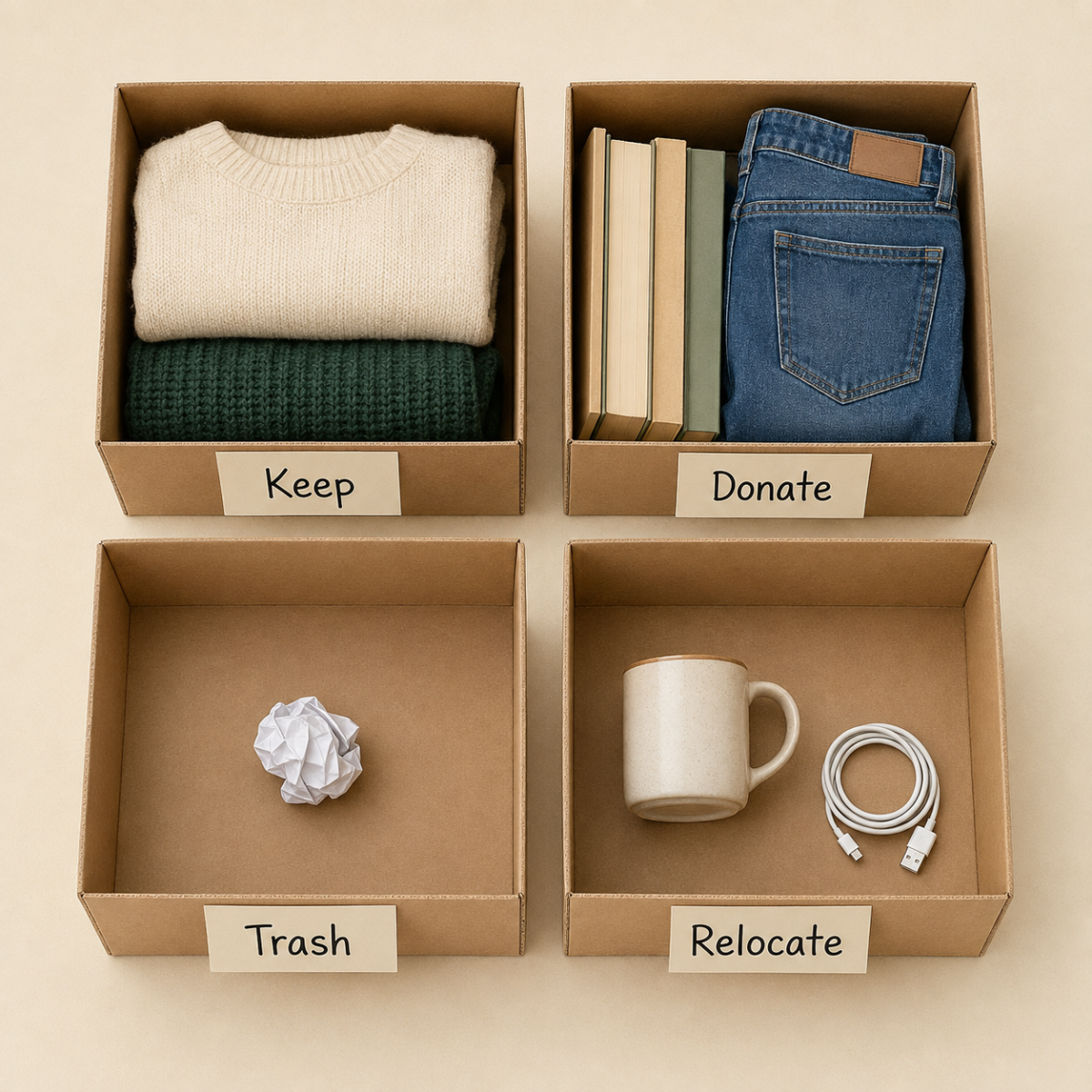
The four-box method sorts everything in a space into exactly four categories: keep, donate, trash, and relocate. Every single item gets assigned to one box before you move to the next item, which is what keeps a challenge moving instead of stalling on hard decisions.
Here’s what each box actually means in practice:
- Keep. Stays in this space, in this room, because it’s used regularly and belongs here.
- Donate. Still functional and usable, just not needed by you. Goes in a bag or box that leaves the house within the week, not “eventually.”
- Trash. Broken, expired, or genuinely unusable. No sentimental exceptions for this box specifically; if it’s earned a sentimental exception, it belongs in Keep instead.
- Relocate. Belongs somewhere else in your home, not this space. A kitchen item found in a bedroom closet, for example.
The rule that makes this method work: touch every item exactly once, and assign it to a box before picking up the next thing. Setting an item down “to think about later” is how a 20-minute session turns into a three-hour stall. If you genuinely can’t decide, give yourself a 10-second cap, then default to Donate. You can always buy a replacement for the rare item you regret losing. You can’t get the time back from a decision that took twenty minutes instead of ten seconds.
The 14-Day Decluttering Challenge Calendar
Spread across 14 days, in 20-to-30-minute daily sessions, one manageable zone at a time, is how this challenge avoids becoming a single exhausting weekend. Each day targets one specific, bounded area, small enough to finish in one sitting using the four-box method above.
| Day | Target zone | Approx. time |
| 1 | One dresser drawer (the worst one) | 20 min |
| 2 | Bathroom cabinet or medicine cabinet | 20 min |
| 3 | Junk drawer (kitchen or entryway) | 25 min |
| 4 | Coat closet, hanging section only | 30 min |
| 5 | Coat closet, floor and shelf | 25 min |
| 6 | Under the bathroom sink | 20 min |
| 7 | Kitchen “everything else” cabinet | 30 min |
| 8 | Bookshelf or media console | 25 min |
| 9 | Nightstand and its drawer | 15 min |
| 10 | One closet shelf (top or back) | 25 min |
| 11 | Bedroom dresser, remaining drawers | 30 min |
| 12 | Bathroom linen storage | 20 min |
| 13 | Entryway table or drop zone | 20 min |
| 14 | Final walk-through, catch anything skipped | 30 min |
This order isn’t random. It starts with the smallest, lowest-stakes zones (a single drawer) to build momentum before tackling anything genuinely daunting, like a full coat closet, and it deliberately spreads related zones (bathroom cabinet, then under-sink storage, several days apart) rather than clustering them, so no single day asks for more than 30 minutes.
If a zone genuinely needs more time than its slot allows, don’t extend the day. Stop at the time limit, mark what’s left as “carry over,” and finish it at the start of the next day’s session instead. A challenge that respects its own time limits is one you’ll actually complete; one that balloons past 30 minutes on day one usually doesn’t make it to day four.
The One-Question Test That Speeds Up Every Decision
Ask one question for every item that makes you hesitate: “Have I used this in the last year, and would I buy it again today if I didn’t already own it?” A no to either half of that question is a strong signal for Donate or Trash, not Keep.
This single question resolves most of the genuinely hard decisions in a decluttering challenge faster than any pro-and-con list. It works because it replaces a vague, emotional question (“do I like this?”) with two concrete, answerable ones. Almost everyone likes the idea of a kitchen gadget they used twice in 2023. Almost no one would buy that same gadget today, at full price, for how often they actually reach for it.
A few categories deserve a slightly different version of the question:
- Sentimental items: “Does this specific object create the memory, or would a photo of it do the same job?” Photograph what you’re on the fence about before deciding, then revisit the photo (not the object) in a month.
- “Someday” items: “Do I have a specific, dated plan for this in the next 90 days?” A vague someday isn’t a plan.
- Duplicates: “If I could only keep one, which one would I actually reach for?” Keep that one, donate the rest, no matter how good a deal the second one was.
What to Do With What You Declutter
Every item that leaves a space during a challenge needs an actual exit point, not just a temporary spot by the front door. Donations should leave the house within a week, sellable items need a specific listing deadline, and trash needs to go out with the next collection, not sit “for now” in a bag that becomes its own new pile.
The biggest way a decluttering challenge quietly fails isn’t bad decisions during the sorting itself. It’s a garage-door effect: bags and boxes pile up by the exit, fully sorted, and then just… stay there for weeks, taking up exactly the space you were trying to clear. Set a hard rule before day one: nothing leaves its box until you have somewhere for it to actually go, and every box has a departure date attached to it before you start filling it.
A workable exit plan for each category:
- Donate: Pick one drop-off location near you and put the date on your calendar before day one starts, not after the boxes are full.
- Sell: Give yourself a two-week listing window. Anything unsold by the deadline moves to Donate automatically, no exceptions and no re-listing.
- Trash: Goes out with the very next collection day, full stop.
- Relocate: This one has zero excuse to sit around; carry it to its actual home the same day you find it.
Common Reasons Decluttering Challenges Stall (and How to Restart)
The three most common reasons a decluttering challenge stalls partway through are skipping the daily time cap, letting “maybe” items pile up instead of assigning them to a box, and losing momentum after missing a single day. Each has a specific, fast fix rather than a full restart.
Skipping the time cap. If day one runs 90 minutes instead of 20, day two starts to feel like a chore instead of a quick win, and that’s usually where challenges quietly die. Fix: set an actual timer, and when it goes off, stop, even mid-drawer. Momentum from finishing on time beats the satisfaction of a fully finished drawer that cost you your motivation for tomorrow.
Letting a “maybe” pile grow. Every item that avoids a box because you couldn’t decide becomes tomorrow’s problem, and tomorrow’s problem compounds. Fix: apply the 10-second cap from the one-question test above, and default anything you can’t decide on quickly to Donate. You’re not making a permanent judgment on the object’s worth. You’re making a decision that keeps the challenge moving.
Missing a day. Missing one day of a 14-day challenge is not the same as failing it, but treating it that way is exactly what causes people to abandon the whole thing. Fix: pick back up on the next zone on the list, not the one you missed. Circle back to the skipped zone at the very end, folded into day 14’s walk-through, rather than letting one missed day cost you the entire second week.
Frequently Asked Questions
How is a decluttering challenge different from a seasonal reset? A seasonal reset is quick, recurring maintenance for a space that’s mostly under control. A decluttering challenge is a deeper, more structured process for a space that’s genuinely overloaded, using the four-box method across a set number of days rather than a quick seasonal pass.
What if I don’t have 14 days available in a row? The calendar is designed to flex. Skip a day and resume where you left off; the order matters more than the exact dates. What matters is finishing each day’s zone within its time limit once you start it, not doing all 14 days back-to-back.
Do I need to buy storage bins before starting a decluttering challenge? No, and buying them first is one of the more common mistakes. Sort everything using the four-box method first, then measure and shop for storage based on exactly what’s left in the Keep box, not before.
What should I do with sentimental items I’m not ready to part with? Photograph the item, put the physical object in a single, bounded “sentimental” box (not scattered across multiple spaces), and revisit that box, not each individual decision, during your next seasonal reset rather than mid-challenge.
How long until a decluttered space stays decluttered? That depends less on the challenge itself and more on what happens after it. A recurring seasonal reset and a few small daily habits are what actually keep a space from sliding back to where it started; the Home Maintenance Routine Guide covers exactly which habits do that work.
Related Reading
- The Complete Seasonal Reset Guide — the bigger-picture order (reset, then challenge, then maintain) this guide fits into: https://taimsspace.com/the-complete-seasonal-reset-guide/
- Seasonal Reset Guide — the room-by-room, season-by-season checklist for the lighter maintenance pass most spaces only need: https://taimsspace.com/seasonal-reset-guide/
- Home Maintenance Routine Guide — the daily habits that keep a space from ever needing this level of challenge again: https://taimsspace.com/home-maintenance-routine-guide/
- Category: Decluttering Challenges — every structured decluttering plan and challenge on the site: https://taimsspace.com/decluttering-challenges/
- Hub: Seasonal & Maintenance — the full Maintain-stage hub, covering resets, challenges, routines, and move checklists: https://taimsspace.com/the-complete-seasonal-reset-guide-2/
- Home Maintenance Routine Guide — related practical guide on Taims Space.
- Seasonal Reset Guide — related practical guide on Taims Space.
- Complete Small-Space Decluttering Guide — related practical guide on Taims Space.
- One-Weekend Decluttering Challenge — related practical guide on Taims Space.
- The Complete Seasonal Reset Guide — related Taims Space guide.
- Complete 30-Day Decluttering Challenge — related Taims Space guide.
- 20-Minute Declutter Method — related Taims Space guide.