Table of Contents
Be honest for a second: how many bins, baskets, and “organizing systems” in your home right now are actually just holding stuff you never sorted through in the first place? For most people, the answer is more than they’d like to admit, and it’s the exact reason so many organizing projects quietly fail within a month.
Real decluttering isn’t about making a mess look neater. It’s about deciding what genuinely earns a spot in your home and getting everything else out the door, not into a closet, a garage corner, or a spare room labeled “deal with later.” That last part is where most attempts actually fall apart. Moving clutter is not the same as removing it, and a home full of neatly hidden clutter still functions like a cluttered home in every way that matters day to day.
This guide walks through a method built around small, sustainable sessions rather than one exhausting weekend, and it’s specifically designed to get items actually out of your possession, not just out of view.
Why Most Decluttering Attempts Don’t Stick
The typical decluttering attempt goes something like this: a burst of motivation, an entire Saturday cleared out, every room attacked at once. By Sunday evening, there’s a pile of “maybe” items with nowhere assigned to go, a stack of donation bags still sitting by the door three weeks later, and a general sense of having done a lot of work without much to show for it.
Two things usually cause this. First, trying to declutter an entire home in one sitting is exhausting enough that decision fatigue sets in fast, and tired decisions default to keeping things “just in case” rather than actually evaluating them. Second, without a clear next step for the “no” pile, donation bags sit around indefinitely, which means the clutter never actually left, it just changed shape and location.
A method built around smaller, room-by-room sessions with a specific plan for where “no” items go immediately solves both problems at once. It doesn’t require a single heroic weekend, and it doesn’t leave a trail of good intentions sitting in bags by the front door.
The Method: Room by Room, Category by Category
Effective decluttering works through one room at a time, sorting by category within that room rather than trying to evaluate an entire home’s worth of belongings simultaneously. Trying to declutter “the whole house” as a single mental category is overwhelming by design. Trying to declutter “the kitchen junk drawer” is a task you can actually finish in fifteen minutes.
Start with the room that bothers you most day to day, not necessarily the biggest project. Momentum matters more than efficiency here, and finishing one visibly improved space early tends to carry motivation into the next one far better than starting with the hardest room in the house.
Within each room, sort by category rather than by physical pile. Pulling every mug out of every cabinet at once, for example, makes it obvious how many you actually own and which ones haven’t been touched in a year, in a way that sorting drawer by drawer never quite reveals.
For each item, three honest questions do most of the work:
- Have I used this in the last year? Not “might I,” but genuinely used, for its actual intended purpose.
- Would I buy this again today, at today’s price, knowing what I know now?
- Does keeping this cost me more in space and mental clutter than it’s worth in actual use?
An item that fails all three questions is a clear no. An item that passes even one honestly earns another year in the home, and that’s fine. The goal isn’t minimalism for its own sake. It’s making sure what stays actually earns its space.
What to Do With the “No” Pile Immediately
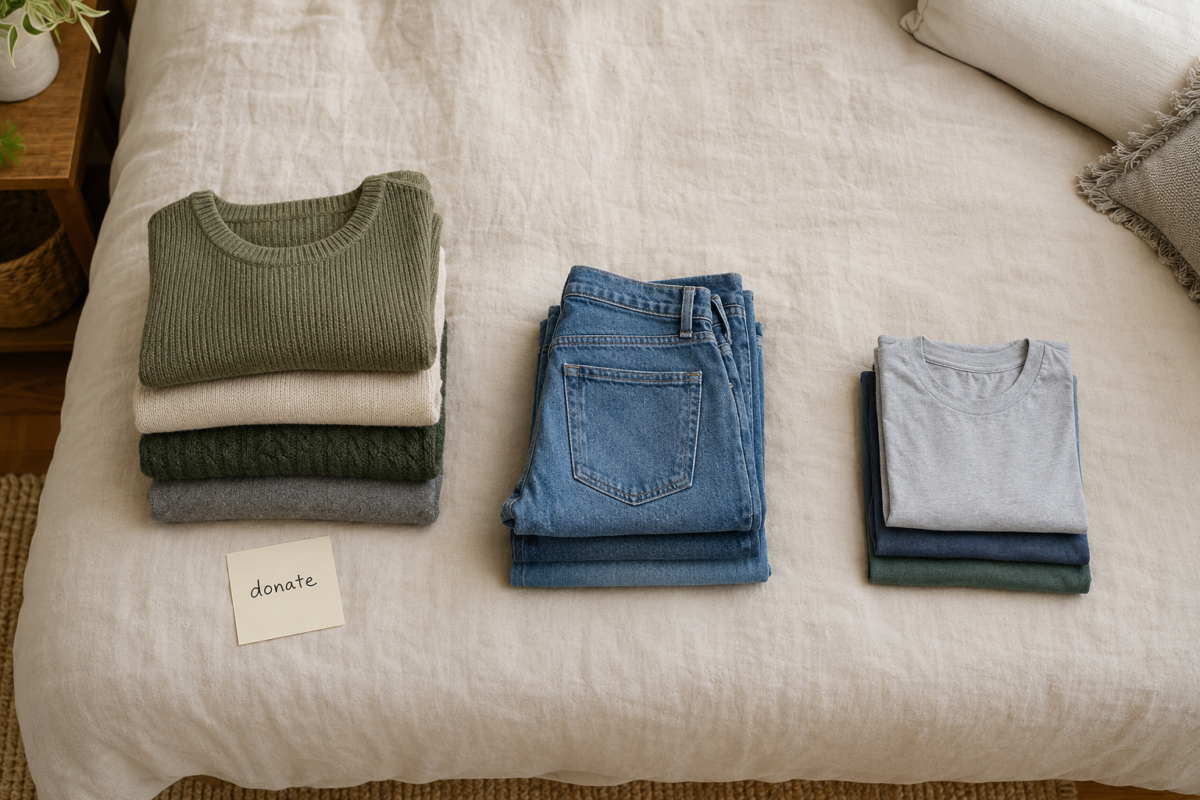
A decluttering session isn’t finished until the discarded items have physically left the house, or at minimum left the room with a specific next destination already assigned. This single step is the difference between decluttering that sticks and decluttering that just relocates the mess.
For donation items, the fix is removing the delay between deciding and delivering. Keep a donation box or bag actively in the car, ready to drop at a donation center on the next errand run, rather than accumulating bags in a hallway waiting for “someday.” If a specific pickup service is available in your area, scheduling it for the same week as the decluttering session removes the gap entirely.
For items with resale value, set a firm deadline. List them within a specific window, a week is usually reasonable, and donate anything unsold after that point rather than letting the “I’ll sell this eventually” pile sit indefinitely. The mental clutter of an unsold pile often costs more than the resale value would have earned anyway.
For trash and recycling, the answer is immediate: straight to the appropriate bin, the same day, no holding period. There’s no legitimate reason for actual trash to sit in a bag “just in case,” and giving it a holding period is often just decision avoidance wearing a practical-sounding excuse.
The households that keep clutter from returning treat this step as non-negotiable. A decluttered pile that sits in the garage for two months isn’t actually decluttered. It’s just clutter that moved.
The Categories People Get Stuck On Most
A few categories consistently slow the process down more than others, and it helps to have a specific approach ready for each.
Sentimental items are the hardest, and the honest fix isn’t forcing yourself to discard things that genuinely matter. It’s being selective rather than keeping everything with any emotional tie. Choosing the handful of items that best represent a memory, and photographing the rest before letting them go, preserves the sentiment without requiring physical storage for every single object tied to it.
“Someday” items, the craft supplies for a hobby you haven’t touched in two years, the exercise equipment for a routine you keep meaning to restart, deserve one honest deadline. If it hasn’t been used by a specific date you set for yourself, it goes, regardless of the genuine intention behind keeping it.
Duplicate or backup items, extra chargers, spare kitchen gadgets, multiples of the same tool, rarely need more than one or two on hand. Keeping a reasonable backup makes sense. Keeping five is usually just accumulated inertia rather than a real need.
Gifts you never wanted carry guilt that has nothing to do with the item’s actual usefulness in your life. The giver’s intention was the gesture, not permanent storage obligation. An item that doesn’t serve you can be let go without it reflecting poorly on the relationship behind the gift.
Keeping Clutter From Coming Back
Decluttering once solves a moment in time, not a permanent state, unless something changes about how new items enter the home going forward.
A one-in, one-out habit for categories prone to accumulation, like clothing or kitchen gadgets, keeps volume roughly stable without requiring a full re-declutter down the line. It doesn’t need to be a strict rule for every category, just the ones that tend to creep.
A quarterly mini-session, even just twenty minutes per room, catches drift early before it becomes a full project again. This is far less overwhelming than letting a year pass and facing another full-scale decluttering effort from scratch.
Pausing before bringing new items home, particularly for impulse purchases, prevents a lot of future clutter before it starts. A simple habit of waiting even a day before a non-essential purchase filters out a surprising number of items that would have joined the “someday” pile within a month anyway.
Decluttering Beyond Physical Objects
Clutter that never gets discussed in most decluttering advice is the paper and digital kind, and both quietly add to the sense of overwhelm even when the physical home looks fine.
Paper clutter tends to accumulate in one specific spot, usually a kitchen counter or entryway table, and the fix is the same sorting logic applied to physical items. Mail gets sorted immediately into act-on, file, or recycle, with nothing allowed to sit in an undefined middle pile. A single small file box or folder handles the “file” category, and anything not touched within a defined window, a year is reasonable for most household paperwork, gets shredded or recycled.
Digital clutter, meaning an overflowing phone photo library, a desktop covered in files, or an inbox with thousands of unread messages, doesn’t take up physical space but genuinely adds to daily mental load. A short weekly habit of deleting obvious duplicates and unsubscribing from unread newsletters does more over time than one overwhelming digital purge attempt.
Neither of these needs the same urgency as physical clutter, since neither is visibly taking up a room. But addressing them with the same room-by-room, category-by-category logic keeps the whole decluttering effort consistent, rather than treating physical and digital mess as two entirely separate problems where only one ever actually gets solved.
Frequently Asked Questions
How long does it take to declutter an entire home? It depends heavily on how much has accumulated and how much time you can give it, but a room-by-room approach over several weekends is realistic for most homes, versus attempting everything in a single exhausting day that often stalls partway through.
What should I do with sentimental items I don’t want to throw away but never use? Photograph them before letting go, and keep only the handful that best represent the memory rather than every item tied to it. This preserves the sentiment without requiring permanent physical storage for everything.
Is it okay to declutter a little at a time instead of all at once? Yes, and it’s often more sustainable. Smaller, consistent sessions avoid the decision fatigue that leads to keeping things “just in case,” and they’re easier to maintain as a habit than one large, exhausting effort.
What’s the best way to actually get rid of donation items instead of letting them pile up? Keep a donation box active in your car so it leaves with the next errand trip, rather than accumulating bags by the door. Scheduling a pickup service for the same week as the decluttering session works even better if one’s available locally.
How do I declutter items that belong to someone else in my household? Don’t remove them unilaterally. A shared decluttering session, even a short one, gets buy-in that a surprise purge never does, and it avoids resentment over belongings disappearing without warning.
Related Reading
- The Complete Home Organization Guide — the full decluttering → systems → storage sequence this guide fits into
- Storage Solutions Guide — the storage worth adding once decluttering reveals what’s actually staying
- Closet Organization Guide — a focused, room-by-room application of this same decluttering method
- The Complete Small-Space Decluttering Guide — a related Taims Space guide.
- Where to Start Decluttering — a related Taims Space guide.
- The 20-Minute Declutter Method — a related Taims Space guide.
- Decluttering Challenge Guide — a related Taims Space guide.
- Daily Organization Systems Guide — a related Taims Space guide.
Category: Decluttering Hub: /organization-and-storage/
Reviewed by the Taims Space editorial team.