Table of Contents
One closet. That’s what you’ve got, and it’s somehow supposed to hold every season’s clothing, the vacuum, the extra linens, and whatever else in your home doesn’t have an obvious room to live in. If it currently feels like it’s failing at that job, the closet probably isn’t actually too small. It’s probably just using less than half its real capacity.
A standard reach-in closet, even a modest one, has far more usable volume than the single hanging rod and one shelf it typically comes with suggests. Most of that potential sits in the space above the existing rod, in the floor space beneath the hanging clothes, and in how efficiently the hanging clothes themselves are stored. Almost none of it requires anything permanent.
This guide walks through how to actually use that potential, starting with the addition that changes a closet’s capacity more than anything else on this list.
The Single Biggest Change: Add a Second Rod
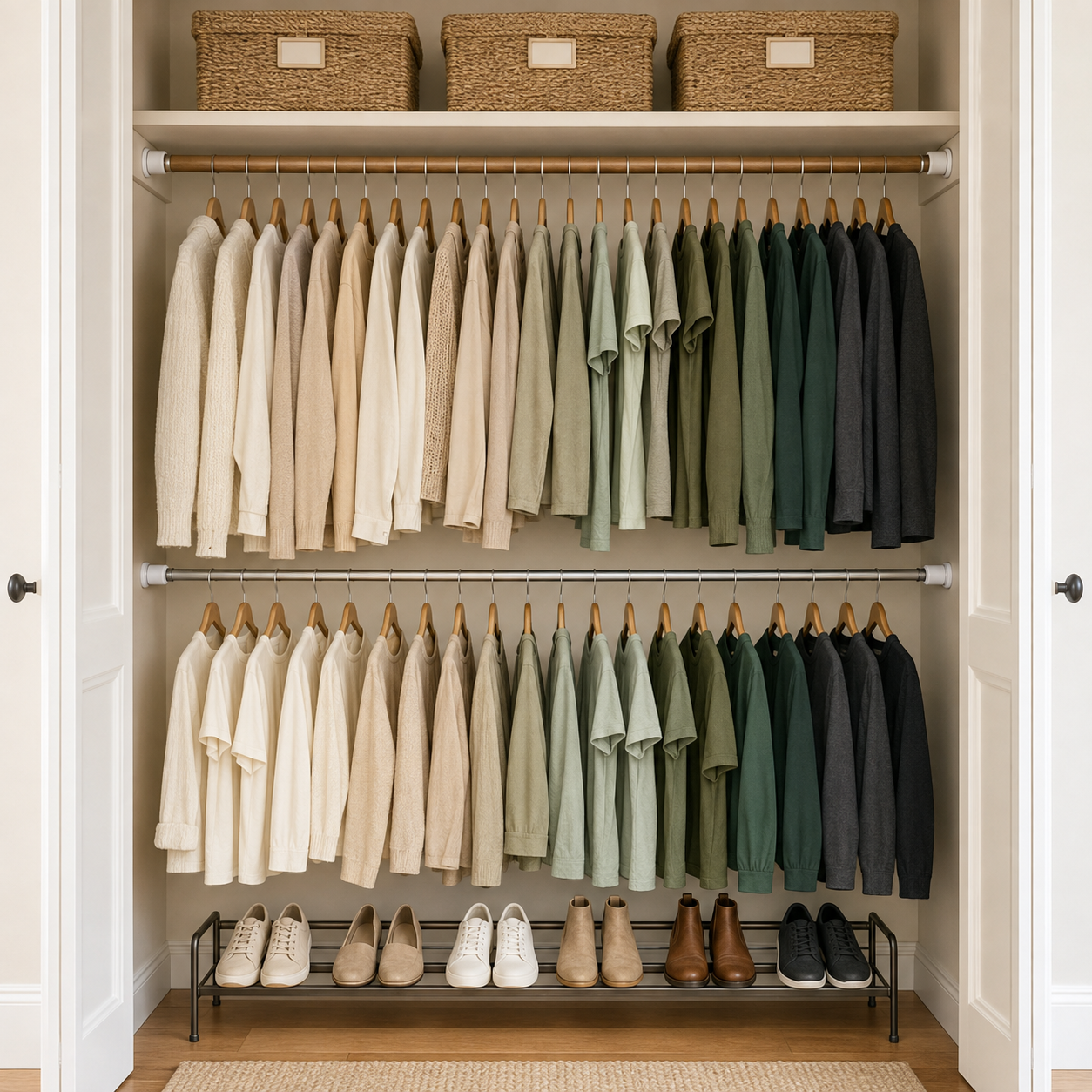
Adding a second, lower hanging rod beneath the existing one is the single highest-impact change available for a standard reach-in closet, since it can roughly double the amount of clothing the closet holds without any new floor space or permanent installation. Most closets are built with a single rod positioned for full-length hanging, which wastes an enormous amount of vertical space for anything shorter, like shirts, folded pants on hangers, or jackets.
A tension-mounted rod, installed without screws or drilling, fits beneath the existing rod and creates a genuine second tier for shorter items. Reserve the original, higher rod for the items that actually need full length, dresses, long coats, and use the new lower rod for everything else. This single change is often enough to solve a closet that felt hopelessly full before a single other product gets added.
For closets without room for a full second rod across the whole width, even adding one on just half the rod’s length, above a stack of bins or shoe storage on the other side, adds meaningful capacity without requiring the full-width installation.
Using the Space Above the Existing Rod
The shelf above a standard closet rod is usually the single most underused spot in the entire closet, mainly because it’s awkward to reach and easy to ignore.
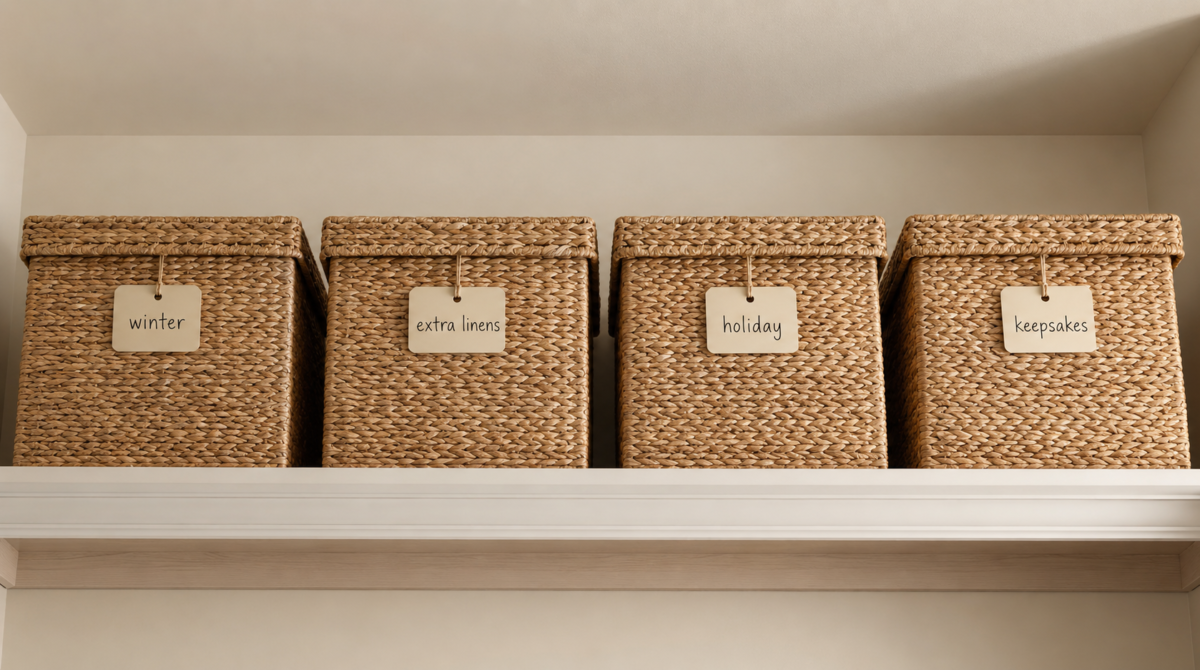
This is the right spot for infrequently used items, not daily ones. Off-season clothing, extra bedding, and the box of holiday decorations all belong here, since the awkward reach matters less for things you’re only accessing a few times a year. Matching, labeled bins keep this shelf from becoming an unidentifiable pile, and labeling matters more here than almost anywhere else in the closet, since the contents aren’t visible at a glance the way hanging clothes are.
If the shelf is deep enough, stacking two rows of bins, front and back, doubles its effective capacity. Keep the more frequently accessed bin in front and the true long-term storage in back, since digging past a front row for something used rarely is a minor inconvenience, but doing the reverse turns a simple task into a genuine hassle every time.
Floor Space Beneath the Hanging Clothes
The floor of a reach-in closet often becomes an unintentional dumping ground, a pile of shoes, a stray bag, whatever didn’t have anywhere else to go, simply because nothing was ever assigned to it deliberately.
A shoe rack or slim shelving unit, sized to fit the closet’s actual depth, gives shoes a defined home instead of a growing pile. Angled shoe racks, which store pairs at a slight incline, fit more pairs into the same footprint than flat storage does.
Stackable bins or a small drawer unit work well for items that don’t hang, like folded sweaters, accessories, or a small set of out-of-rotation shoes. This reclaims floor space that would otherwise sit as unstructured clutter beneath the hanging clothes.
A hamper that fits the actual footprint available, rather than a bulky freestanding one that eats into the closet’s usable floor space disproportionately, keeps laundry contained without stealing room from everything else trying to live on that same floor.
Organizing What’s Actually Hanging
Once the structural additions are in place, how the hanging clothes themselves are organized determines whether the closet stays functional day to day or slides back into a jumbled mess within a few weeks.
Matching, slim hangers free up a surprising amount of rod space compared to a mismatched collection of bulky plastic and wire hangers. Slim velvet-style hangers in particular can add noticeably more hanging capacity to the same length of rod, purely from the reduced thickness per item.
Grouping by category, then by color within each category, makes finding a specific item fast and also makes it immediately obvious when something hasn’t been worn in a long time, since out-of-rotation items tend to cluster at one end untouched.
A seasonal rotation system, where off-season clothing moves to the upper shelf bins and current-season items take the prime rod space, keeps the closet from trying to hold an entire year’s wardrobe hanging at once. This single habit does more for a closet’s daily usability than almost any single product addition.
Closet Organization Mistakes That Undo the System
A few patterns show up repeatedly in closets that had a good system once and slowly lost it.
Buying storage before measuring the exact space. A second rod or shelving unit that’s slightly too wide or too deep for the closet either doesn’t fit or creates its own new obstruction, undermining the whole point of a targeted addition.
Skipping labels on anything not immediately visible. The upper shelf bins in particular need labels, since their contents aren’t visible without pulling them down. Unlabeled bins tend to get opened and re-closed repeatedly during a search, which wastes more time than labeling would have taken in the first place.
Letting the floor become a catch-all again. Without a specific assigned spot for shoes, bags, or miscellaneous items, the closet floor tends to drift back into an unstructured pile within a few weeks, even after a thorough organizing session.
Never revisiting the seasonal rotation. A closet organized once and never revisited slowly loses its logic as the seasons change and new items enter the wardrobe. A quick rotation at the start of each season keeps the system matching what’s actually being worn.
When Two People Share One Closet
A closet built for one person’s wardrobe gets noticeably harder to manage once it’s holding two people’s clothing, and the fixes above still apply, but a shared closet benefits from a bit more structure on top of them.
Splitting the closet by zone, not by mixing everything together, keeps a shared closet from becoming a daily source of friction. One side of the rod, one section of the upper shelf, and a defined portion of the floor space each belong to one person, rather than both people’s items interspersed throughout. This makes finding anything faster and reduces the low-grade tension that comes from one person’s clothes gradually spreading across the whole closet.
A shared decluttering session matters even more here than in a solo closet. Since removing someone else’s items unilaterally isn’t fair game, agreeing on a joint session, even a short one, keeps both halves of the closet from becoming lopsided, with one person’s side overflowing while the other stays reasonable.
Color-coding or using different hanger styles per person is a small trick that helps in a shared space specifically, making it immediately obvious at a glance whose item is whose without needing to check labels or ask.
If the closet genuinely can’t fit two full wardrobes even with good organization, it’s worth being honest about that rather than forcing it. Overflow to a nearby dresser or a small wardrobe elsewhere in the bedroom is a reasonable solution, and it’s better than a permanently overstuffed shared closet that neither person can actually use well.
Walk-In Closets: The Same Principles, More Room to Apply Them
A walk-in closet isn’t a fundamentally different problem than a reach-in closet, just one with more surface area to apply the same principles across. The temptation with extra space is to spread out loosely rather than organize deliberately, which often means a walk-in ends up feeling just as chaotic as a small reach-in, purely because the extra room made sloppy habits easier to get away with for longer.
The same hierarchy still applies: add a second rod tier wherever a single rod wastes vertical space, use upper shelving for infrequent items with clear labels, and keep the floor assigned rather than open to whatever gets dropped there. A walk-in just means applying that hierarchy across more linear feet of rod and more square footage of floor, not a different approach altogether.
Frequently Asked Questions
How much more storage does adding a second closet rod actually create? For closets holding a lot of shirts, folded slacks, or shorter items, a second rod can roughly double usable hanging space, since most closets are built with a single rod positioned for full-length garments that most items don’t actually need.
What’s the best way to organize a closet shelf that’s hard to reach? Reserve it for infrequently used items, like off-season clothing or holiday decorations, and use well-labeled bins so you’re not guessing at contents you can’t see from the floor. Reach frequency matters more than anything else when deciding what goes up there.
Do I need to buy matching hangers to organize a closet well? It’s not required, but it helps more than most people expect. Matching, slim hangers create visual calm and free up real rod space compared to a mismatched, bulky collection, which often makes a genuinely tight closet feel workable again.
How often should I rotate seasonal clothing in and out of my closet? Twice a year, at the start of each major season shift, keeps a closet’s prime rod space matching what’s actually being worn. This also doubles as a natural decluttering checkpoint for items that didn’t get worn the previous season.
Is a tension rod strong enough to hold a full second row of clothing? Yes, for typical clothing weight, tension rods rated for closet use hold up well, though it’s worth checking the specific product’s weight rating if the closet is holding unusually heavy items like winter coats on that lower rod.
Related Reading
- The Complete Home Organization Guide — the full decluttering → systems → storage sequence this guide completes
- The Decluttering Guide — the method worth applying to a closet before adding any new storage products
- Storage Solutions Guide — general storage principles that extend the ideas in this guide to the rest of the home
- The Complete Small Closet Organization Guide — a related Taims Space guide.
- Closet Systems Without Renovation — a related Taims Space guide.
- How to Store Off-Season Clothes — a related Taims Space guide.
- Shoe Storage for Small Closets — a related Taims Space guide.
- Home Maintenance Routine Guide — a related Taims Space guide.
Category: Closet Organization Hub: /organization-and-storage/
Reviewed by the Taims Space editorial team.