Table of Contents
Every piece of furniture in a small space occupies square footage that’s genuinely scarce, which means each one is worth evaluating on a simple question: is this doing everything it possibly could for the space it takes up, or is it just doing one job while a nearly identical alternative could be doing two? A plain coffee table and a storage ottoman occupy the same footprint. Only one of them is also solving a storage problem at the same time.
This is the core idea behind double-duty furniture, and it’s less about buying additional pieces and more about choosing smarter versions of furniture a room needs anyway. A bed was always going to be in the bedroom. A bench was always a reasonable choice for an entry. The only real decision is whether that furniture is also quietly holding real storage capacity, hidden in plain sight, or just taking up its footprint without contributing anything beyond its primary function.
Ottomans: The Highest Return on Footprint
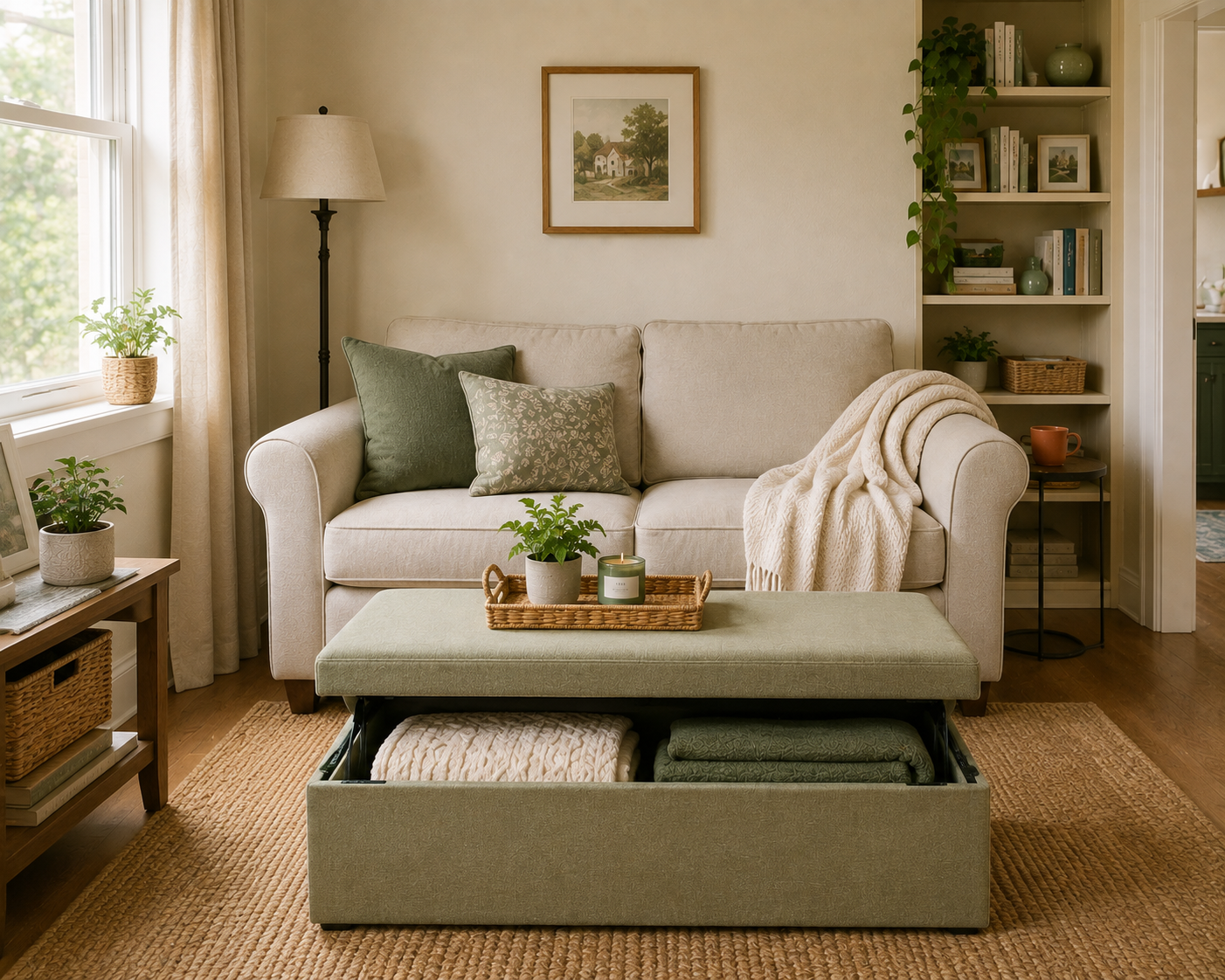
An ottoman with storage built in does more per square foot than almost any other piece of furniture available for a small space, since it simultaneously functions as a coffee table, extra seating, and a genuine storage container, all within a footprint that a plain coffee table would occupy anyway.
Lift-off lids versus hinged lids serve slightly different needs. A hinged lid stays attached and swings open, which is convenient for quick, frequent access but requires clearance above the ottoman to open fully. A lift-off lid detaches completely, which works better in a tight space where a hinged lid’s swing radius would be awkward, though it means setting the lid aside somewhere during access.
Interior dimensions matter more than exterior size when shopping. Some ottomans look substantial from the outside but have padding, internal framing, or a shallow cavity that reduces the actual usable storage significantly. Checking the manufacturer’s listed interior dimensions, not just the overall size, avoids a disappointing surprise once the piece arrives.
A tray-top ottoman adds function without sacrificing storage. A removable tray that sits on top of the storage compartment lets the ottoman function as a stable surface for drinks or a laptop during regular use, while the storage underneath remains fully accessible whenever the tray is lifted off.
Ottomans work well in nearly every room, not just living rooms. A smaller storage ottoman at the foot of a bed, in a home office as an alternative to a filing cabinet, or even in an entry as impromptu seating, extends this same double-duty principle well beyond its most obvious living-room use.
Beds: The Largest Hidden Storage Opportunity in Most Homes
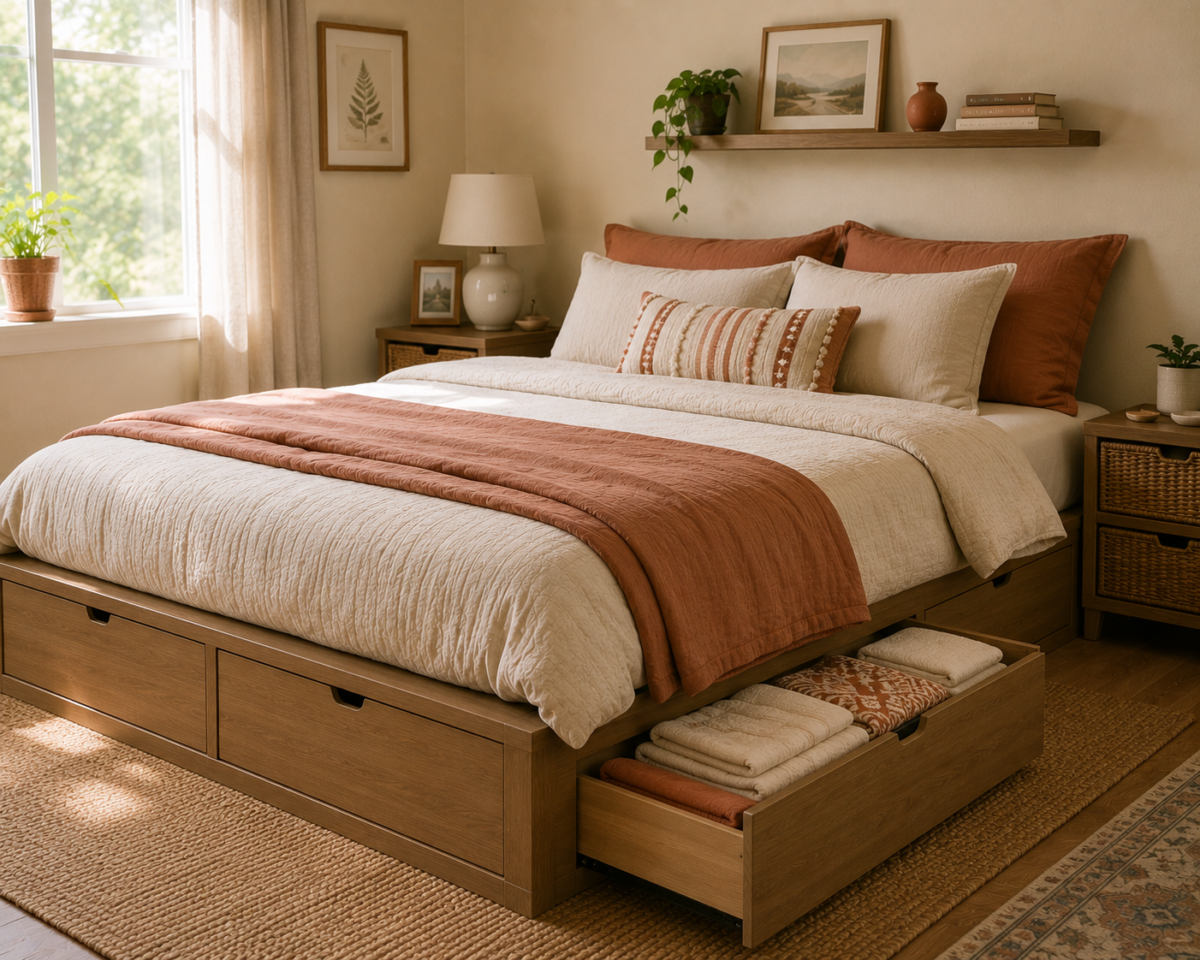
A bed occupies one of the largest single footprints in most homes, and the clearance underneath it, roughly 8 to 10 inches in a standard frame, represents a meaningful amount of unused volume if it isn’t being activated in some way.
Platform beds with built-in drawers formalize this space into genuine, easy-to-use storage. Rather than relying on loose bins slid under a standard frame, a bed specifically designed with drawer storage built into its base turns what would otherwise be an awkward, low-clearance gap into drawers that open and close the way any other piece of storage furniture would.
Drawer placement affects how usable the storage actually is. Drawers on the sides of a bed frame, rather than only at the foot, allow access from both sides of the room without needing to walk around to a single access point, which matters more in a small bedroom where the bed might be positioned close to a wall on one side.
A bed with storage headboard shelving extends the same principle upward. Some platform frames include shelving or small cubbies built into the headboard itself, adding a secondary storage zone that doesn’t require any additional furniture, like a nightstand, to hold books, a lamp, or small personal items.
For beds without built-in storage, rated risers and bins activate the same space retroactively. A standard frame paired with bed risers, which add clearance, and flat, rigid bins built for under-bed use accomplishes much of the same function as a purpose-built storage frame, at a lower cost if replacing an existing bed isn’t practical.
Benches: Function at the Entry, the Foot of the Bed, or a Hallway
A bench earns its place by solving a specific access problem, somewhere to sit while managing shoes, somewhere to set down a bag momentarily, while simultaneously hiding the actual clutter that tends to accumulate in exactly these transitional spaces.
A bench with a hinged, lift-up seat holds items directly underneath the sitting surface, which works well for shoes, seasonal accessories, or anything that needs to stay close to an entry without being visible on an open shelf or left out on the floor.
A bench with baskets or bins underneath, rather than an enclosed compartment, offers a different trade-off. This style sacrifices some capacity compared to a fully enclosed bench but gains flexibility, since the baskets can be pulled out individually rather than needing to lift an entire seat to access anything stored inside.
Sizing a bench correctly for its specific location matters more than it might seem. An entry bench needs to leave clearance for a door’s full swing and any walking path past it, while a bedroom bench at the foot of a bed needs to leave enough space between itself and the bed to actually be useful as a place to sit while getting dressed.
A bench doesn’t need to be limited to one obvious spot. A narrow bench in a hallway, at the base of stairs, or even doubling as extra seating pulled up to a small dining table when guests are over extends this piece’s usefulness well beyond a single fixed function.
Coffee Tables and Side Tables: Smaller Footprints, Real Capacity
Coffee tables and side tables occupy smaller footprints than ottomans or benches, but they still represent real, if modest, opportunities for hidden storage that shouldn’t be overlooked just because the scale is smaller.
A coffee table with a lower shelf adds a visible, easily accessible storage layer for books, remotes, or baskets, without adding any height or footprint beyond a standard coffee table’s dimensions.
A lift-top coffee table raises to become a working surface, useful for a laptop or a meal, while revealing storage space underneath that a standard fixed-top table simply doesn’t offer, making this style particularly useful in a living room that also functions as an occasional workspace.
Nesting side tables don’t hide storage in the traditional sense, but they solve a related small-space problem: needing extra surfaces only occasionally. A set of two or three tables that stack into one footprint when not needed provides the flexibility of additional surfaces without permanently dedicating floor space to tables used only when guests are over.
A side table with a drawer handles small, frequently needed items, remotes, coasters, a notepad, keeping them out of sight but still within arm’s reach of a favorite seating spot, a small-scale version of the same principle that applies to larger furniture throughout this guide.
Dressers and Wardrobes: Height Over Width, With Storage That Compounds
Dressers already exist purely for storage, but choosing the right style still makes a meaningful difference in how much capacity a given footprint actually provides, and a few specific choices extend the double-duty principle even within a category that’s already storage-focused.
A tall, narrow dresser holds roughly the same volume as a wide, low one while using significantly less floor footprint, freeing that recovered floor space for a different function entirely, extra walking room, a small chair, or simply an emptier, calmer feeling room.
A dresser topped with a mirror doubles as a vanity, combining two functions, clothing storage and a getting-ready surface, that would otherwise require two separate pieces of furniture in a bedroom.
A wardrobe with both hanging space and drawers consolidates what might otherwise require a closet plus a separate dresser into one piece, particularly valuable in a room with a small or nonexistent closet.
Choosing Which Pieces to Prioritize First
Not every double-duty furniture swap needs to happen at once, and prioritizing based on where the biggest gap currently exists produces faster, more noticeable improvement than trying to overhaul every piece of furniture in a home simultaneously.
Start with whichever room currently has the least dedicated storage. A living room with no closet or cabinet at all benefits disproportionately from a storage ottoman or bench, since it’s likely the room with the fewest existing storage options to begin with.
Prioritize furniture that was going to be replaced anyway. If a coffee table or bed frame is already due for an upgrade, choosing a storage-integrated version at that natural replacement point costs little extra compared to a standard version, making it an easy, low-friction place to start.
Consider which category of belongings currently lacks a home. If off-season clothing is the biggest storage pain point, a platform bed with drawers addresses that directly. If shoes and bags cluttering an entry are the issue, a storage bench solves that specific problem more directly than a general shelving addition would.
What to Check Before Buying Any Piece in This Category
A few practical checks, run before purchasing, catch most of the problems that show up later, either in daily function or in disappointment once a piece arrives.
Confirm actual interior storage capacity, not just overall dimensions. As covered above with ottomans, exterior size can be misleading once padding, framing, or drawer mechanisms are accounted for. Checking a manufacturer’s stated interior dimensions, or reading reviews that specifically mention real-world capacity, avoids buying based on an inflated sense of how much a piece will actually hold.
Check weight capacity for both the storage function and any seating or surface function. A storage bench needs to support a person sitting on it in addition to whatever’s stored underneath, and an ottoman used as a footrest or extra seat needs the same dual consideration. A piece rated only for its storage capacity, without accounting for its secondary use, can wear out faster than expected.
Test drawer and lid mechanisms in person when possible, or read reviews carefully when buying online. A sticky drawer glide or a lid that doesn’t stay propped open on its own turns a theoretically convenient piece of furniture into one that’s genuinely annoying to use daily, which undermines the entire point of choosing a multi-purpose design in the first place.
Measure the specific room’s clearance for opening mechanisms. A hinged ottoman lid, a bench seat that lifts, or bed drawers that pull outward all need real clearance to function, and a piece that technically fits a room’s footprint but can’t actually open properly once positioned defeats its own purpose.
Combining Multiple Double-Duty Pieces in One Room
Just as with vertical storage and bin systems, double-duty furniture works best when a few pieces are combined thoughtfully rather than relying on a single piece to solve an entire room’s storage needs on its own.
In a small living room, a storage ottoman paired with a coffee table featuring a lower shelf covers two different categories, soft items like blankets in the enclosed ottoman, and frequently grabbed items like remotes or books on the open shelf, without either piece competing with the other for the same function.
In a bedroom, a platform bed with drawers paired with a tall, narrow dresser topped with a mirror addresses clothing storage from two angles, everyday items in the more accessible dresser drawers, and bulkier or less frequently used items in the bed’s larger drawer capacity, while the mirror adds a getting-ready function neither piece would provide alone.
In an entry, a storage bench paired with a small table featuring a drawer handles two different item categories, shoes and bags in the bench, and small daily essentials like keys or mail in the table drawer, within a space that’s often too small to accommodate more than these two pieces at all.
Frequently Asked Questions
Is multi-purpose storage furniture worth the extra cost compared to standard furniture? Generally yes, since it replaces furniture a room needs regardless, a coffee table, a bench, a bed frame, with a version that adds real storage capacity for a modest price difference. This makes it one of the most space-efficient purchases available in a small home.
What’s the best piece of storage furniture to start with in a small living room? A storage ottoman is usually the highest-value starting point, since it functions as both a coffee table and seating while adding genuine storage capacity, all within a footprint the room needed to fill anyway.
How much storage can a platform bed with drawers actually hold? It varies by design, but a well-built platform bed with multiple drawers can hold roughly as much as a small to medium dresser, making it one of the largest single storage additions available without adding any new furniture to a bedroom.
Should I choose a hinged-lid ottoman or a lift-off lid ottoman? It depends on the space. A hinged lid is more convenient for frequent access but needs clearance above to open fully; a lift-off lid works better in a tight space where that swing radius would be awkward, though it requires setting the lid aside during access.
Can a coffee table really hold meaningful storage, or is it mostly decorative? A coffee table with a lower shelf or a lift-top design can hold genuine, regularly used items, books, remotes, a laptop, and while its capacity is smaller than an ottoman or bed, it still represents real storage that a standard fixed-top table simply doesn’t offer.
Related Reading
- The Complete Small-Space Storage Guide — the full three-layer storage system this multi-purpose furniture fits into.
- The Bin and Basket System That Actually Stays Organized — the sizing and labeling approach for whatever goes inside these storage-integrated pieces.
- Vertical Storage Ideas for Rooms With No Floor Space Left — the wall-mounted layer that pairs with floor-based furniture for a complete system.
- Furniture Scale That Actually Works in One Room — sizing guidance for choosing furniture, storage-integrated or otherwise, that fits a small room correctly.
- Parent Category: Small-Space Storage
- Parent Hub: Organization & Storage