Table of Contents
Organizing a space once is the easy part. Keeping it organized, week after week, without it slowly sliding back into the same clutter that prompted the original effort, is the part almost nobody actually solves. A beautifully sorted closet or a freshly labeled bin system doesn’t stay that way on its own, it stays that way because of small, repeated habits that either exist or don’t.
The good news is that maintaining an organized small space doesn’t require constant vigilance or hours of daily effort. It requires a small number of specific routines, run consistently, that catch clutter before it accumulates rather than tackling it after it’s already become a project. This guide covers those routines in the order they matter most: a short nightly reset that prevents daily buildup, a dedicated system for the one category of clutter that never actually stops arriving, mail and paper, and an approach for making any of this work when more than one person shares the space.
Layer One: The Nightly Reset
A short, consistent reset at the end of each day is the single most valuable habit in this entire guide, since it prevents the specific pattern that turns a tidy space into a cluttered one: small amounts of daily mess compounding, day after day, until a weekend deep clean feels necessary just to get back to baseline.
Ten minutes is enough, and that’s the point. A reset doesn’t need to be a full cleaning session. It needs to catch what’s accumulated during the day, dishes left out, items that migrated from their proper spot, surfaces that have collected small clutter, and return the space to a baseline state before the next day starts fresh.
Consistency matters more than thoroughness. A reset done every night, even an imperfect, rushed one, prevents buildup far more effectively than an occasional, more thorough cleaning session done once a week. The goal is never letting clutter accumulate past a single day’s worth, rather than periodically clearing out several days or weeks of accumulated mess.
The reset works because it’s small enough to actually happen. A task that takes ten minutes and has a clear, defined scope gets done consistently in a way that an open-ended “clean up the apartment” task rarely does, especially at the end of a tiring day when motivation for anything more involved is genuinely low.
For the exact routine, room by room, that fits into ten minutes and covers the areas that matter most, The 10-Minute Nightly Reset That Keeps Clutter From Piling Up breaks this down step by step.
Layer Two: A System for the Clutter That Never Stops Arriving
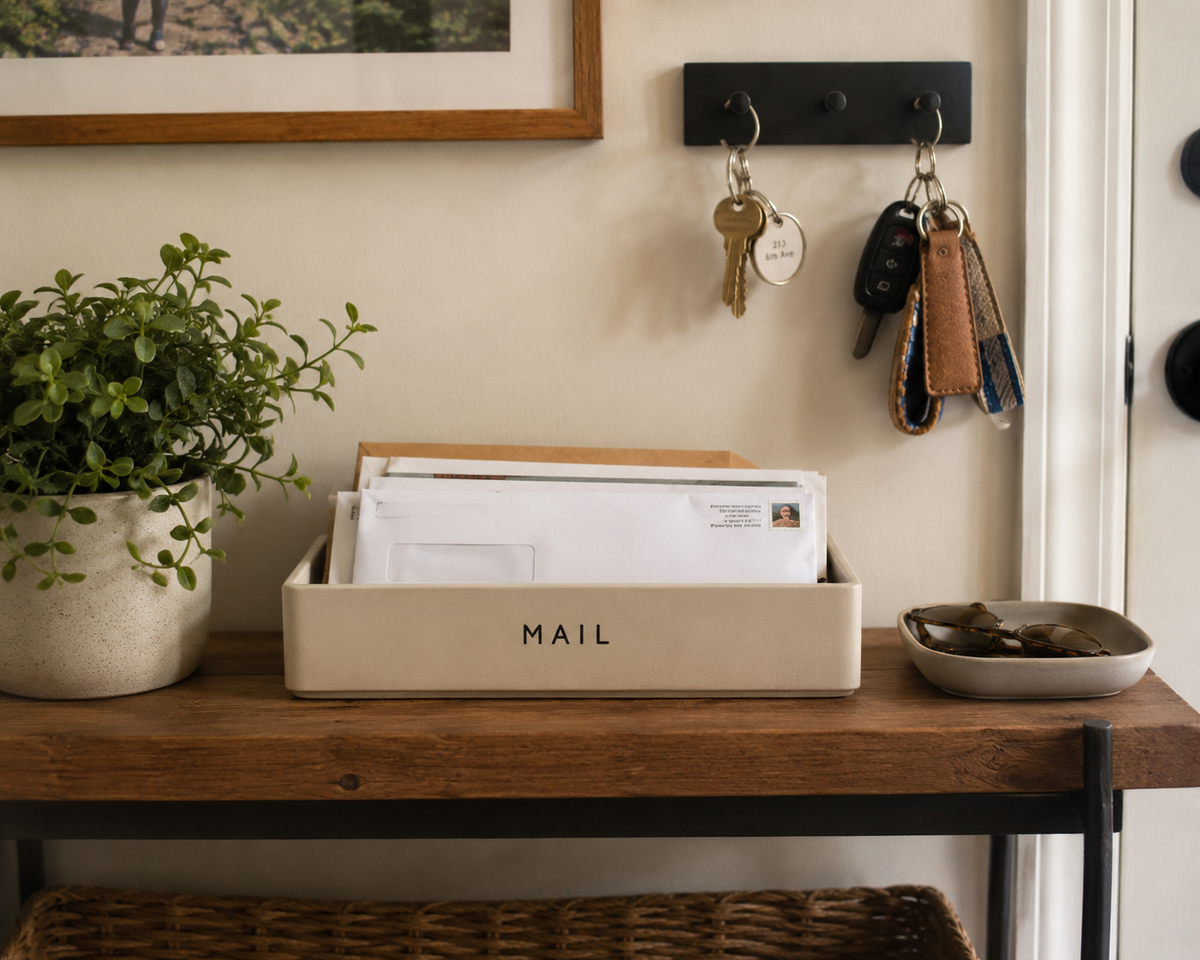
Most categories of clutter, once decluttered and organized, stay relatively stable, a bookshelf doesn’t generate new books on its own. Mail and paper are different. They arrive constantly, every single day, in a household that gets any mail at all, which means this category needs an ongoing system rather than a one-time organizing project.
Paper clutter accumulates faster than almost any other category because it has no natural endpoint. A piece of mail doesn’t announce whether it’s important or disposable, and without a system that sorts it immediately upon arrival, it tends to pile up on whatever surface is nearest the door, growing into a stack that becomes genuinely intimidating to sort through later.
A landing spot near the entry, dealt with daily, prevents this pile from ever forming. Rather than letting mail accumulate anywhere convenient, a dedicated tray or small system positioned right where mail enters the home, sorted the same day it arrives, keeps this category from ever reaching the volume that makes it feel overwhelming.
Not all paper needs the same treatment, and sorting it immediately makes that distinction easy. Junk mail can be discarded on the spot; bills need a specific action-tracking spot; documents worth keeping need a genuine filing home rather than an indefinite holding pile. Making this three-way sort part of a daily habit, rather than a periodic project, keeps each category from ever building up.
The full system for exactly where mail and paper should land, how to sort it consistently, and what to do with the specific subcategories that tend to cause the most buildup lives in A Daily System for Mail, Paper, and the Stuff Without a Home, covering this layer in complete depth.
Layer Three: Making It Work With More Than One Person
A system that depends entirely on one person’s memory, habits, or vigilance is fragile by design, and it’s one of the most common reasons an otherwise well-designed organization system quietly falls apart in a shared household. If only one person consistently returns items to their place, resets the space nightly, or sorts the mail, the system’s success depends on that one person never having an off day, which is an unreasonable standard for anyone to maintain indefinitely.
Shared systems need to be genuinely simple enough that everyone in the household can follow them without extensive explanation. A system with too many specific rules or too much nuance tends to only really work for whoever designed it, while everyone else in the household follows it inconsistently or not at all.
Visibility matters more in a shared household than a single-person one. A system that only makes sense to the person who set it up creates friction for everyone else trying to use it correctly, whereas clear labels, obvious landing spots, and a system that’s genuinely intuitive to a newcomer holds up regardless of who’s using the space on a given day.
Different household members may need different roles within the same overall system, and that’s fine. Not everyone needs to do everything identically, what matters is that the system as a whole functions even when responsibilities are distributed unevenly across the people actually living there.
For specific strategies on building routines that hold up regardless of who’s home, who’s busy, and who genuinely forgets to put things away sometimes, Daily Systems That Work When More Than One Person Lives There covers this layer in complete detail.
How These Three Layers Work Together
The nightly reset and the mail system both run daily, and they work best as parallel habits rather than sequential steps, since they address different categories of clutter that both need daily attention regardless of order. The household layer isn’t really a separate routine at all, it’s the framework that determines whether the first two layers actually function consistently in a home with more than one person, which is why it’s addressed last: it applies across everything covered in the first two layers rather than adding a fourth, separate task.
A realistic weekly rhythm looks like a ten-minute reset every night, a same-day mail sort whenever mail arrives, and, if the household includes more than one person, a shared understanding of where things go and who’s responsible for what, built once and referenced as needed rather than re-explained every single day.
Beyond the Daily Layers: A Lighter Weekly Check
While this guide focuses primarily on daily habits, since those are what prevent buildup in the first place, a brief weekly check catches anything the daily systems missed and keeps the whole system calibrated.
A once-a-week walkthrough, ten to fifteen minutes, catches drift the nightly reset might have missed. Even a consistent nightly routine occasionally lets something slip, a bill that got set aside without full processing, an item that ended up in the wrong spot. A weekly check, rather than letting these small misses accumulate for weeks, resolves them before they become a bigger project.
This is also the right moment for slightly bigger tasks that don’t fit a ten-minute nightly window. Restocking supplies, a quick check of the bin and basket system covered elsewhere on this site, or addressing anything flagged during the week as needing more attention than a nightly reset allows.
Keep this weekly check genuinely light. It’s meant to be a check-in, not a full cleaning session, and treating it as anything more involved risks it becoming the kind of dreaded, effortful task that daily habits are specifically designed to prevent in the first place.
Adapting the System to a Home’s Actual Rhythm
No two households run on quite the same schedule, and the general framework in this guide works best when it’s adjusted to fit real routines rather than followed as a rigid, one-size-fits-all script.
A nightly reset doesn’t have to happen at the same clock time every day. What matters is that it happens once daily, whether that’s right after dinner, right before bed, or whenever the day’s activity has genuinely wound down. Attaching it to a consistent point in the day’s natural rhythm, rather than a specific hour, tends to hold up better against days that don’t go exactly as planned.
Households with unpredictable schedules can build in flexibility without abandoning consistency. For anyone working irregular hours or with a schedule that shifts week to week, the reset can move around the day as needed, the underlying habit, doing it once before the day fully ends, matters more than a fixed time slot.
Some homes generate more daily clutter than others, and the ten-minute window is a starting point, not a strict limit. A household with young children, frequent guests, or simply more daily activity might need a slightly longer reset some days, and that’s a reasonable adjustment rather than a sign the system itself has failed.
Building These Habits When None of Them Currently Exist
Starting from zero, with none of these routines in place yet, can feel like a lot to build all at once, and it’s worth introducing them gradually rather than attempting to adopt the entire system on day one.
Start with the nightly reset alone for the first week or two. It’s the single highest-impact habit in this guide, and giving it dedicated attention before adding the mail system or household coordination makes it more likely to actually stick as a genuine habit rather than one of several new routines competing for attention simultaneously.
Add the mail system once the nightly reset feels automatic. By this point, the habit of doing a short daily routine should already feel more natural, which makes adding a second daily habit, sorting mail the day it arrives, a smaller lift than it would have been starting from nothing.
Address household coordination whenever it becomes clear the system needs it, not necessarily on a fixed timeline. Some households need this conversation immediately; others can build the first two layers individually and adjust for shared use once it’s clear where the friction points actually are.
What Happens When a Routine Gets Skipped
Even a well-built system runs into missed days, and how those misses are handled matters more than whether they happen at all, since expecting perfect, uninterrupted consistency sets up an unrealistic standard that eventually causes the whole system to be abandoned.
One skipped night isn’t a failure, and it doesn’t require a bigger catch-up session the next day. A single missed nightly reset means slightly more to deal with the following night, not an emergency requiring extra time or effort to compensate. Treating it as a minor, expected variation rather than a broken streak keeps the habit sustainable over months rather than becoming something to feel discouraged about after one off day.
A pattern of consistently skipped routines, rather than an occasional miss, is worth addressing directly. If a nightly reset or mail sort is being skipped most days rather than occasionally, that’s useful information that the routine itself might need adjusting, perhaps it’s taking longer than the intended ten minutes, or it’s scheduled at a time that consistently doesn’t work, rather than a sign of insufficient willpower.
Restarting after a longer lapse doesn’t require starting from a fully decluttered baseline again. If several weeks pass without any of these routines happening and clutter has genuinely built back up, a single more thorough reset session, rather than the usual quick ten-minute version, gets things back to a manageable starting point before returning to the regular daily rhythm.
Frequently Asked Questions
How long does a nightly reset routine actually take? About ten minutes for most small spaces, covering the areas that accumulate clutter fastest rather than a full cleaning. The short time commitment is intentional, since a routine that takes too long tends to get skipped on tired or busy days.
What’s the best way to stop mail from piling up? Sort mail the same day it arrives, using a dedicated landing spot near the entry rather than letting it accumulate on whatever surface is nearest the door. Immediate sorting into discard, action-needed, and keep categories prevents the pile from ever reaching an overwhelming size.
How do I get roommates or family members to follow an organization system? Keep the system simple enough that anyone can follow it without extensive explanation, and make landing spots and labels obvious rather than relying on one person’s memory or habits. A system only one person understands tends to only really work when that person is the one maintaining it.
Is a nightly reset better than a weekly deep clean? They serve different purposes and work best together. A nightly reset prevents daily buildup from accumulating in the first place, while an occasional, lighter weekly check catches anything the daily routine missed, without either one needing to replace the other entirely.
How do I start building these habits if I’m not currently doing any of them? Begin with the nightly reset alone for a week or two before adding anything else. Building one habit at a time, rather than trying to adopt an entire system simultaneously, makes it far more likely that each individual routine actually sticks.
Related Reading
- The 10-Minute Nightly Reset That Keeps Clutter From Piling Up — the full routine, room by room, that fits into a short daily window.
- A Daily System for Mail, Paper, and the Stuff Without a Home — where the constant inflow of paper should actually land, sorted daily.
- Daily Systems That Work When More Than One Person Lives There — shared routines that don’t depend on just one person keeping up.
- The Complete Small-Space Decluttering Guide — the decluttering process worth completing before building daily maintenance habits on top of it.
- Parent Category: Daily Organization Systems
- Parent Hub: Organization & Storage