Table of Contents
The apartment came with one coat closet, a handful of kitchen cabinets, and absolutely nowhere to put the vacuum, the off-season clothes, or the box of holiday decorations you’ve been shuffling between corners for a year. If that sounds familiar, the instinct is usually to assume you just own too much for the space. Most of the time, that’s not actually the problem.
The real issue is almost always that the storage a rental comes with was never designed around how much a real person owns. It’s designed around a bare minimum, and everything above that minimum has to be solved without touching a wall, a ceiling, or a landlord’s patience. The good news: nearly every serious storage gap in an apartment has a solution that requires zero permission, because it’s either vertical, portable, or built for exactly this problem.
This guide walks through those solutions room by room, starting with the single principle that makes almost all of them work.
The One Principle Behind Every Permission-Free Storage Solution
Storage that doesn’t require a landlord’s approval almost always works by using vertical space, floor space, or existing furniture differently, rather than attaching anything permanent to a wall, ceiling, or floor. Once that distinction clicks, an apartment that felt genuinely out of storage usually reveals several untouched options.
Vertical space is the biggest one, and it’s the most consistently wasted. Any wall with open space above furniture height, any closet with unused space above the hanging rod, any gap beside a piece of furniture that reaches the ceiling, all represent storage that’s currently doing nothing. Floor space works the same way: the gap under a bed, the dead zone beside a dresser, the narrow strip behind a door, all count.
Existing furniture is the third lever, and it’s the one people use least. A bed frame with drawers built in, an ottoman that opens for storage, a bench with a lift-up seat: furniture that does double duty adds real storage capacity without adding a single new footprint to the room.
Once you start looking at an apartment through this lens, vertical, floor, and furniture-based, most “we’re just out of storage” situations turn out to have real, unused capacity hiding in plain sight.
Entryway and Closet Storage
The entryway sets the tone for the whole apartment, and it’s also one of the most consistently underutilized storage zones available.
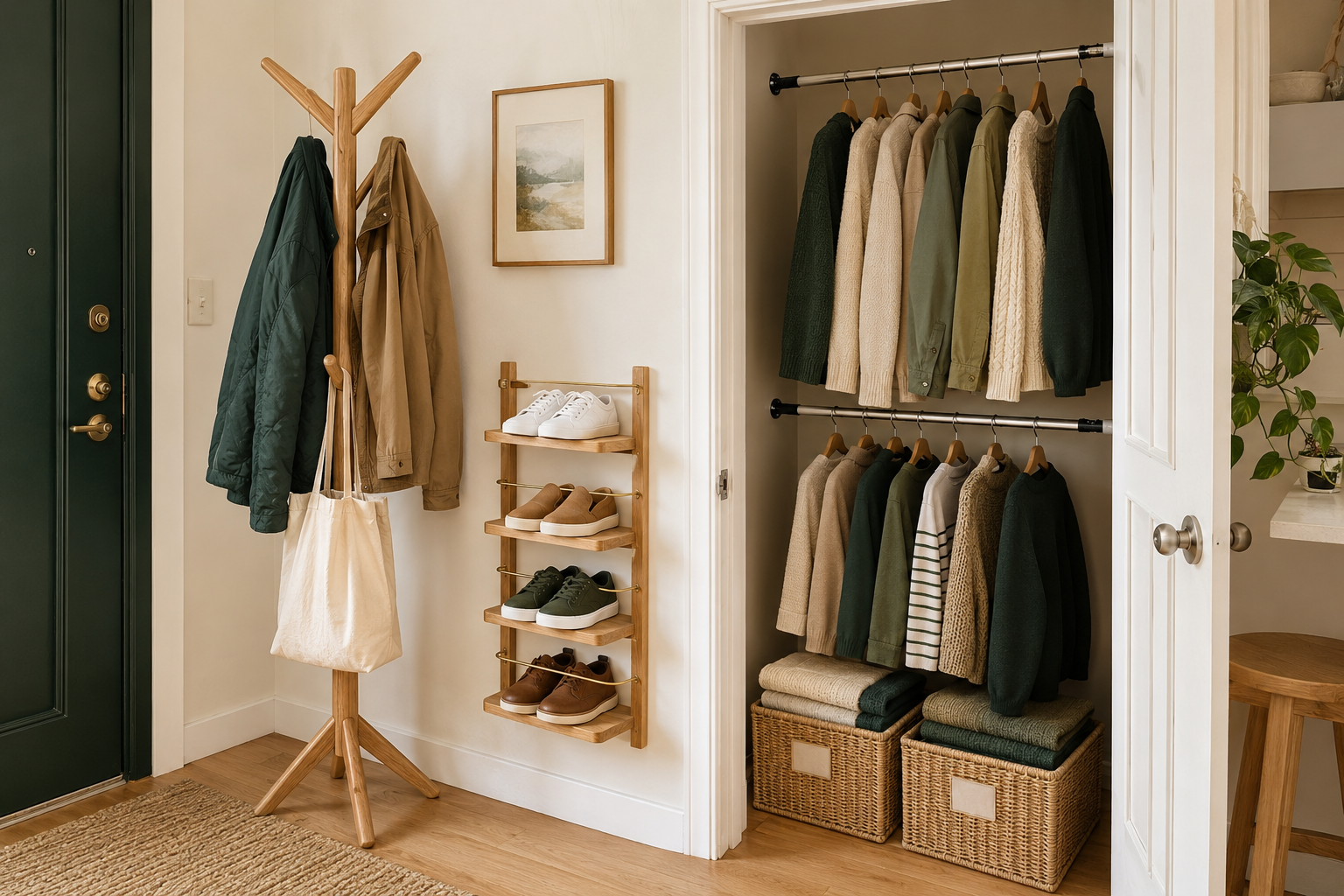
A freestanding coat rack or wall-leaning shelf unit solves the classic pile-of-coats-on-a-chair problem without a single wall attachment. Positioned near the door, it gives outerwear an actual home instead of a landing spot on whatever furniture happens to be closest.
A slim shoe rack, no more than 10 to 12 inches deep, fits in nearly any entryway, even one with almost no floor space, and immediately removes the pile of shoes that otherwise collects by the door.
Inside an actual closet, a tension-mounted closet rod system, installed floor to ceiling without a single screw, adds a genuine second or third storage tier above the original single hanging rod. Combined with stackable bins on the added shelves, this alone can roughly double a small closet’s real capacity.
Over-the-door organizers, hung on the inside of a closet door, use a surface that’s otherwise completely wasted. Shoes, accessories, or small folded items all work well here, since the pocket depth is shallow but the total surface area adds up across a full door.
Bedroom and Living Room Storage
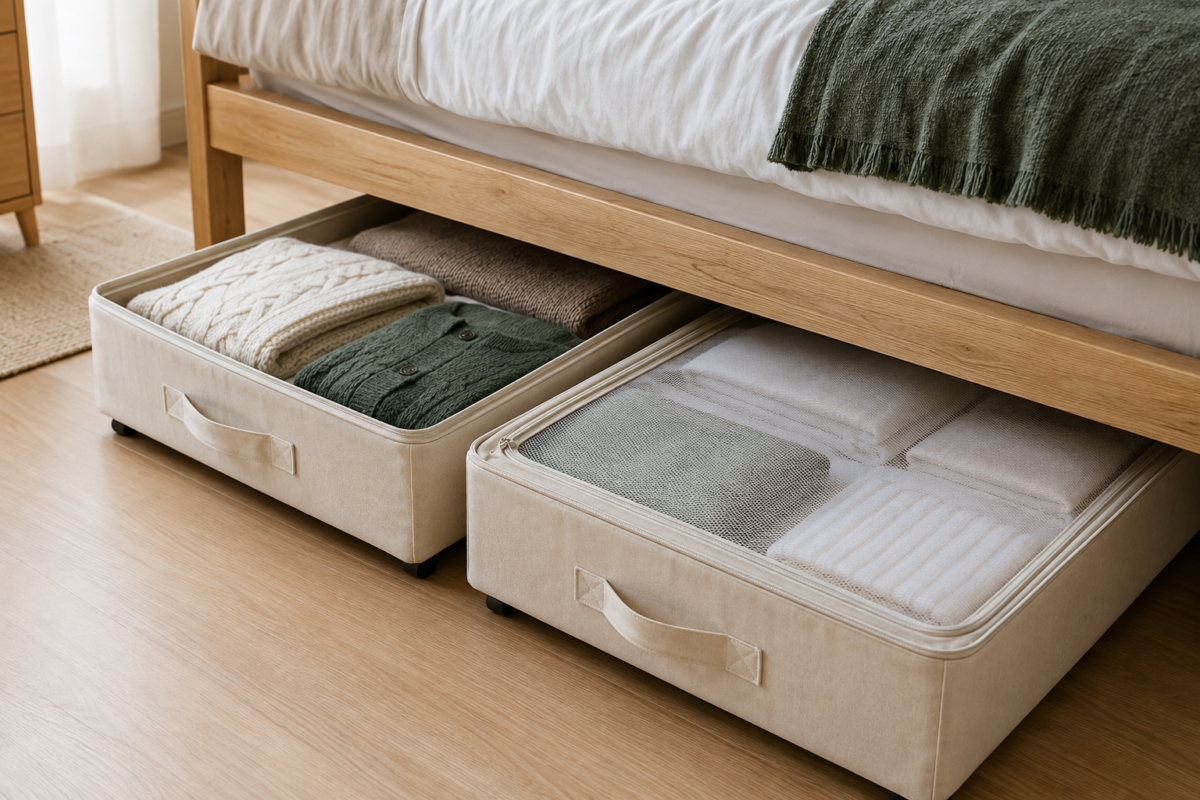
Under-bed storage is the single most underused space in most bedrooms. Flat, rolling storage bins, sized to slide under a standard bed frame, can hold off-season clothing, extra linens, or rarely used items, reclaiming what’s essentially a dead zone in nearly every bedroom layout.
Furniture that opens, like a storage ottoman, a bench with a lift-up seat, or a bed frame with built-in drawers, solves storage without adding a single new piece of furniture’s worth of footprint to the room. If you’re furniture shopping for a small space anyway, prioritizing pieces with this dual function over ones without it is one of the most useful decisions available.
Vertical shelving in an underused wall gap, whether that’s beside a dresser, in a corner, or above a doorway, adds real capacity in spots that otherwise sit empty. A narrow bookshelf, even just 10 to 12 inches deep, can hold books, folded blankets, or bins without eating meaningfully into a room’s usable floor space.
A slim rolling cart works in a living room the same way it works in a kitchen: it slides into a narrow gap, functions as a genuine extra storage piece, and rolls out of the way when it’s not needed.
Storage for Shared or Multi-Purpose Rooms
Studios and small one-bedrooms often ask a single room to hold storage for functions that would normally be split across separate rooms in a bigger home, and that requires a slightly different approach than storing within one well-defined space.
Assigning storage by activity, not by room, works better than trying to force a studio’s storage into traditional bedroom, living room, and kitchen categories. If a corner functions as a work zone, the storage nearest it should hold work supplies, regardless of whether that spot would technically be called the “bedroom” or “living room” side of the studio.
Closed storage near open zones matters more in shared spaces, since visual clutter reads as more chaotic in a room that’s also doing double or triple duty. A cabinet or set of closed bins near the living zone keeps the space feeling calm even though it’s holding items from several different categories of daily life.
A single designated catch-all spot, ideally with a lid or door, gives a home to the miscellaneous items that don’t fit neatly into any one zone’s storage. Without this, those items tend to migrate onto whatever surface is closest, which erodes the zoning work a studio depends on to feel organized.
Storage Mistakes That Waste Space Instead of Saving It
A few patterns show up repeatedly and quietly undo good storage intentions.
Buying storage before measuring the exact gap it’s meant to fill. A cart or shelf that’s an inch too wide for a hallway or closet gap either doesn’t fit or creates its own obstruction, turning a storage solution into a new problem.
Filling every available vertical inch without leaving any breathing room. A closet or shelf packed floor to ceiling with no gaps becomes hard to actually use, since nothing can be pulled out or put back without disturbing everything around it. Leaving a small amount of slack space keeps storage functional rather than just full.
Storing frequently used items in the hardest-to-reach spots. Vertical and under-bed storage works best for things used monthly or less. Items needed weekly belong somewhere easier to reach, even if that means slightly less “storage-efficient” placement, because storage that’s inconvenient to access gets bypassed and clutter returns to the nearest open surface instead.
Treating storage as solved after the initial setup. What worked when you moved in doesn’t automatically keep working as belongings and habits shift. A quick seasonal check, especially around closet and under-bed storage, catches drift before it turns into a real problem again.
When In-Apartment Storage Genuinely Runs Out
Even with every vertical, floor, and furniture-based trick applied, some apartments genuinely don’t have room for certain categories of belongings, and that’s a real limit worth naming rather than pretending a clever bin arrangement always solves it.
Seasonal sports equipment, large luggage, and genuine keepsakes are the usual culprits. These are items used rarely enough that dedicating prime apartment real estate to them stops making sense, especially in a studio or small one-bedroom where every cubic foot is already working hard.
A small off-site storage unit is a legitimate answer here, and it’s worth evaluating honestly rather than assuming it’s always wasteful. For a handful of genuinely bulky, low-frequency items, a small unit often costs less over a year than the alternative of buying extra furniture or larger storage pieces just to house things that get touched twice a year.
Borrowing space from a willing family member or friend, for the handful of truly occasional items like holiday decorations, is another reasonable option that a lot of people don’t consider simply because it feels like an imposition. In practice, most people are glad to trade a small corner of their garage or basement for the same favor down the line.
The goal isn’t to fit absolutely everything inside the apartment at any cost. It’s making sure the space that’s genuinely used daily or weekly stays functional and calm, even if that means a small number of low-frequency items live somewhere else entirely.
Frequently Asked Questions
What’s the best storage solution for an apartment with no closets? A freestanding wardrobe or armoire is the closest substitute, and it doesn’t require any wall attachment. Paired with under-bed bins and a slim entryway shelf, it can replace most of what a built-in closet would normally provide.
Is it worth installing a tension-mounted closet system if I’m only renting for a year? Yes. These systems install and remove without tools or damage, and the added shelving or rods typically move with you to the next apartment. There’s very little downside even on a short lease.
How do I add storage to a studio apartment without making it feel more cluttered? Prioritize closed storage, meaning bins, cabinets, and lidded ottomans, over open shelving in a studio specifically. Visual clutter reads as more chaotic in a room doing multiple jobs at once, so keeping storage contents out of sight helps the space feel calmer overall.
What size under-bed storage bins fit a standard bed frame? Most standard bed frames clear roughly 7 to 10 inches, which fits the majority of flat, rolling under-bed bins sold for this purpose. Measuring your specific frame’s clearance before buying avoids the common mistake of buying bins that are too tall to slide underneath.
How often should I reassess my apartment’s storage setup? Every few months, or whenever a specific spot, like a closet shelf or an under-bed bin, starts feeling consistently overstuffed. A short seasonal check catches small drift before it turns into a full reorganization project.
Related Reading
- The Complete Apartment & Rental Guide — the full layout → decor → storage sequence this guide completes
- Studio Apartment Guide — how zoning shapes where storage should actually go in a single-room layout
- Rental-Friendly Decor Guide — the styling layer to add once storage gaps are closed
- Complete Guide to Apartment Storage — related Taims Space guide.
- Vertical Storage for Apartments — related Taims Space guide.
- Under-Bed and Under-Furniture Storage — related Taims Space guide.
- Storage Furniture That Moves With You — related Taims Space guide.
- Complete Guide to Studio Apartment Living — related Taims Space guide.
Category: Apartment Storage Hub: /apartments-and-rentals/
Reviewed by the Taims Space editorial team.