Table of Contents
No garage. No basement. No built-in closet in half the rooms that would normally have one. If that’s the home you’re working with, most generic storage advice, the kind that assumes a garage full of shelving units and a basement for overflow, simply doesn’t apply to you.
The honest truth is that a home without those fallback spaces isn’t actually short on storage potential. It just has to find that potential in places most storage advice never mentions: the walls, the floor beneath furniture, and pieces of furniture that quietly do two jobs instead of one. None of it requires construction or a landlord’s blessing.
This guide ranks the storage solutions that work regardless of whether you own a single built-in closet, starting with the ones that add the most real capacity for the effort and cost involved.
The Storage Hierarchy for Homes Without Built-Ins
Without a garage, basement, or ample built-in storage, the highest-value storage additions are vertical wall space, furniture that opens or converts, and floor space currently going unused, in roughly that order. Understanding this hierarchy before buying anything prevents the common mistake of spending on the lowest-impact category first simply because it’s the most familiar.
Vertical wall space wins because it’s the most universally available and the least often used. Nearly every room has open wall space above furniture height that’s currently holding nothing, and that space scales with the room, not with whether the building has a garage.
Furniture that opens comes second because it adds storage without adding footprint. A piece that would take up floor space either way, a bench, an ottoman, a coffee table, might as well also hold something, and the difference in cost between a storage version and a non-storage version of the same furniture piece is usually small.
Floor space comes third, mainly because it’s more limited and requires more careful measurement, but the gap under a bed, beside a dresser, or in an oddly shaped corner still represents real, usable square footage that a lot of homes leave completely empty.
Vertical Storage: Where Most of the Real Capacity Lives
Wall-mounted shelving is the single highest-return storage addition available in a home without built-in storage, since it adds genuine capacity using space that’s otherwise doing nothing. A three or four-tier shelf unit, sized to the wall it’s going on, typically adds what would otherwise require a whole extra piece of floor furniture.
The rooms that benefit most from this are the ones traditional storage advice assumes have a closet or pantry already: a home office without a filing cabinet, a bathroom without a linen closet, an entryway without a coat closet. In each of these, vertical shelving above the existing furniture or fixtures adds a genuine second layer of storage that the room’s original layout never accounted for.
Pegboard systems, especially in a home office, craft space, or entryway, offer a flexible version of the same principle. Hooks and small shelves can be rearranged as needs change, which makes pegboard particularly useful for storage needs that shift over time rather than staying fixed.
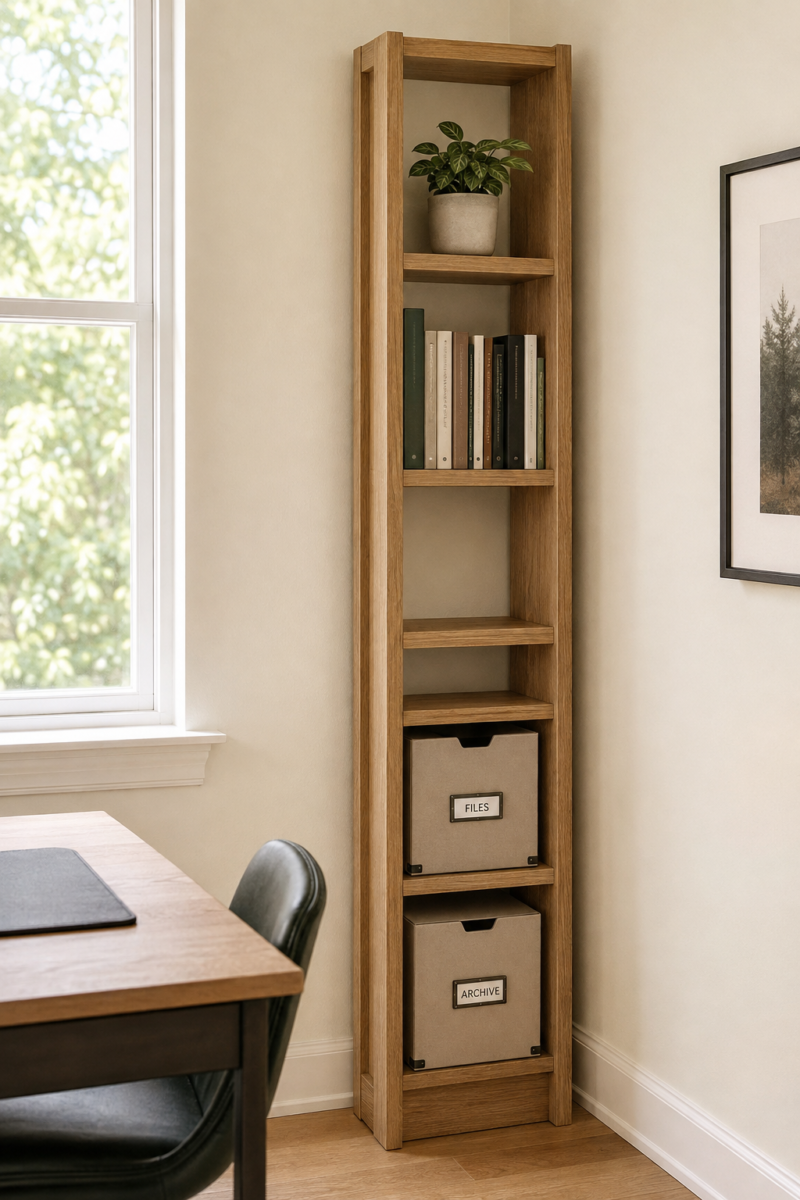
Tall, narrow furniture deserves a specific mention here because it maximizes vertical storage while minimizing floor footprint, which matters most in exactly the kind of home this guide is written for. A narrow bookshelf, roughly 12 inches deep, fits into far more spots than a wide dresser or cabinet, and often holds a comparable amount when the full height is used well.
Furniture That Works Twice as Hard
For homes without a garage or basement to fall back on for overflow, every piece of furniture is a chance to add storage capacity, and choosing pieces that do double duty is one of the smartest decisions available when furnishing or replacing anything.
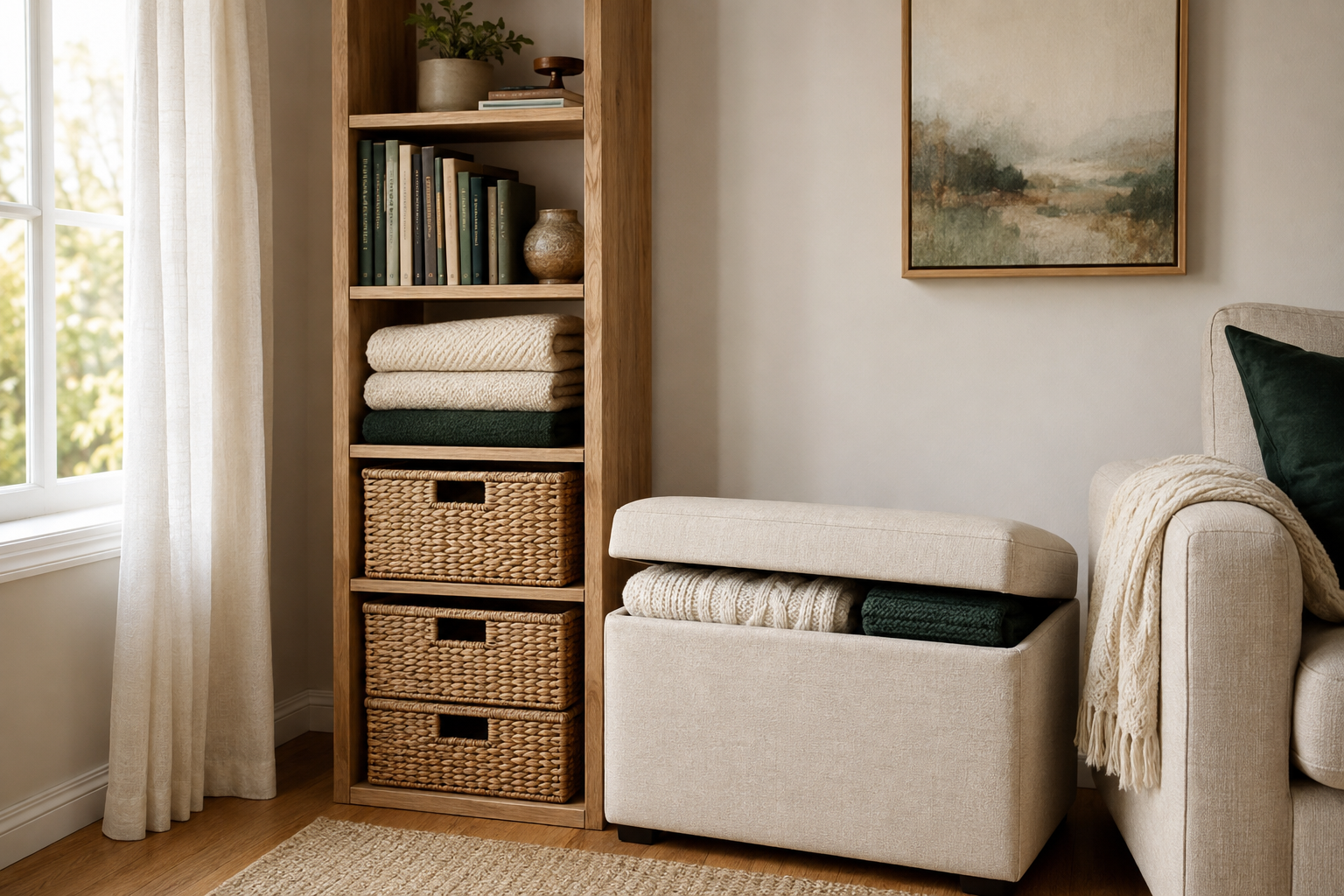
Storage ottomans and benches replace what would otherwise be purely decorative or seating furniture with something that also holds blankets, seasonal items, or miscellaneous belongings. The cost difference between a storage version and a standard version is often minimal, which makes this close to a free upgrade whenever new seating is on the list.
Beds with built-in drawers, or bed risers paired with under-bed bins, turn what’s usually the single largest piece of dead space in a home into genuine storage. This matters more in homes without a basement specifically, since off-season clothing and rarely used items need somewhere to live, and under-bed storage is often the closest substitute available.
Coffee tables and console tables with a lower shelf or hidden storage, rather than an open leg design, add a home for books, remotes, and the small daily items that otherwise migrate onto whatever surface is nearest. This is a small addition individually, but it adds up across a full living room.
Dining chairs or benches with a lift-up seat, where available, quietly solve one of the trickiest storage categories: seasonal items and linens that don’t have an obvious home in a smaller space.
Floor and Gap Storage: The Space Between Furniture
Every home has small, often-overlooked gaps between pieces of furniture or appliances, and these represent real storage potential that requires almost no investment to use well.
Narrow rolling carts, typically 10 to 16 inches wide, slide into gaps beside a fridge, a dresser, or a bookshelf and function as a genuine extra storage unit that can roll out when needed and tuck away the rest of the time.
The space behind a door is one of the most consistently wasted spots in any home. A slim over-the-door organizer or a hanging rack uses this space fully, and it works in almost any room, not just closets, since any door with a bit of clearance behind it qualifies.
Corners, especially in rooms with an awkward layout, often go completely unused because standard rectangular furniture doesn’t fit them well. A corner shelf unit, built or bought specifically for the angle, reclaims space that would otherwise sit empty simply because nothing standard was designed to fill it.
Storage Mistakes That Undo Good Intentions
A few patterns repeat across homes trying to solve storage without a garage or basement to fall back on, and each one quietly wastes either money or space.
Buying bulky storage furniture before measuring the exact gap. A piece that’s a few inches too wide for the intended spot either doesn’t fit or gets shoved somewhere less useful, which defeats the purpose of a targeted purchase in the first place.
Choosing decorative storage over functional storage. A beautiful basket that’s too small to hold anything meaningful looks the part without adding real capacity. Prioritize actual volume over aesthetics for the pieces meant to solve a genuine storage gap, and save the purely decorative choices for spots where storage isn’t the real goal.
Overlooking maintenance access. Storage that blocks an outlet, a vent, or an appliance’s access panel creates a different kind of problem down the line. It’s worth checking that any new storage placement doesn’t interfere with something the home actually needs regular access to.
Assuming more storage always solves clutter. Sometimes the real issue isn’t a shortage of storage but too much stuff for any reasonable amount of storage to hold gracefully. If storage additions keep filling up as fast as they’re added, the better fix is often decluttering first, which the dedicated guide below covers in full.
Building a Storage Plan on Different Budgets
Storage solutions that work well don’t need to be expensive, but knowing where to spend and where to save makes a real difference in how far a limited budget stretches.
On a tight budget, prioritize the cheapest, highest-return items first: tension rods for closet dividers, adhesive hooks rated for actual weight, and a single well-placed wall shelf in the room that needs it most. These typically cost under $20 each and solve real, specific gaps rather than adding general-purpose storage that may or may not get used.
With a moderate budget, a quality wall-mounted shelving system and one piece of multi-purpose furniture, like a storage ottoman or a bed frame with drawers, deliver the most noticeable change. Spend on the pieces that get used daily rather than spreading the budget thin across many small purchases that each solve a minor problem.
With more room to spend, custom or built-to-fit solutions, like a closet system sized exactly to a specific space, or furniture built to fill an oddly shaped corner precisely, close the remaining gaps that off-the-shelf products can’t quite solve. These tend to have the best return when they replace a spot that’s been a persistent, unsolved storage problem for a while, rather than being spent on a spot that a cheaper solution would have handled just as well.
Regardless of budget, the sequence stays the same: solve the highest-friction, most-used storage gap first, and let the remaining budget follow the actual problems rather than a general wish list.
Frequently Asked Questions
What’s the best storage solution for a home with no closets at all? A freestanding wardrobe or armoire, paired with under-bed bins and a slim entryway shelf, can replace most of what built-in closets would normally provide. None of these require any wall attachment or construction.
Is it worth buying furniture with hidden storage if it costs more than a standard version? Usually yes, if the price difference is modest. The added storage capacity typically outweighs a small cost increase, especially in a home without a garage or basement for overflow items.
How do I add storage to an oddly shaped room with awkward corners? Corner shelving units, built specifically for the angle, reclaim space that standard rectangular furniture can’t use well. Custom-cut floating shelves are another option for corners too tight for standalone furniture.
Should I prioritize vertical storage or furniture with hidden storage first? Vertical wall storage generally offers the most capacity for the least cost, so it’s usually worth solving first. Furniture with hidden storage works well as a complement once wall space is being used well.
How do I know if I actually need more storage or just need to declutter? If storage additions keep filling up shortly after being added, that’s usually a signal the real issue is volume, not capacity. A decluttering pass often reveals that less storage is needed than it first appeared.
Related Reading
- The Complete Home Organization Guide — the full decluttering → systems → storage sequence this guide fits into
- The Decluttering Guide — the method worth applying before adding new storage, so it’s solving a real, known need
- Closet Organization Guide — a focused breakdown for turning one small closet into genuine storage capacity
- The Complete Small-Space Storage Guide — a related Taims Space guide.
- Vertical Storage Ideas — a related Taims Space guide.
- The Bin and Basket System — a related Taims Space guide.
- Storage Furniture That Pulls Double Duty — a related Taims Space guide.
- Complete Small Closet Organization Guide — a related Taims Space guide.
Category: Storage Solutions Hub: /organization-and-storage/
Reviewed by the Taims Space editorial team.