Table of Contents
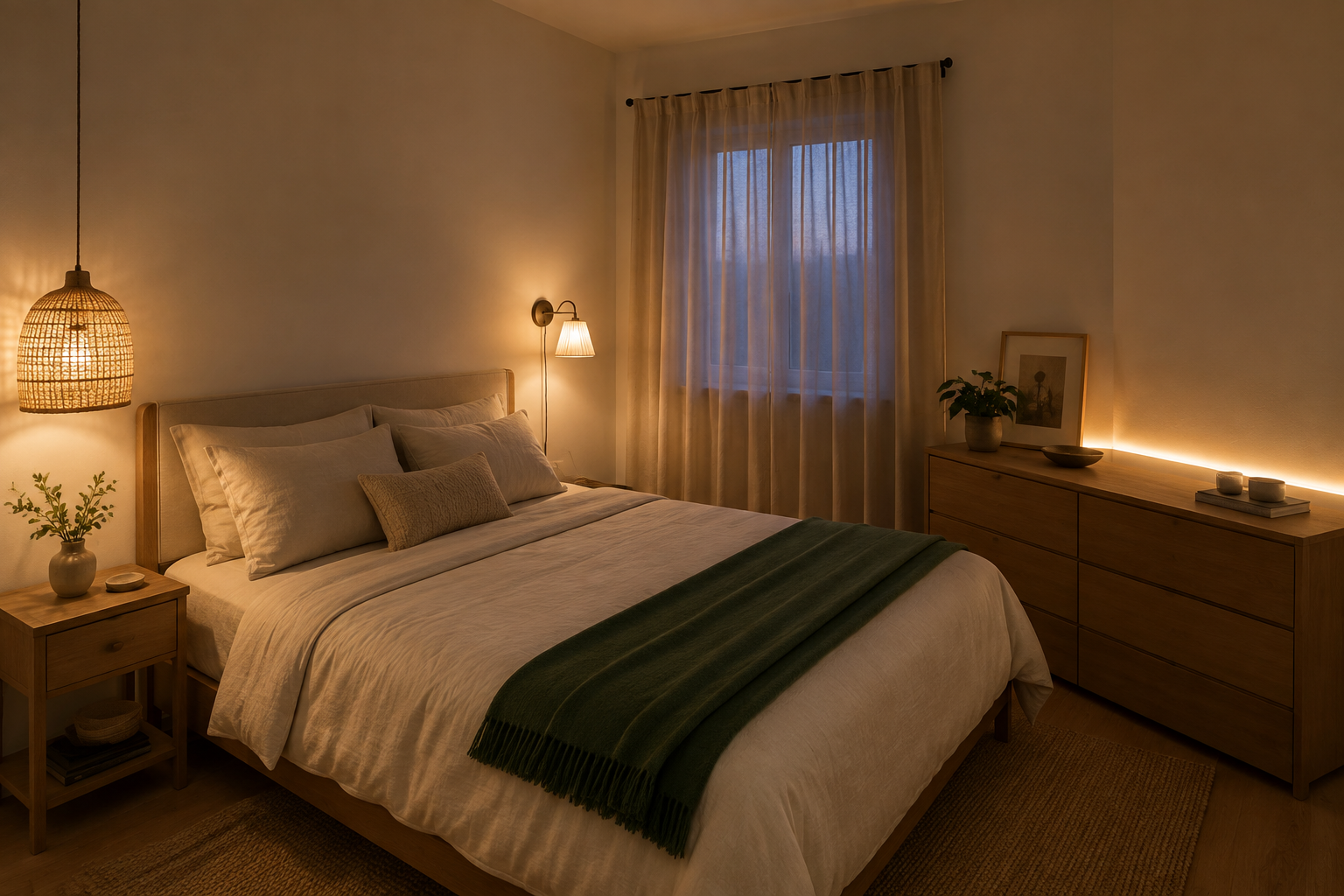
Stand in the middle of your bedroom right now and turn on only the main light. Notice where the shadows fall. If the corners go flat and dark while the center of the room feels overly bright, that’s not your room being small. That’s one bulb doing a job that’s supposed to belong to three.
Small bedrooms don’t feel bigger because of paint color or a clever piece of furniture. They feel bigger when light reaches every part of the room instead of pooling in the middle, because your eye reads a room’s size by how far the light travels, not by the square footage on a floor plan. Fix that, and a 100-square-foot bedroom can genuinely read as more spacious than it is.
The Real Reason One Ceiling Light Makes a Room Feel Small
A single overhead fixture lights the center of a room and leaves the edges in shadow, and shadowed edges are exactly what makes a small room feel like it stops sooner than it actually does. Your eye can’t fully register a wall or a corner it can’t see clearly, so the room’s visual boundary shrinks to wherever the light stops reaching.
This is also why so many rental bedrooms feel dorm-like no matter how nicely they’re decorated. A builder-grade flush mount in the center of the ceiling was never designed to make a room feel good. It was designed to meet a minimum lighting code as cheaply as possible. Everything past that is on you, and it’s the highest-leverage fix available in the entire room.
If you haven’t yet worked through the full sequence for the rest of the room, the complete small bedroom decorating guide walks through how lighting sets up every color and texture decision that comes after it. This article goes deeper into lighting specifically.
Layer Light at Three Different Heights, Not One
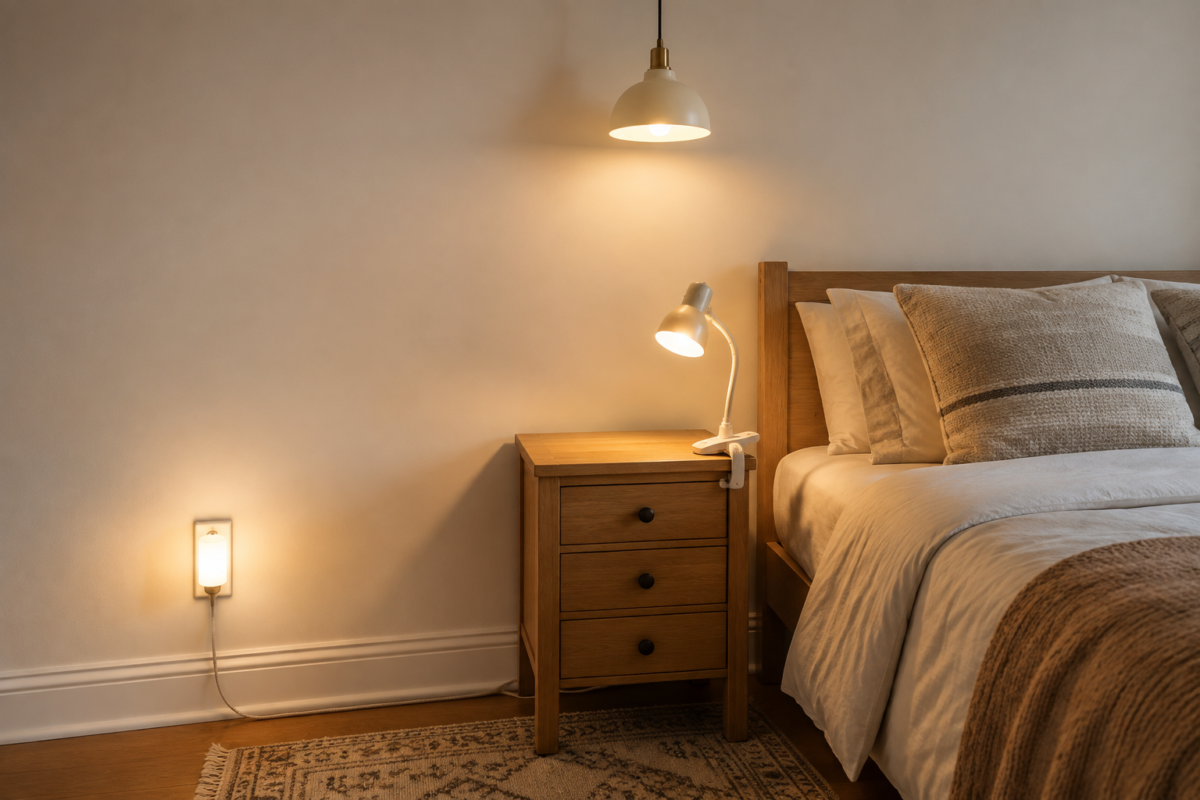
A room feels larger when light comes from more than one direction, because multiple light sources at different heights soften shadows and let your eye travel around the whole space instead of stopping at the one bright spot in the center.
- Low light, around knee to waist height, like a plug-in sconce beside the bed or a small table lamp on a dresser, grounds the room and makes the lower half feel intentional instead of dark.
- Mid light, around eye level when seated, like a clip lamp on a nightstand, handles reading and getting dressed without relying on the ceiling fixture at all.
- High light, at or above eye level standing, like a pendant or the original ceiling fixture, ties the other two layers together and keeps the room from feeling bottom-heavy.
Turn on all three at once and even a small bedroom stops feeling like one lit box. It starts feeling like a room with actual depth to it.
Use Light to Trick the Eye Into Seeing More Room
Beyond just adding sources, where you point light changes how big the room reads, and this is the layer most people skip entirely.
Uplighting a corner by aiming a small floor lamp or plug-in wall wash toward the ceiling pulls the eye upward and makes the ceiling feel taller, which reads as more overall volume in the room even though the floor space hasn’t changed at all.
A mirror placed to reflect a light source, not just a window, doubles the light in the room without adding another fixture. Position a mirror across from a lamp or sconce rather than beside it, so the reflection actually bounces usable light back into the room instead of just showing a picture of the wall behind you.
Light along the baseboard or under low furniture, using a stick-on LED strip under a bed frame or dresser, creates the visual effect of the furniture floating slightly off the floor. Floating furniture reads as more open floor space even when the actual footprint hasn’t shrunk.
Warm Bulb Temperature Matters More Than the Fixture Itself
You can buy the most beautiful lamp in the world and still end up with a room that feels sterile if the bulb inside it is the wrong temperature. Bulb temperature is measured in Kelvin, and for a bedroom you want every single bulb sitting between 2700K and 3000K, labeled “warm white” or “soft white” on the package, never “daylight” or “cool white,” which run 4000K and higher and belong in a kitchen or office.
Mismatched temperatures across different lamps in the same room are one of the fastest ways to make a space feel unfinished, even when every fixture individually looks nice. Check the Kelvin number on every bulb currently in the room, not just the new ones you’re adding, so the whole room glows at one consistent temperature instead of three different ones fighting each other.
Rental-Friendly Fixtures That Don’t Touch a Wire
None of this requires drilling, hardwiring, or landlord approval.
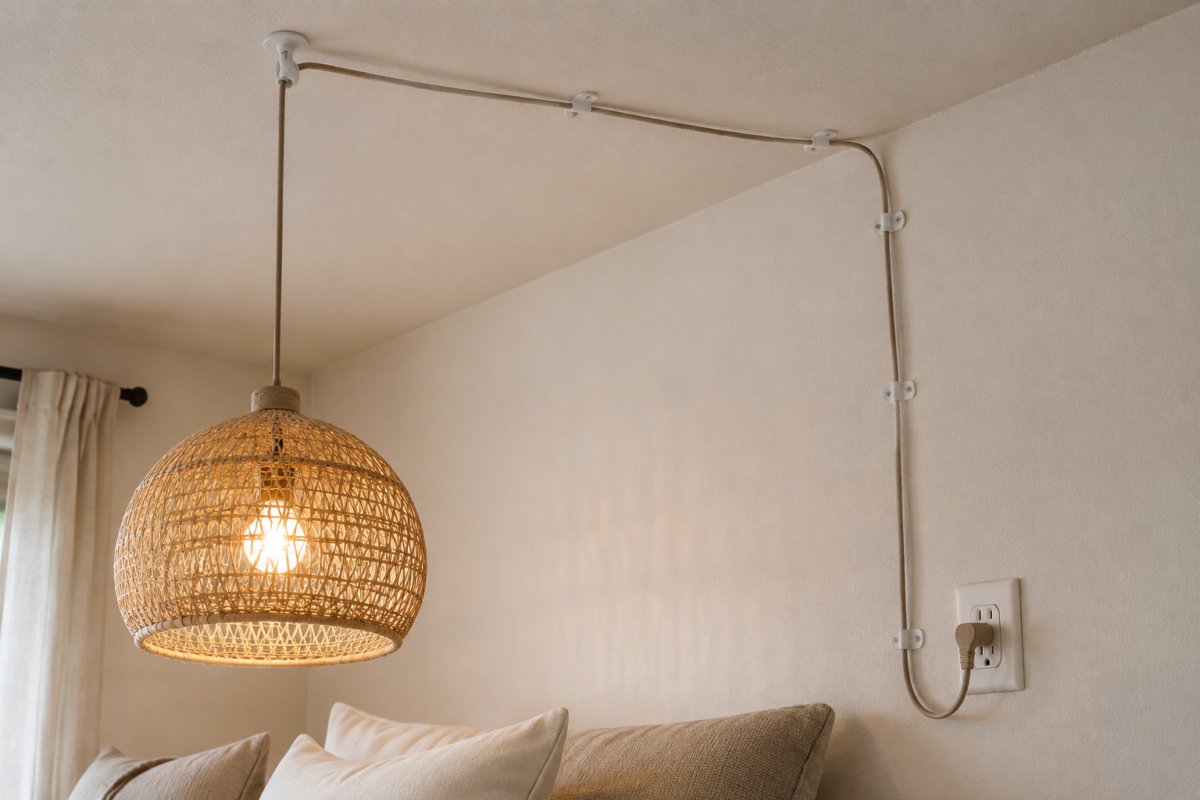
Plug-in wall sconces mount with adhesive strips rated for the fixture’s weight, and the cord runs down the wall inside a paintable cord channel or a simple adhesive clip, so it reads as intentional instead of makeshift. Swap-in pendant kits replace the shade and cord on an existing hardwired ceiling fixture, or hang from a separate hook and plug into a nearby outlet, giving you a real pendant look without an electrician. Battery-powered puck lights handle accent spots anywhere an outlet isn’t close enough, including inside a closet or under open shelving. Stick-on LED strips run on a small battery pack or plug adapter and work for the under-furniture and baseboard tricks above.
Add a Dimmer Before You Add Another Lamp
If your budget only stretches to one more purchase after your first sconce or lamp, a plug-in lamp dimmer is worth more than a second fixture. A single light source that can shift from bright, task-ready light in the morning to a low, warm glow at night does the work of two or three lamps, and it lets the same lighting layer support getting dressed at 7am and winding down at 10pm without buying separate fixtures for each. Plug-in dimmers work with any lamp, need no wiring, and cost less than most decorative lamps on their own.
Frequently Asked Questions
What’s the fastest way to make a small bedroom feel bigger with lighting? Add a second light source at a different height than your current overhead fixture, and switch every bulb in the room to warm white between 2700K and 3000K. Those two changes alone do more than any single furniture purchase.
Do LED strip lights actually make a small bedroom look bigger? Yes, when they’re placed under furniture or along a baseboard rather than as the room’s main source of light. The visual effect of furniture appearing to float slightly off the floor reads as more open space, even though the actual square footage hasn’t changed.
Should small bedroom lighting be warm or cool? Warm, consistently, across every fixture in the room. Cool or daylight bulbs above 4000K make a bedroom feel closer to an office than a place meant for rest, and mismatched temperatures between fixtures are one of the most common reasons a bedroom feels unfinished.
Can I add better lighting to a bedroom without drilling into the wall? Yes. Plug-in wall sconces, swap-in pendant kits, battery-powered puck lights, and stick-on LED strips all work without any wiring or drilling, which makes every idea in this guide fully rental-friendly.
Related Reading
- For the full room sequence this lighting strategy sets up, the complete small bedroom decorating guide covers color and texture next.
- Once lighting is handled, the small bedroom layout guide covers where furniture should physically sit around your new light sources.
- If clutter is competing with your new lighting for attention, small bedroom storage ideas covers the systems that keep surfaces clear.
- For more lighting, color, and styling approaches for this room, visit the Bedroom Decor category page.
- To see how this fits into organizing every room in a small home, start at the Small Bedrooms hub.