
Table of Contents
Every organization system eventually runs into the same test: does it hold up when more than one person is responsible for it? A beautifully designed nightly reset or mail sorting system can work flawlessly for weeks when one person is doing all of it, and then quietly fall apart the moment that person is busy, tired, or simply expects someone else to have handled it that day.
This isn’t a character flaw in any one household member. It’s a design flaw in the system itself, one built around a single person’s habits and memory rather than something genuinely shared. A system that works in a household with more than one person needs to be built differently from the start: simple enough for anyone to follow, visible enough that no one needs to be told twice, and distributed in a way that doesn’t quietly default back to whoever cares most.
Why Shared Systems Fail Differently Than Solo Ones
A single person’s organization system fails when motivation drops. A shared system fails for a more specific reason: unclear ownership. When a task technically belongs to “everyone,” it often ends up belonging to no one in particular, since each person can reasonably assume someone else will handle it.
Ambiguous responsibility is worse than no responsibility at all. A task explicitly assigned to no one gets noticed as a gap fairly quickly. A task vaguely assigned to “whoever” often goes unnoticed for much longer, since everyone can point to the general expectation that someone would take care of it, without anyone actually stepping up to do so consistently.
Different people notice different things as “messy.” What one household member considers cluttered, another might not register at all, which means a system relying on someone simply noticing when something needs attention will get inconsistent results depending on who’s paying attention that day.
A system designed by one person often only makes intuitive sense to that person. Categories, labels, and routines that feel obvious to whoever set them up can feel arbitrary or confusing to someone else in the household, which creates friction that discourages consistent use, even from people who genuinely want to participate.
Making Ownership Explicit, Not Assumed
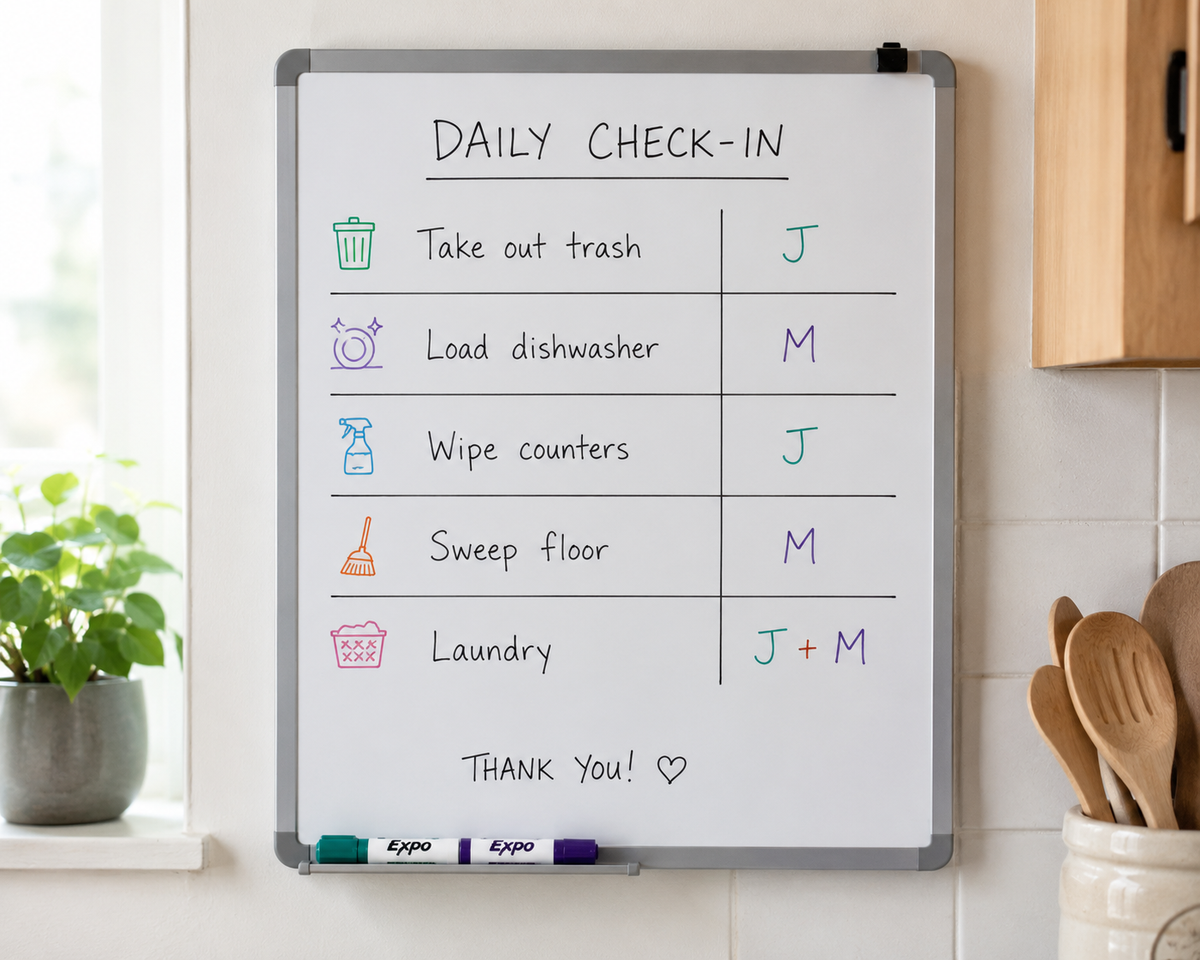
Assign specific tasks to specific people, rather than leaving responsibilities general. Rather than “someone should sort the mail,” a shared system works better when it’s explicitly, “whoever gets home first sorts the mail” or “Alex handles the kitchen portion of the nightly reset, Jordan handles the living room.” Specificity removes the ambiguity that lets a task quietly go undone.
Rotate assignments if a fixed split feels unfair or someone’s schedule changes. A rigid, permanently fixed division of tasks can start to feel unbalanced if one person’s role consistently takes more time or effort than another’s. Revisiting and rotating assignments periodically keeps the system fair and adaptable as circumstances shift.
Make the assignment visible, not just discussed once and expected to be remembered. A shared note, a small whiteboard, or even a simple recurring reminder keeps the division of responsibilities in view, rather than relying on everyone’s memory of a conversation that happened once, weeks or months earlier.
Address gaps directly and specifically, rather than with a general complaint. “The kitchen wasn’t reset last night” is more concrete and less likely to create defensiveness than “nobody ever cleans up around here,” since the first identifies a specific, addressable gap while the second reads as a broader, harder-to-respond-to criticism.
Designing Systems That Don’t Require Explanation
Use visible labels and obvious landing spots rather than systems that depend on inside knowledge. A well-labeled bin, a mail sorting tray with visible sections, a designated spot for shoes right by the door, these all communicate their own purpose without needing anyone to be separately told how the system works.
Keep the number of rules low. A system with three or four simple, memorable expectations, mail gets sorted daily, dishes get done before bed, shoes go by the door, holds up better across an entire household than one with a dozen specific rules that only the person who created them can fully remember or explain.
Walk new household members or occasional guests through the system once, briefly, rather than assuming it’s self-explanatory. Even a genuinely intuitive system benefits from a short, casual explanation for anyone new to the household, a roommate moving in, a partner spending significantly more time in the space, since what feels obvious to an established resident isn’t always obvious to someone new.
Revisit the system together periodically, especially after a change in who lives there. A system built for two people doesn’t necessarily scale cleanly to three, and a system built around one household’s rhythm might not fit a new member’s schedule or habits. A brief check-in after any change keeps the system actually matched to who’s currently using it.
Handling the Motivation Gap Between Household Members
It’s genuinely common for different people in the same household to care about tidiness or organization to different degrees, and pretending this gap doesn’t exist tends to create more friction than addressing it directly and reasonably.
Focus agreements on shared spaces, and give more individual latitude in personal spaces. A living room, kitchen, or shared bathroom affects everyone and reasonably needs a shared standard everyone agrees to maintain. A personal bedroom or individual desk, by contrast, can reasonably be left to each person’s own preference, since its state doesn’t directly affect anyone else’s daily experience of the home.
Set a shared, explicit baseline rather than relying on an unspoken, assumed standard. “Clean” means different things to different people, and a vague expectation that everyone should just “keep things tidy” tends to produce mismatched results. A specific, agreed-upon baseline, dishes done before bed, surfaces cleared each night, gives everyone the same concrete target rather than relying on differing individual interpretations of a vague standard.
Address a genuine, persistent gap directly, calmly, and specifically, rather than letting frustration build silently. If one household member is consistently not participating in agreed-upon shared systems, a direct, specific conversation, ideally focused on the particular task and its impact rather than broader character judgments, tends to produce a better outcome than accumulated tension that eventually surfaces all at once.
Systems That Scale With Household Size
Two-person households can often manage with informal, verbally agreed divisions. A quick daily or weekly check-in about who’s handling what tends to work well at this scale, since coordination overhead is naturally low with just two people involved.
Three or more people benefit from something more visible and explicit. A shared note, a simple chart, or a recurring digital reminder helps prevent the diffusion of responsibility that becomes more likely as more people are involved, since with more people, it becomes easier for each individual to assume someone else has it covered.
Households with children need age-appropriate versions of the same principles. Even young children can participate in simplified versions of shared systems, a specific, small, well-defined task rather than an abstract expectation to “help keep things tidy,” which teaches the same underlying habit of explicit, owned responsibility from an early age.
Households with frequent guests or a rotating set of people present benefit from a system durable enough to function even when regular residents are away. If the system depends entirely on specific individuals being present to function, it breaks down whenever those people are traveling, working late, or otherwise unavailable. Building in enough redundancy, more than one person capable of handling each task, keeps the system functional even with some variability in who’s actually home on a given day.
When a Shared System Genuinely Isn’t Working
A pattern of one person consistently doing more than their share is worth naming directly rather than absorbing indefinitely. Systems drift over time, and what started as a roughly even split can quietly become uneven without anyone explicitly deciding that should happen. Periodically checking whether the actual distribution of effort still matches what was originally agreed keeps this from becoming a long-term, unaddressed imbalance.
Sometimes the system itself needs redesigning, not just better individual follow-through. If a specific task consistently doesn’t get done despite clear assignment, that’s worth treating as information about the system’s design, maybe the task is poorly scoped, maybe it’s assigned to the person with the least natural fit for it, rather than assuming the fix is simply more reminders or more willpower from whoever’s responsible.
It’s reasonable to have different systems for different categories of tasks. A strict, explicitly assigned rotation might work well for something like mail sorting, while a more flexible, first-one-home-handles-it approach might work better for the nightly reset. Not every task in a shared household needs to follow the exact same structural approach.
Introducing a New System to an Established Household
Rolling out a shared system for the first time, in a household that hasn’t had one before, benefits from a different approach than simply announcing new expectations and hoping everyone adjusts.
Start with a conversation, not a set of rules already decided. A system that’s collaboratively built, even loosely, tends to get more genuine buy-in than one person unilaterally deciding how things will now work and presenting it to everyone else as a finished plan. Even a short discussion about what’s currently frustrating and what a reasonable fix might look like goes a long way toward actual follow-through.
Pilot a small piece of the system before rolling out everything at once. Introducing just the nightly reset for a couple of weeks, before adding the mail system and any other routines, gives the household a chance to adjust gradually rather than facing a sudden, all-at-once overhaul that feels like a lot to take in.
Expect an adjustment period, and don’t treat early inconsistency as a sign the system has failed. A new shared habit typically takes several weeks to become genuinely automatic for everyone involved, and a rocky first week or two is a normal part of that process, not evidence that the whole approach was wrong from the start.
Communicating About the System Without It Becoming a Source of Conflict
Even a well-designed shared system occasionally needs a conversation about how it’s going, and how those conversations happen matters as much as the system’s actual design.
Bring up issues close to when they happen, rather than letting frustration accumulate. A specific, timely comment about a missed task is far easier to hear and respond to than a larger, delayed conversation that’s absorbed weeks of unspoken irritation and now carries more emotional weight than the original issue warranted.
Frame check-ins as adjusting the system, not assigning blame. “Is this task working for you, or should we swap who handles it” tends to produce a more constructive conversation than “why do you keep forgetting this,” even when the underlying issue is the same. The first invites a genuine problem-solving discussion; the second tends to put the other person on the defensive before the conversation even really starts.
Acknowledge when the system is working well, not just when something’s gone wrong. A household that only discusses shared systems when there’s a problem can start to associate the whole topic with tension. Occasionally noting that a particular routine is working smoothly reinforces the behavior and keeps the overall tone around household coordination more positive.
Frequently Asked Questions
How do I get roommates to actually follow a shared cleaning or organization system? Assign specific tasks to specific people rather than leaving responsibilities vague, and make the system visible through labels, a shared note, or a simple chart rather than relying on memory or an assumed understanding. Specificity and visibility both reduce the ambiguity that lets tasks quietly go undone.
What should I do if one person in the household consistently doesn’t participate in shared systems? Address the specific gap directly and calmly, focused on the particular task rather than a broader character judgment, and check whether the task itself might be poorly designed or unfairly distributed before assuming the issue is purely a matter of individual effort.
Should personal bedrooms follow the same organization rules as shared spaces? Not necessarily. Shared spaces, living rooms, kitchens, shared bathrooms, reasonably need an agreed-upon standard since they affect everyone, while personal spaces can generally be left to each individual’s own preference without the same shared expectation.
How do daily organization systems need to change for a household with children? Give children age-appropriate, specific, and simplified tasks rather than abstract expectations to help generally. A small, well-defined responsibility teaches the same underlying habit of explicit, owned responsibility that the rest of a shared system relies on.
What’s the best way to divide daily tasks like the nightly reset among multiple people? Split by room or task type, rather than expecting one person to handle everything or leaving it entirely unassigned. Rotating the specific division periodically keeps it feeling fair, especially if one portion consistently takes more time or effort than another.
Related Reading
- The Complete Guide to Daily Organization Systems — the full system this shared household guidance fits into, alongside the nightly reset and mail management.
- The 10-Minute Nightly Reset That Keeps Clutter From Piling Up — the daily habit worth splitting across household members using the approach covered here.
- A Daily System for Mail, Paper, and the Stuff Without a Home — how to adapt a mail system for a household where more than one person receives mail.
- The Bin and Basket System That Actually Stays Organized — the labeling approach that makes shared storage systems intuitive to everyone using them.
- Parent Category: Daily Organization Systems
- Parent Hub: Organization & Storage